
Most service business owners assume growth requires a steady stream of ad spend. Run ads, get leads, stop ads, lose leads. That loop is expensive, fragile, and completely unnecessary for most businesses. Organic marketing for service businesses offers a sustainable alternative, and the data backs this up: organic acquisition costs roughly $942 per client compared to $1,907 through paid channels. That’s a 2x cost difference that compounds every single month you invest in the right organic systems.
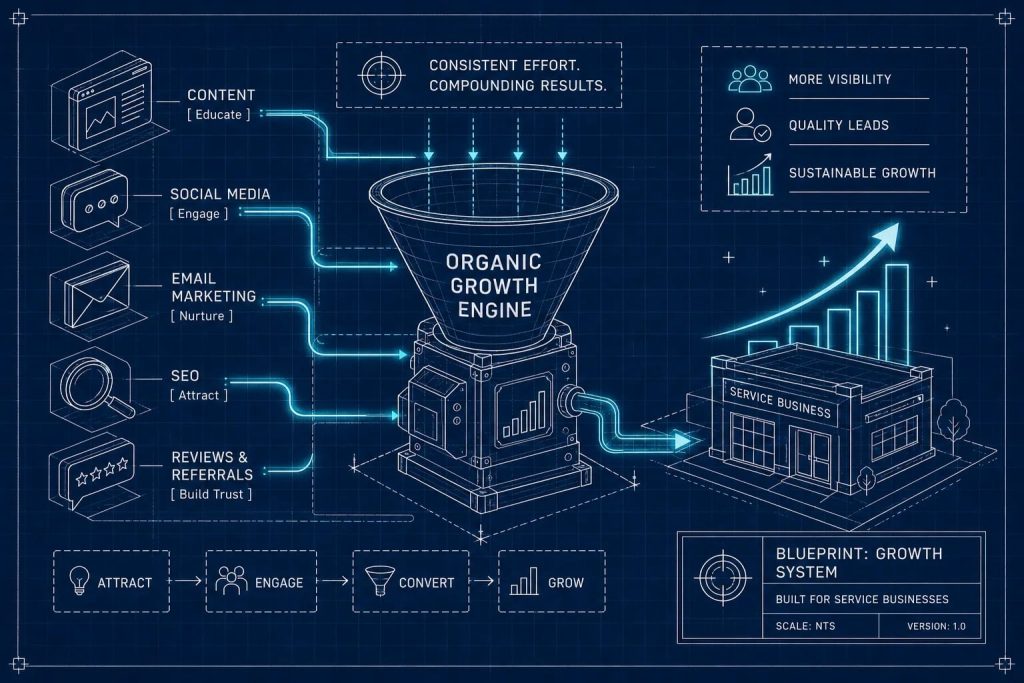
At TW3 Marketing, our entire client playbook is built around a single insight: authority signals come before traffic tactics. Businesses that skip the foundation and jump straight to publishing content or chasing keywords often see limited progress and delayed ROI, typically within the first six months, because they lack the trust signals that convert traffic into clients. The businesses that follow a structured approach, from auditing trust gaps to building referral systems and local search dominance, generate leads that convert better and clients who stay longer.
This article is your practical playbook. By the end, you’ll know which organic channels produce actual clients (not just website visitors), how to pick three priority tactics without guessing, and how to run a 90-day plan with KPIs you can measure from week one.
Why Organic Marketing for Service Businesses Outperforms Paid
The ROI argument is worth settling before diving into tactics. Organic-dominant businesses don’t just spend less to acquire clients, they also retain them longer. According to HubSpot’s 2025 benchmark data, organic-dominant brands carry an LTV:CAC ratio of 4.2, compared to 1.7 for paid-dominant brands. That’s not a small edge. That’s the difference between a business that compounds and one that treads water.
One real example makes this concrete: organic-acquired customers at $8.31 CAC with $936 in lifetime value versus paid customers at $465 CAC with only $720 LTV. The paid channel costs 56x more to acquire a client who ends up being worth 23% less. The math isn’t close. The reason comes down to intent, someone who finds a plumber through a Google search or a friend’s recommendation arrives already sold on the category. They’re not browsing. They’re deciding who to trust, and that trust is baked into how they found you.
Organic also has a compounding quality that paid advertising simply cannot replicate. A well-optimized local page or a referral system with momentum keeps generating leads whether or not you wrote a check last Tuesday. For service businesses with seasonal demand, that compounding effect becomes a genuine competitive moat over time.
The Organic Channels Ranked by Actual Lead-to-Client Conversion
Not all organic channels convert equally, and treating them as if they do is one of the most common mistakes service businesses make. Here’s the honest hierarchy based on published B2B service benchmark data, and where organic marketing for service businesses tends to generate the fastest returns.
Referrals: Still the Highest-Converting Organic Source
Referrals produce a 56% lead-to-MQL rate and a 68.7% opportunity-to-deal rate in B2B service benchmarks. No other organic channel comes close to those numbers. A referred lead arrives pre-sold on trust, which dramatically shortens the sales cycle and improves close rate. But referrals aren’t passive. They require a deliberate system: follow-up timing, ask scripts, and incentive structures that make it easy and rewarding for happy clients to send you their contacts. For most local service businesses, a double-sided referral program, commonly a $25 to $150 reward to the referrer plus a discount for the new client, is among the fastest organic wins available, based on what consistently performs across referral program research.
Local SEO and Organic Search: The Scalable Engine
SEO-driven leads close at a 14.6% rate, well above the industry average for outbound prospecting. One locksmith business profiled in TW3 client research scaled to 40 to 50 high-quality leads per day and cut its ad spend to zero using local organic search alone. That kind of result doesn’t happen by accident. It comes from consistent Google Business Profile optimization, local landing pages built for specific service areas, and technical website hygiene that helps Google understand what you do and where you do it. Organic search is the only channel that works while you sleep.
Content and Organic Social as Supporting Amplifiers
Content marketing converts around 3 to 4% when aligned to comparison and pricing intent, meaning content that answers specific buying questions rather than generic educational topics. Organic social averages about 1.7% in direct conversion, which makes it a poor primary lead channel. Where both shine is in reinforcing the channels above: content boosts your local SEO rankings, and social builds the trust that turns a warm referral into a booked appointment. Think of them as fuel for your SEO and referral engines, not standalone lead sources.
Authority-Building as Your Organic Growth Engine
Publishing three blog posts and calling it content marketing isn’t a strategy. Authority-building is something different, a structured approach to making your business the obvious choice in search results, in AI recommendations, and in a prospect’s mind before they ever contact you. Six signals consistently determine whether a business earns organic recommendations or gets passed over: positioning, proof, expertise, visibility, engagement, and experience. These aren’t abstract concepts. They’re the same signals AI platforms like ChatGPT and Google AI weight when deciding which businesses to surface, signals that align closely with the criteria TW3 Marketing uses in its structured authority audits for clients.
Expert Content That Positions Your Business as the Go-To Resource
Expert content isn’t blog posts about generic topics. It’s articles and pages that answer the specific questions your customers type into Google and ChatGPT before they call anyone. A roofing company in TW3 client data grew to $150,000 in monthly recurring revenue within six months, and continued scaling beyond $250,000 MRR, by publishing informational content built around high-intent local search queries. They didn’t need a big content budget. They needed the right questions and the discipline to answer them better than any competitor in their market.
Reputation Signals That Convert Searchers into Callers
Review volume, recency, and how you respond to feedback are trust signals that directly influence both human decisions and AI recommendations. A gutter services company that invested in reputation alongside local SEO saw an 85% booking rate and 400% growth in off-season leads (TW3 client data). Prospects use reviews as a proxy for confidence. Research on review behavior consistently shows that volume and recency often outweigh a perfect rating, a business with 12 reviews and a 4.9 average frequently outperforms a competitor with 3 reviews and a 5.0 average, because volume signals you’ve actually served enough people to have real proof.
AI-Friendly Website Structure That Earns AI Recommendations
AI platforms like ChatGPT and Google AI pull from structured, clearly organized websites that signal expertise and geographic relevance. The factors these systems weight most heavily include consistent NAP data across directories, schema markup that makes business facts machine-readable, clear service and location pages, and third-party mentions on trusted platforms. Businesses that restructure their site architecture around these signals get surfaced in AI-generated recommendations, a fast-growing traffic source that many service businesses have room to improve on in 2026.
The Local SEO and Reputation Foundation Every Service Business Needs
Before any content strategy or referral program produces consistent results, the local foundation needs to be solid. This is where most businesses have the biggest untapped opportunity, and where the fastest wins live.
Google Business Profile as Your Number One Free Lead Asset
A fully optimized Google Business Profile is the single highest-ROI organic action a local service business can take. That means selecting the correct primary and secondary categories, listing every service with keyword-rich descriptions, populating the Q&A section with real customer questions, and uploading enough photos to signal an active, legitimate business. Local pack position one captures roughly 44% of local pack clicks versus 12% for position three. Optimization that moves you from position three to position one can triple your call volume without spending a dollar on ads. A carpet cleaning business in one TW3 case study ranked number two on Google locally after prioritizing GBP optimization alongside a rebuilt website.
Review Generation, Citation Consistency, and Trust Signals
Inconsistent NAP data across directories actively hurts local rankings. If your business name, address, or phone number appears differently across Google, Yelp, Angie, and the BBB, search engines treat that inconsistency as a trust problem. Tools like BrightLocal (under $50 per month) handle citation monitoring and review tracking without enterprise-level pricing. Reviews need a proactive generation system, specifically, a scripted ask sent within 24 to 48 hours of job completion, not a hopeful waiting game.
Local Landing Pages Built for High-Intent Searches
Generic service pages don’t rank for city-specific searches. A plumber in Dallas needs a separate, optimized page for each major service area: Dallas, Plano, Frisco, McKinney. These pages capture searchers with the highest purchase intent and convert at 10 to 25% on a well-built page, compared to the 2 to 5% baseline for broader pages. For service businesses with a defined geographic footprint, building these pages consistently across your service area is one of the highest-leverage moves in organic marketing for local service providers.
How to Choose Your 3 Priority Organic Tactics
Most service businesses stall because they try to run every channel simultaneously and see results from none. The goal isn’t to diversify, it’s to concentrate effort on three channels that match your current business stage and commit to them for 90 days before adding anything else.
Matching Channels to Your Current Business Stage
A business with zero online presence should prioritize Google Business Profile optimization, local SEO, and review generation before producing content. A business with existing traffic but low conversion rates needs reputation and trust signal work before generating more visitors. Stage determines sequence. Adding more traffic to a broken foundation doesn’t fix the foundation, it just makes the problem more expensive.
A Simple Scoring Method for Prioritization
Score each channel across three factors: your current capacity to execute it consistently, the time-to-first-result (referrals and GBP are fastest; content SEO typically takes 3 to 6 months), and alignment with how your specific customers search and decide. Referrals score high on speed for most service businesses. Local SEO scores high on scale. Content scores high on long-term compounding. Pick the three channels with the highest combined score and commit to them through the 90-day plan below.
A 90-Day Organic Marketing Plan for Service Businesses
This is the part most playbooks skip: the actual numbers to track so you know whether your effort is working or wasted. Use this framework from day one.
Days 1, 30: Audit, Foundation Cleanup, and Quick Wins
Run a baseline audit of your Google Business Profile, existing reviews, and website technical health. Fix NAP inconsistencies across major directories. After resolving those citation errors, respond to all existing reviews, positive and negative, and identify your top five service-area keyword gaps using Google Search Console. Target KPIs for this phase: GBP profile fully complete, all citation errors resolved, and baseline organic traffic logged in Search Console for comparison in future months.
Days 31, 60: Content, Reputation, and Referral System Launch
Publish two to three service-area landing pages targeting high-intent local searches. Launch a review ask sequence for every recent client, delivered via text within 48 hours of job completion. Set up a simple referral incentive and communicate it directly to your top 10 existing clients. Target KPIs for this phase: 5 or more new reviews published, 2 new local pages indexed and appearing in Search Console, and first documented referral leads tracked in a simple spreadsheet or CRM. (These are recommended operational targets based on TW3 client benchmarks; individual results will vary by market and service type.)
Days 61, 90: Measure, Adjust, and Double Down
Pull your organic traffic growth from Search Console and compare it to your day-one baseline. Calculate your visitor-to-lead conversion rate on each key page using the formula: organic visitors multiplied by conversion rate equals leads per month. Organic service pages should be converting at 2 to 5% at minimum; strong local pages should push toward 10%. Whatever is ranking and converting gets double the attention and investment in the next 90-day cycle. Whatever isn’t gets cut or rebuilt before scaling.
Build the Asset, Then Scale It
Organic marketing for service businesses compounds over time, many businesses see measurable gains within 3 to 6 months, and the advantage over paid channels grows with each passing quarter. The data is consistent: lower acquisition costs, higher lifetime value, and close rates that outperform paid alternatives when the foundation is built correctly. That makes it far from optional for any service company that wants sustainable growth.
The three actions that matter most are picking your priority channels using the scoring framework above, executing the 90-day plan with real KPI tracking (not just traffic vanity metrics), and measuring lead quality alongside lead volume. Organic visitors multiplied by conversion rate equals leads. Leads multiplied by close rate equals clients. Those are the numbers that matter.
If you want to know where your gaps are before investing in content or reputation tactics, start with a TW3 Marketing Authority Score™ Check, a proprietary diagnostic that shows you how your business currently appears across Google and AI platforms, so your next 90 days target the right problems instead of the most obvious ones. The compounding starts the moment you fix the right things first.
