
Your SEO agency sends a report showing page-one rankings across a dozen high-value keywords. Traffic is holding steady. The green arrows are everywhere. Then a homeowner types into ChatGPT, “Who’s the best HVAC company near me?” and your business doesn’t appear anywhere in the response. A competitor you’ve never seen rank above you gets recommended instead. That’s not a glitch. That’s the SEO vs. AI search visibility gap, and it’s showing up in Authority Audits across service businesses right now.
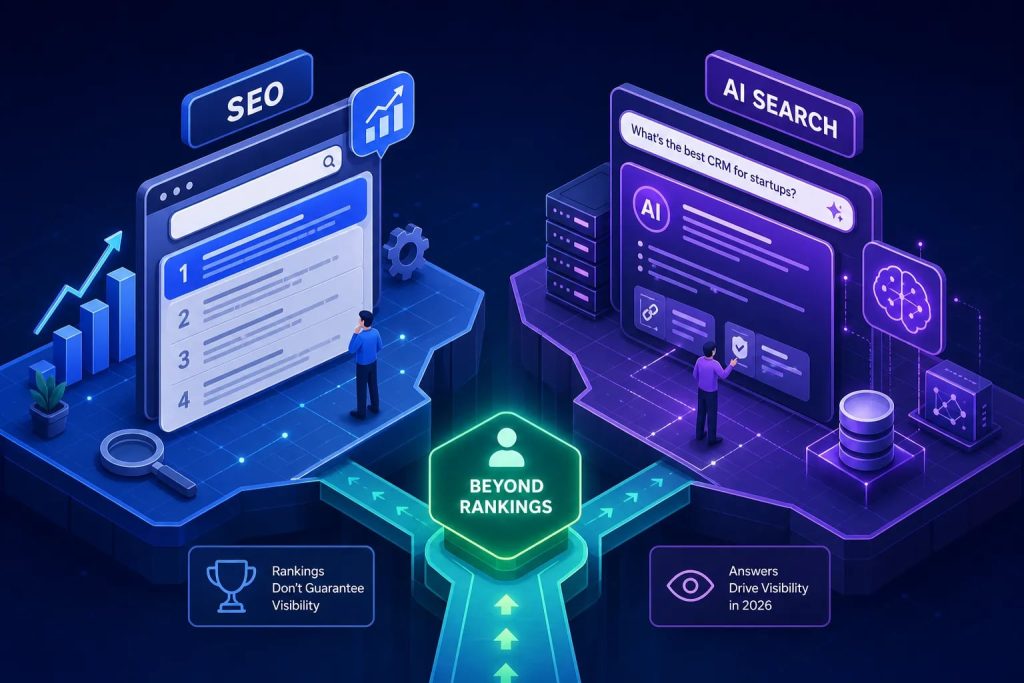
At TW3 Marketing, this is the pattern we see most often: solid organic rankings sitting alongside near-zero AI citation presence. The reason is straightforward. Traditional SEO and AI-powered search are built on different logic, reward different signals, and produce different winners. If you’re investing in search marketing in 2026 and treating them as the same game, you’re playing with half a strategy. Here’s exactly where they diverge and what you can do about it.
What traditional SEO actually measures
Traditional SEO was built around a specific theory of relevance. The more authoritative sites link to you, the more keyword signals appear on your page, and the stronger your technical setup, the higher you rank. For nearly two decades, this framework held across almost every industry and market. Service businesses that cracked the code on backlink acquisition, on-page keyword placement, and site architecture consistently earned top organic positions and the traffic that came with them.
The pillars driving organic rankings were keyword targeting (both exact match and semantic variations), backlink acquisition as a proxy for trust, and on-page signals like meta titles, H1 structure, and page speed. These signals were designed to tell Google’s crawler which pages were most relevant to a given query, not which business was most credible or expert. That distinction is critical, and it’s where the model starts to break down.
A page can rank number one for “best HVAC company near me” and still never appear in an AI Overview, because the crawler signals that earned the ranking don’t translate into the extractable authority signals an AI reasoning system needs to cite a source. According to a 2025 SparkToro/Datos analysis, organic CTR on queries where AI Overviews appear dropped from 1.76% to 0.61% by late 2025, a 61% decline. Ranking isn’t enough if the AI absorbs the click before the user reaches your listing.
SEO vs. AI search: How sources are chosen
AI-powered search doesn’t rank pages the way traditional search does. Systems like Google AI Overviews, ChatGPT, and Perplexity break a query into sub-questions, retrieve passage-level evidence from multiple sources, and synthesize an answer using the most trustworthy, extractable content they find. The selection logic is fundamentally different from keyword matching, which means the optimization approach, what practitioners increasingly call AI search optimization or generative engine optimization (GEO), has to be different too.
The shift is from keyword density to citation worthiness. AI systems use a hybrid retrieval stack: semantic intent matching at the query level, passage-level extractability within the page, and source trust signals that determine whether a page is safe to cite. An AI system isn’t rewarding the page that used a keyword 14 times. It’s rewarding the page that answered the question clearly, credibly, and in a format that can be pulled and quoted without surrounding context.
Passage-level evidence
The practical signals that make content answerable to AI systems are specific. Answer-first paragraph structure puts a direct response in the first 40 to 60 words before any background or examples. Break that opening answer into a single tight claim, then follow it with supporting detail. Question-based H2 and H3 headings mirror the way users actually prompt AI. Self-contained answer blocks can be extracted without needing the surrounding paragraph for context. Pages structured this way consistently outperform dense prose pages in citation frequency, even when the prose page carries stronger traditional SEO signals.
Source trust signals
Schema markup is where AI SEO intersects most directly with traditional technical optimization. It helps the system categorize the page type, identify entities, and understand where one answer ends and another begins. For local service businesses, FAQPage, Service, and LocalBusiness schema are the most directly tied to citation frequency in AI-generated answers, and they reinforce the same structured data signals Google’s standard crawler already rewards.
The five key differences between SEO and AI search
Understanding the SEO vs. AI search gap is clearest when you see the differences side by side. These aren’t minor nuances in optimization tactics. They represent completely different philosophies about what makes a source valuable, and service business owners who understand them can stop guessing about why AI recommendations aren’t coming through.
Rankings versus recommendation rate. Traditional SEO measures rank position as the primary success metric. AI search measures citation frequency, how often a business is actually recommended when relevant queries are asked. You can hold position one for years and carry a citation rate of zero if you haven’t built the extractable authority signals AI systems require.
Backlinks versus demonstrated expertise. Backlinks signal authority to crawlers. For AI reasoning systems, authority comes from demonstrated expertise signals: author attribution, credentials visible on the page, third-party brand mentions across directories and publications, and entity consistency across the web. A service business with a strong local reputation but no structured digital authority presence will be invisible to AI even with a respectable backlink profile.
Meta tags versus structured schema. Meta titles and descriptions help crawlers understand page type and relevance. Schema markup helps AI systems understand content type, entity relationships, and answer boundaries. Consider a plumbing company that adds FAQPage schema to its “water heater repair” page: that single markup addition can increase the likelihood of that page being cited in AI Overviews for related queries, even without additional backlinks.
Keyword presence versus structured extractability. Traditional SEO rewards keyword presence and semantic density. AI search rewards pages where answers are structured to be lifted without context: concise lead paragraphs, bullet lists, tables, and short Q&A blocks that stand alone. The format of the answer matters as much as the content.
Page-level versus passage-level evaluation. Traditional SEO operates primarily at the page level: the whole page earns or doesn’t earn a ranking. AI search operates at the passage level. A single well-structured section can earn a citation even if the rest of the page is average. One high-quality answer block can generate AI visibility even when the broader page hasn’t fully earned top organic placement.
Why a strong SEO score doesn’t guarantee AI visibility
A perfectly optimized website by traditional SEO standards can be completely invisible to AI systems. The signals that earn a ranking and the signals that earn an AI citation overlap only partially, and for service businesses, the non-overlapping portion is where most businesses are weakest. According to BrightEdge’s 2025 AI search report, HVAC queries trigger AI Overviews on roughly 63% of searches, while plumbing queries follow at around 58%. The AI response is the first thing the customer sees. If your business isn’t cited in it, your ranking doesn’t help.
Traditional SEO audits don’t measure the authority signals AI systems rely on: clear positioning, verifiable proof in the form of reviews and credentials, demonstrated expertise in content, consistent entity presence across the web, engagement indicators, and on-site experience signals. A contractor can rank for “contractor near me” on Google while scoring near zero on every signal an AI system uses to decide whether to recommend that contractor to a homeowner.
This is exactly the problem TW3 Marketing’s Authority Audit™ was built to diagnose. The Authority Audit™ is a 100-point diagnostic scoring system that measures both traditional SEO signals and the six authority signals AI platforms use to evaluate recommendation worthiness: positioning, proof, expertise, visibility, engagement, and experience. Instead of guessing which signals are missing, service businesses get a specific score across every dimension and a clear picture of where the gap between “ranking” and “being recommended” actually lives.
Five tactical shifts to compete in both search and AI answers
Optimizing for traditional SEO and AI-powered search isn’t a choice between two separate strategies. The tactics that improve AI citation worthiness mostly strengthen traditional SEO performance at the same time. The goal is identifying the moves that generate lift in both systems simultaneously.
The first four shifts are about restructuring content for AI extractability. Lead every key section with a direct answer paragraph of 40 to 60 words before adding context or examples. Rewrite H2 and H3 headings as questions that mirror real user prompts, “How does X work?” outperforms “Overview of X” consistently. Add FAQPage, HowTo, Article, and Organization schema markup aligned to visible page content. Include author attribution, visible credentials, and update dates on all substantive content pages. These aren’t AI-only changes: they align with what Google’s passage indexing already rewards and improve both organic performance and AI citation likelihood.
The fifth shift is about building entity presence off the page. AI systems treat brand mentions, third-party coverage, and consistent entity naming the same way traditional SEO treats backlinks: as external trust signals. For service businesses, this means building consistent presence across directories, review platforms, local publications, and trade associations so AI systems can corroborate who you are and what you do. Most service businesses have this in the physical world through reputation and word-of-mouth. The gap is in translating that real-world credibility into a structured digital presence that AI can actually read and verify.
Measuring success when clicks become citations
Traditional SEO measurement was built for a click-based world: rank position, organic traffic, CTR, and time on site. That framework is still useful, but it’s no longer sufficient. As AI search absorbs more query intent and delivers answers without requiring a click, the businesses that win will be tracking visibility before the click, not just the clicks themselves.
The new visibility KPIs for AI-era search include citation frequency (how often your brand appears in AI-generated answers), AI share of voice (your citations as a share of total competitor citations in tracked prompts), answer inclusion rate, and citation position within the AI response. These metrics require a prompt-set approach: tracking a fixed list of buyer-intent queries consistently over time rather than monitoring keyword rank changes alone. Build your prompt set around the exact questions your customers are typing into ChatGPT and Perplexity when they’re looking for your service, “Who’s the best [service] company near me?” and “What should I look for in a [trade] contractor?” are strong starting points.
The measurement funnel connects AI visibility to business outcomes through a clear sequence. AI citations drive AI referral traffic, trackable in GA4 by filtering sessions where the source contains “chatgpt.com,” “perplexity.ai,” or “bing.com/chat” under Acquisition > Traffic Acquisition. That traffic generates assisted conversions and AI-influenced leads. Brand search lift, the increase in branded search demand that correlates with AI citation growth, is a particularly strong signal for service businesses because it confirms that AI exposure is producing real awareness, not just dashboard impressions. The goal isn’t citations for vanity metrics. It’s citations that produce calls, form fills, and signed contracts.
The SEO vs. AI search gap is measurable, and closeable
SEO and AI search are not the same game. Treating them as identical explains why most service businesses are investing in rankings while losing ground in AI recommendations. These five shifts, answer-first content structure, question-based headings, schema implementation, author attribution, and structured entity presence, close the gap on both fronts simultaneously. None of them require abandoning what’s already working in traditional SEO.
What they do require is knowing exactly where you stand before making changes. Before adding more content, running more ads, or rebuilding a website, a service business owner needs a clear read on their current authority score across both traditional SEO signals and AI recommendation signals. That’s what the TW3 Marketing Authority Audit™ delivers: a specific, scored picture of exactly what’s holding your business back from being recommended, not just ranked.
The difference between ranking and being recommended in the SEO vs. AI search landscape is specific and measurable. The gap is real, it’s diagnosable, and it’s closeable with the right diagnostic. If you’re ready to find out exactly where your business stands in both worlds, the Authority Audit™ is where that picture starts.
