
A ChatGPT local business recommendation happens when a homeowner picks up their phone and asks, “Who’s the best HVAC company near me?” Within seconds, ChatGPT names two or three companies, explains why each may be a good choice, and prompts the homeowner to make a call. One business wins that opportunity. The others effectively disappear, not because they provide worse service, but because ChatGPT didn’t have enough trustworthy information to recommend them.
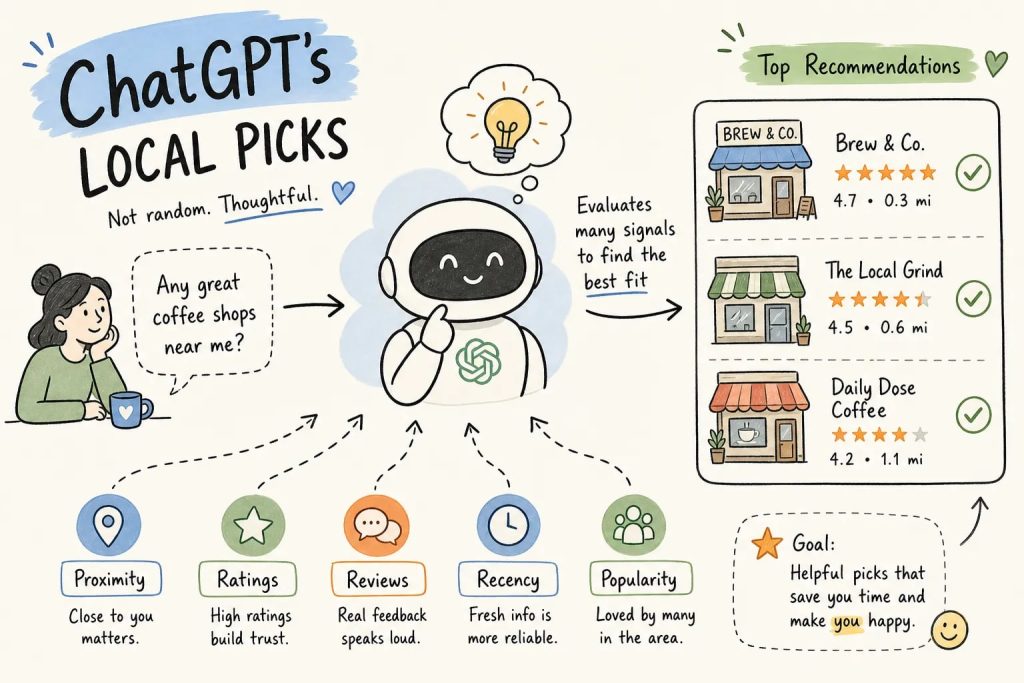
This happens across nearly every local service category, including plumbers, roofers, insurance agents, and solar installers. The businesses ChatGPT recommends aren’t necessarily the oldest or even the ones with the most reviews. They’re often the businesses sending the clearest and most consistent digital authority signals.
At TW3 Marketing, this is one of the first things we examine when a local business owner wants to know why competitors keep receiving calls that should be going to them.
This article explains how you can earn a ChatGPT local business recommendation. We discuss how ChatGPT decides which local businesses to recommend, the signals that influence its recommendations, and what you can do to earn a place on that shortlist, instead of being passed over entirely.
What Actually Happens When Someone Asks ChatGPT for a Local Business
When a user asks ChatGPT for a local business recommendation, the model doesn’t run a search the way Google does. It generates an answer by pulling from publicly available web content, combined with real-time web retrieval in certain versions. The result is a composed recommendation, not a ranked list of search results. There’s no “position one” to chase.
The Organic Answer vs. the Sponsored Placement
In 2026, ChatGPT has two distinct layers for local queries. The first is the organic AI-generated answer, where ChatGPT names businesses it believes are credible and relevant based on the information it can find and synthesize. The second is a separately labeled sponsored placement that can appear below the answer. OpenAI has stated that sponsored placements do not influence the organic answer content itself. For a local business, earning a mention in the organic answer is a fundamentally different challenge than running a paid ChatGPT ad. This article focuses on the organic layer, because that’s where most businesses have the biggest opportunity and the biggest blind spot.
Why This Is Not the Same as a Google Search
Google ranks pages. ChatGPT synthesizes an answer. That distinction changes everything about what “optimization” means for AI local SEO. You can’t build a link, tweak a meta description, or buy a position inside ChatGPT’s written response. The business either gets named confidently or it gets left out. That means the work happens upstream, in how your business is documented and described across the entire open web.
Where ChatGPT Gets Its Information About Local Businesses
ChatGPT doesn’t have a secret database of local service providers. It learns what it knows about a business from publicly available digital information: business websites, directory listings, review platforms, local news mentions, and structured content across the web. If a business has a thin or inconsistent digital footprint, ChatGPT simply has less reliable information to draw from, and less confident information means a lower chance of getting named in a ChatGPT local business recommendation.
The Role of Reviews, Directories, and Citations
Reviews on Google, Yelp, and industry-specific platforms are among the most widely crawled and referenced sources for local business reputation. Consistent NAP data, name, address, and phone number, across directories reinforces a business’s identity so the model can confidently associate all of those mentions with a single, real entity. Tools like Zapier, Markifact, and Windsor.ai can automate the connection between platforms like Google Business Profile and AI-accessible data layers, helping that information surface when ChatGPT retrieves it. The more sources that corroborate the same information, the more confidently ChatGPT can summarize and recommend the business.
Why Content That Demonstrates Expertise Matters
ChatGPT weights content that reads like genuine expert authority. Detailed service pages, FAQ content, case studies, and blog posts that answer specific questions all give the model more material to draw from. A business that has written clearly about what it does, who it serves, and why it’s qualified gives ChatGPT the raw material it needs to generate a confident recommendation. Generic filler content doesn’t move the needle, specific, structured, expert content does.
Why Many Local Businesses Are Invisible to ChatGPT
Most local business owners have never thought about how they appear to an AI model. They have a website, a Google Business Profile, and a handful of reviews, and they assume that’s enough. For traditional local SEO, that combination might be passable. For AI recommendation engines, it often falls well short.
What a Weak Authority Signal Looks Like to an AI Model
Consider two HVAC companies serving the same city. The first has a fully built-out Google Business Profile, consistent citations across many directories, 80 recent reviews with detailed descriptions of specific jobs, and service pages that explain exactly what they do and where they work. The second has a basic website, an incomplete profile, 12 reviews, and generic service descriptions. ChatGPT can summarize the first business confidently and in detail. It can barely say anything specific about the second. When a homeowner asks for a recommendation, the model names the business it can describe, not the one it can barely identify.
The Trust Gap That Traditional Marketing Doesn’t Fix
Paid ads don’t affect organic ChatGPT mentions, those answers are earned, not bought. Social media activity may sometimes surface as a third-party reference, but neither channel directly builds the underlying authority signals that AI recommendation engines read. Many businesses are spending significant money on marketing channels that don’t move the needle on AI discoverability. They’re filling the funnel while leaving a gap in the foundation that determines whether AI will recommend them at all.
The Signals That Raise Your Chances of Being Recommended by ChatGPT
The signals that determine whether a ChatGPT local business recommendation includes your name fall into six categories:
- Positioning, Is the business clearly and consistently defined?
- Proof, Reviews, testimonials, and documented case results
- Expertise, Authoritative, specific content that answers real questions
- Visibility, Consistent directory presence and citations across the web
- Engagement, Social proof and response activity
- Experience, How the business is described by others across the web
This is the same Authority Framework™ we use at TW3 Marketing to diagnose every client’s digital presence.
Practical Steps That Strengthen Your AI Footprint
The highest-impact actions aren’t new tactics. They’re foundational work that most businesses have partially done but never completed systematically:
- Claim and fully complete your Google Business Profile, including services, hours, photos, and the description fields most businesses leave blank
- Build consistent citations across major directories (Yelp, BBB, Yellow Pages, Bing Places) and industry-specific platforms
- Generate and respond to reviews consistently, with recency mattering as much as volume
- Publish specific service and FAQ content that directly answers the questions your customers actually ask
- Get mentioned in local publications, chamber of commerce listings, and trade directories to build third-party corroboration
None of these are exotic. What makes them powerful for AI visibility is doing them completely and consistently, not halfway.
What “Being the AI Answer” Actually Requires
ChatGPT names businesses it can summarize confidently and credibly. That standard requires consistency, specificity, and reinforcement from multiple independent sources. One well-written website isn’t enough on its own. The model needs to find the same business identity described the same way across enough sources that it can generate a confident, accurate recommendation without hedging.
How to Find Out Exactly Where Your Business Stands
Before spending time on fixes, you need to know what you’re working with. The good news is that the initial test takes about five minutes and you can run it right now.
A Simple Visibility Test You Can Run Right Now
Open ChatGPT with web browsing enabled. Use a private or fresh window so your browsing history doesn’t influence the result. Then ask it the same questions your customers would ask:
- “Who are the best [service type] companies in [your city]?”
- “I need a [service] in [city]. Who should I call?”
- “[Your business name]: what do you know about them?”
Note whether your business appears, where it shows up, and whether the information ChatGPT provides is accurate. Then ask the same questions in two or three different phrasings to see if the results are consistent. Many business owners report genuine surprise when they try this test, and not always a pleasant one.
What TW3 Marketing’s Authority Audit™ Shows You
The DIY test tells you whether you’re showing up. The TW3 Marketing Authority Audit™ tells you exactly why you’re not, and what to fix first. It’s a 100-point diagnostic that scores your business across all six authority signals: positioning, proof, expertise, visibility, engagement, and experience. It pinpoints the specific gaps keeping ChatGPT, Google AI, and voice assistants from naming you, and ranks them by impact so you’re not guessing where to spend your time. If you want a faster starting point, the Authority Score™ Check delivers a clear picture of how your business currently appears in Google and ChatGPT within 48 hours.
What to Do Once You Know Where the Gaps Are
The fixes that move the needle fastest on AI visibility also strengthen traditional local SEO simultaneously. You’re not building two separate strategies. You’re building one coherent digital authority presence that works across all discovery channels.
The Highest-Leverage Fixes for Local AI Visibility
Start with citation cleanup. Inconsistent NAP data across directories is one of the fastest ways to undermine ChatGPT’s confidence in your business identity. Next, build out service content that is specific, location-aware, and written with genuine expertise rather than generic descriptions. Increase review volume and recency by making it easy for satisfied customers to leave a review, and respond to every one that comes in. Finally, make your positioning unmistakably clear across every digital touchpoint so that anyone, or any AI, encountering your business for the first time knows exactly who you are and who you serve.
How to Track Whether the Changes Are Working
Repeat your DIY ChatGPT visibility test monthly using the same prompts in fresh windows. Track changes in your Authority Score™ over time to see whether the signal improvements are registering. Watch downstream indicators too: more inbound calls, more direct searches for your business name, and an increasing share of “how did you find us” responses that mention AI search or voice assistants. Those signals lag behind the optimization work, but they show up reliably once the foundation is solid.
The Businesses That Get Named Are the Ones That Are Easy to Describe
Back to that homeowner asking ChatGPT which HVAC company to call. That moment is not an anomaly. It’s the new normal for how local service decisions get made, and it’s accelerating across every category: plumbing, roofing, insurance, solar, general contracting. The businesses showing up in those answers didn’t buy their way in. They built a digital presence that gives ChatGPT enough consistent, credible information to name them with confidence.
Unlike paid ad platforms, ChatGPT doesn’t reward the biggest budget, it names the businesses it can verify across multiple independent sources. That’s a real advantage for smaller, well-run local businesses willing to do the foundational work rather than just spend more on ads.
The starting point is knowing where you stand. Run the five-minute visibility test today to see how your ChatGPT local business presence stacks up. If you want a complete picture of exactly which signals are working against you and what to fix first, reach out to the TW3 Marketing team about an Authority Audit™, or request an Authority Score™ Check to see your results within 48 hours.
