
Most service business owners believe their lead problem is a budget problem. Not enough money, not enough reach. But that’s rarely the actual issue. The real issue is that their digital presence can’t convert the traffic it already receives, organic or otherwise. Non-paid lead generation is absolutely achievable for local service businesses, but only when the foundation underneath it is solid.
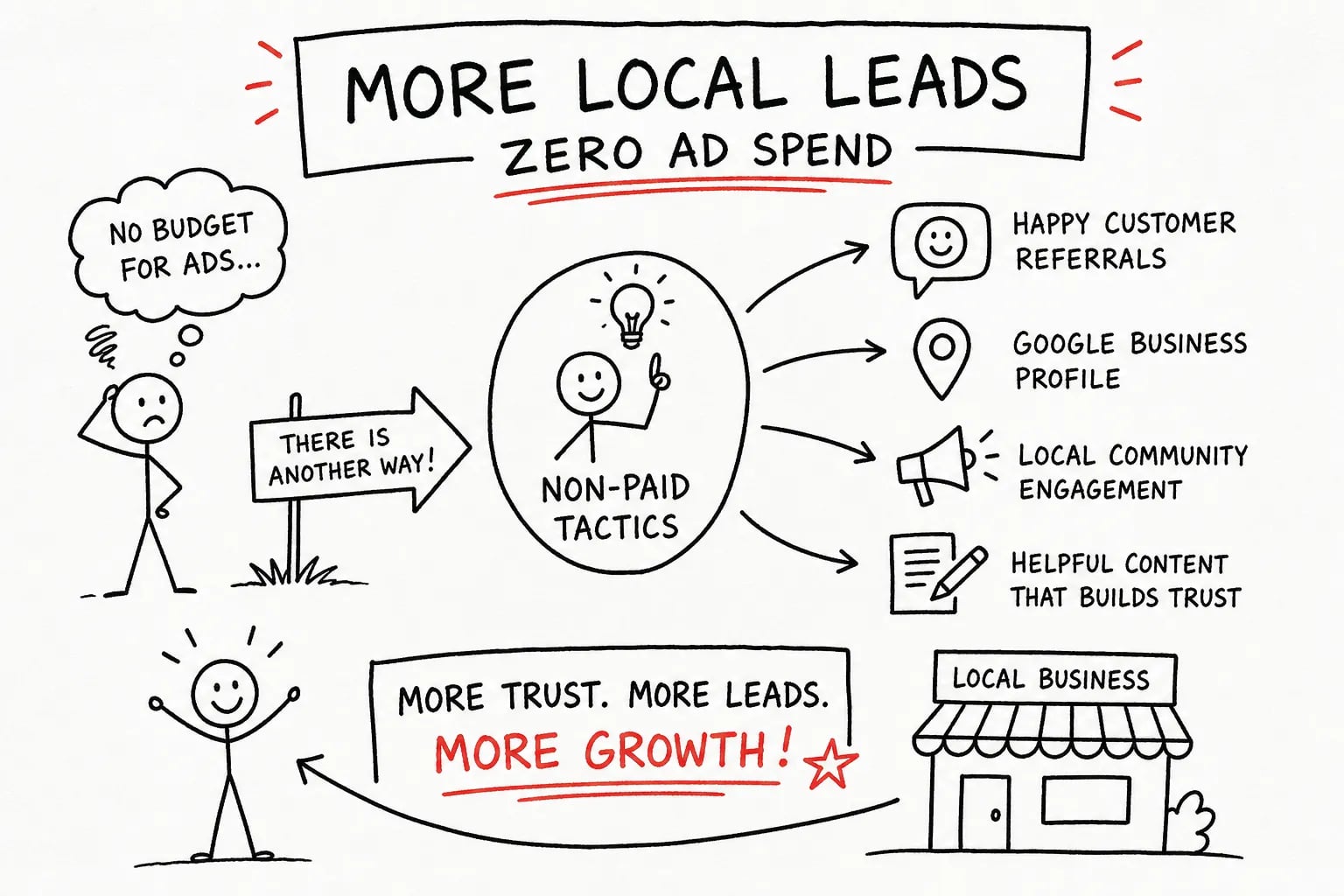
Local SEO, referrals, reviews, and AI visibility are all legitimate channels that produce real, qualified leads at zero media spend. The caveat is this: those channels only work when your business looks credible to the people landing on your page, or to the AI system deciding who to recommend. Without that foundation, you’re driving traffic to a leaky bucket, clicks without conversions.
This guide covers five channels that drive organic customer acquisition for local service businesses, plus a sequencing framework so you actually implement them instead of bookmarking them. The channels are local SEO, referrals, partnerships, reviews, and AI recommendation visibility.
The authority gap that kills organic leads before they start
Here’s a scenario that plays out every day. A plumbing company ranks on the first page of Google. They get referrals from satisfied customers. They post on Facebook occasionally. And yet their phone barely rings from any of it. The problem isn’t the channels. The problem is what visitors find when they arrive.
When a homeowner lands on a website with thin content, no visible reviews, and no clear signal of expertise, they leave. The business earned the click but lost the lead. This is the authority gap: the distance between the traffic a business attracts and the trust signals needed to convert that traffic into a phone call or form submission.
What authority signals actually are
Authority signals are the combination of positioning, proof, expertise, visibility, engagement, and experience that tell both human visitors and AI platforms that a business is credible and worth recommending. These are the six factors TW3 Marketing measures in its Authority Audit™, and they matter across every organic channel covered below.
AI platforms use these same signals. When ChatGPT or Google AI decides which HVAC company to recommend in a given city, it pulls from website clarity, structured data, citation consistency, and review signals, not ad spend. Closing the authority gap is step zero. Every non-paid lead generation tactic in this guide performs better when that foundation is solid.
Local SEO: the highest-intent non-paid lead generation channel you’re underusing
Organic search is almost certainly your largest potential source of inbound contacts, the spread varies widely by industry, but it’s consistently the top channel for local service leads. The question is whether you’re showing up and converting when you do.
Google Business Profile is your most powerful free lead tool
A fully optimized Google Business Profile consistently outperforms a basic one at the same ranking position. Fully completed profiles generate roughly seven times more clicks than incomplete ones, and businesses that actively maintain their profile see measurably more inbound calls. The levers that move the needle are category selection accuracy, service area coverage, photo volume, Q&A population, and consistent posting cadence. None of that costs money. It costs attention.
The businesses that treat their GBP as a set-it-and-forget-it listing are leaving real lead volume on the table. Recent activity signals an active business. Sparse profiles signal one that might not be around, and prospective customers notice.
On-site signals that rank and convert simultaneously
Ranking signals and conversion signals are not the same thing, and most local service businesses optimize for one while neglecting the other. Location-specific service pages, schema markup, and consistent NAP information help search engines understand where you operate and what you do. Clear service descriptions, visible trust indicators, and a frictionless contact path help humans decide to call. You need both. A site that ranks but doesn’t convert is just generating expensive curiosity.
Non-paid lead generation via referrals and local partnerships
Referrals are consistently the highest-trust lead source for local service businesses. A referred customer arrives with pre-existing confidence, which means shorter sales cycles and higher close rates. The problem is that most businesses rely on ad hoc referrals, which are inconsistent by definition.
Building a referral program that runs without reminding
The difference between ad hoc referrals and a structured referral system is a trigger, a specific ask, and a follow-up. In practice, the 24-to-48-hour window after job completion is consistently the highest-conversion moment for referral asks. Satisfaction peaks shortly after a successful job, and waiting even a week can significantly reduce response rates.
The ask itself matters more than the incentive. A genuine, specific request, “Do you know one neighbor or friend who might need this service?”, outperforms a generic discount offer. Dual-sided incentives, where both the referrer and the new customer get value, tend to outperform one-sided ones when an incentive is used at all. Keep the mechanics simple. Complicated referral programs don’t get used.
Strategic partnerships with complementary local businesses
The highest-value local partnerships are with businesses that serve the same customer at a different point in the lifecycle: a plumber and a home inspector, a landscaper and a fence installer, a general contractor and a cabinet maker. These relationships generate warm introductions, not cold traffic. A working partnership has a mutual referral agreement and shared client introductions, not a vague promise over coffee. Put it in writing and revisit it quarterly.
Review generation: the trust signal that drives calls and AI recommendations
Reviews are not reputation management. They are an active lead generation asset. Recency matters as much as volume, and most service businesses have a stale review profile because they get reviews sporadically rather than systematically.
How to generate reviews consistently
The simplest system that actually works: a text or email sent within 24 hours of job completion with a direct link to your review platform. One step. No multiple follow-ups required, though a single reminder at day three helps. Satisfied customers will not leave a review unprompted at anywhere near the rate they will when asked directly, immediately, and easily.
Responding to reviews, including negative ones, measurably improves conversion rates. Businesses that respond to all reviews consistently outperform those that respond to none. The reason is straightforward: responsiveness signals accountability. Customers who are considering calling you are also watching how you handle public feedback.
Where reviews influence lead decisions
Reviews show up at every stage of the lead journey: in the local map pack, on your website, in third-party directories, and increasingly inside AI responses. ChatGPT and Google AI factor review quality, volume, and recency into their business recommendations. That makes review generation a dual-purpose tactic, it builds human trust and improves AI recommendation likelihood at the same time.
AI visibility: getting recommended when customers ask ChatGPT or Google
When a homeowner asks an AI assistant who the best roofer in their city is, the businesses that appear are not necessarily the ones spending the most on ads. They’re the ones with the strongest authority footprint across multiple signals that AI systems can read and interpret.
How AI platforms decide which local businesses to recommend
AI systems like ChatGPT pull from indexed web content, structured data, review signals, and authority indicators. The key inputs are website clarity, consistent citations across directories, LocalBusiness schema markup, and review recency and specificity. A business whose website clearly describes its services, the customers it serves, and the areas it covers, and whose information is consistent across the web, is far easier for an AI to recommend than one with vague positioning and conflicting details.
This is the core of TW3 Marketing’s AI optimization work: restructuring a service business’s web presence so AI systems can clearly read, interpret, and surface their expertise when a relevant local query comes in.
Three concrete steps to improve your AI recommendation footprint
- Make your website explicit about your services, the customers you serve, and the areas you cover, including specific city and service area language on relevant pages.
- Build consistent citations across directories so that AI systems see the same business facts everywhere they look.
- Generate recent reviews that mention specific services and locations, which strengthens both the relevance and the geographic signal.
These steps align directly with the authority signals covered earlier. AI visibility is the output of a strong authority foundation, not a separate tactic added on top.
How to sequence these channels so they compound instead of compete
Most businesses try to do everything at once and end up doing nothing well. Sequence matters because some tactics are foundational and others are amplifiers. Launching referral campaigns or chasing reviews before your authority signals are solid is like building on sand, the effort is real, but the results aren’t.
A simple 30/60/90-day sequence for non-paid lead generation
Before choosing any tactics, get an honest read on where your authority currently stands. TW3 Marketing’s Authority Score™ Check gives local service businesses a clear picture of how they appear in Google and ChatGPT within 48 hours, a practical starting point before committing time to any of the channels above.
From there, the sequencing looks like this:
- First 30 days: Fix the foundation. Optimize your Google Business Profile, clean up on-site authority signals, and build a consistent post-job review request into your operations.
- First 60 days: Activate your referral system and establish one or two local partnerships with complementary businesses.
- First 90 days: Start measuring which channels generate inbound contact and double down on the top performer.
Non-paid lead generation is patient work. It doesn’t spike after a single campaign. It compounds as each signal reinforces the others, and businesses that build the authority foundation first get materially better results from every tactic they add afterward.
Build the credibility first
The central insight here is simple: non-paid lead generation isn’t about finding the cleverest tactic. It’s about making your business credible enough that the tactics you run actually convert. Local SEO, referrals, reviews, and AI visibility all work. They work better when the authority signals underneath them are solid.
Before adding any new organic channel to your mix, get a clear picture of where your authority currently stands. TW3 Marketing’s Authority Score™ Check is a fast way to see exactly how your business appears in Google and ChatGPT right now, no guessing required. Reach out to our team and we’ll walk you through what we find.
Organic leads aren’t free. They cost time and credibility. Do that work first, and the leads follow.
