
What makes a business look credible to AI search engines? When a homeowner asks ChatGPT which HVAC company to call, the AI does not run a fresh search. It retrieves from what it already knows, pulling from businesses it has accumulated enough signal on to confidently recommend. That distinction matters more than most business owners realize.
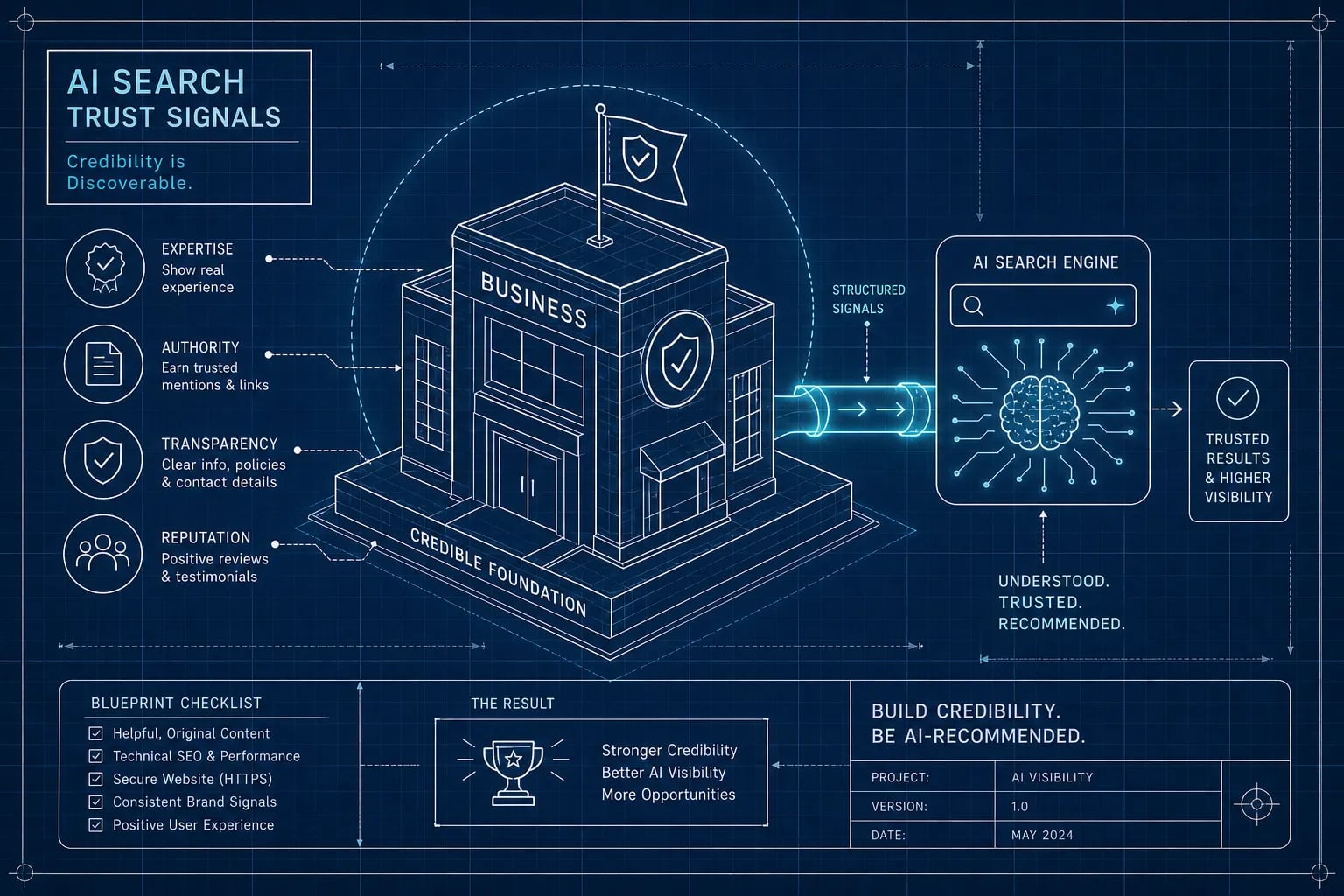
The problem is not that most service businesses have a bad product or poor service. The problem is that their authority signals are too thin for AI systems to surface them with confidence. Across the 70+ industries we’ve audited at TW3 Marketing, the businesses that get skipped by AI recommendation engines share one thing in common: they are not invisible on the web, they are just unverifiable by it.
This article covers six specific signals AI platforms evaluate when deciding which businesses to recommend, why these signals matter more than traditional SEO metrics, and what you can do right now to start closing the gap.
Why AI Recommendation Engines Filter by Authority, Not Just Traffic
Traditional search worked by ranking pages based on backlinks and keyword relevance. AI recommendation systems work differently. They synthesize information across hundreds of sources and surface businesses they have enough corroborating evidence to trust. A business can rank on page one of Google and still not appear in an AI answer if the right authority signals are missing.
What “credibility” means to an AI system is not the same as what it means to a person. AI models are pattern-matchers. They look for consistency, corroboration, and entity clarity, not just on your website, but across every place your business appears online. Credibility to an AI is not about perception. It is about how much independently verified, structured, and consistent information exists about your business across the web.
The practical implication: optimizing your website alone is not enough. AI systems cross-reference your site against your Google Business Profile, directory listings, review platforms, media mentions, and structured data. When those sources agree and reinforce each other, confidence in your business rises. When they conflict or are simply absent, you get deprioritized or skipped entirely.
What Makes a Business Look Credible to AI Search Engines: Six Authority Signals
Across the 70+ industries audited at TW3 Marketing, the pattern is consistent. AI systems are not looking for one killer signal. They are looking for six, and weakness in any one of them limits the impact of the others.
Signal 1, Positioning: Do AI Systems Know Exactly What You Do?
AI needs clarity on your category, service type, and target customer. Vague or generic positioning creates ambiguity, which makes a business harder to recommend for specific queries. This shows up in how you describe your business on your website, in your Google Business Profile, and across directories. If your homepage says “quality service you can trust” without naming your specific trade, geography, and customer type, the AI cannot confidently match you to a relevant query.
Signal 2, Proof: What Independent Sources Say About Your Results
Proof is the external evidence that your claims are real: client results, case studies, named customers, measurable outcomes. AI systems weight external confirmation far more heavily than self-declared authority. A contractor who has been quoted in a regional home improvement publication and whose techniques are referenced in an industry forum carries more AI credibility than one with a polished website and no external footprint.
Signal 3, Expertise: Visible Authority That Others Can Corroborate
Expertise is demonstrated authority: named authors, credentials, published content, and industry citations. This is distinct from proof because it speaks to who you are rather than what you have delivered. An expert signal tells an AI system that real people in your field recognize you as a credible source, not just a satisfied customer base.
Signal 4, Visibility: How Broadly You Appear Across Trusted Sources
Visibility measures how broadly your business appears across directories, trusted websites, and media. The more places an AI can find consistent, corroborated information about you, the more confident it becomes in recommending you. Thin visibility, even paired with a strong website, leaves the AI without enough corroborating data to surface your name.
Signal 5, Engagement: Signs That Your Business Is Active and Operating
Engagement captures active participation: responses to reviews, Q&A activity, community discussions, and updated profiles. These signals tell an AI system that your business is live and current, not an abandoned listing. A Google Business Profile with unanswered reviews and a last-updated date from two years ago reads as stale, regardless of how strong your other signals are.
Signal 6, Experience: On-Site Evidence That You Can Deliver
Experience covers on-site signals that show your business can execute: detailed service pages, FAQs, clear process explanations, and professional presentation that meets visitor expectations. When an AI sends someone to your website, the experience that visitor has either confirms or contradicts the confidence the AI placed in recommending you.
All six signals compound. Strength in visibility amplifies the value of your proof. Strong engagement reinforces your positioning. Weakness in one area drags down the others, which is why patching a single signal rarely produces the AI visibility improvement businesses expect.
Why Third-Party Validation Outweighs What You Say About Yourself
This is the signal most service businesses underweight, and it is also the one AI systems weight most heavily. Third-party reviews carry more influence than on-site testimonials because they are harder to fabricate and easier for AI systems to corroborate. An AI can cross-reference a Google review against your Yelp profile, your Angi listing, and a mention in a local publication. It cannot do the same with a quote on your homepage.
Review velocity matters as much as total volume. A business with 80 reviews and a steady flow of 10 new reviews per month consistently outperforms a business with 200 reviews and no recent activity. Recency signals that the business is active and current. A pile of old reviews tells the AI you used to be relevant. A steady stream of fresh ones tells it you still are.
To build review velocity, consider a simple post-job follow-up sequence: a same-day text requesting feedback, a follow-up email three days later with a direct review link, and a final reminder at the one-week mark. Businesses that implement this kind of systematic ask, rather than waiting for reviews to appear organically, typically see review volume increase within 60 to 90 days.
Cross-platform diversity multiplies the effect. Rather than a single platform with an outsized review count, spread that presence across Google, Yelp, industry-specific directories, and niche platforms relevant to your trade. A roofing contractor cited on Angi, reviewed on both Google and Houzz, and mentioned in a regional home improvement guide has far more corroborating signal than one with a polished website and reviews concentrated in a single place. That breadth is what makes an AI confident enough to recommend you by name.
Structured Data: Making Your Business Machine-Readable for AI Search Engines
Structured data is how you make your business legible to AI systems without relying on them to correctly interpret your copy. The four schema types that matter most for AI discoverability are Organization (brand identity), LocalBusiness (location and hours), Service (what you offer), and Review (reputation signals). Each one serves a different purpose, and a complete implementation uses all four in the right places.
JSON-LD is the recommended implementation format. It lives in the page code and allows AI systems to parse your business facts accurately, regardless of how your visible content is written. The key is alignment: your schema should reflect exactly what is shown on the page. If your hours in schema say Monday through Friday 8am to 5pm, your Google Business Profile and your contact page should match exactly. Mismatches, even minor ones, introduce uncertainty that can reduce how confidently an AI references your business.
Entity consistency is where most implementations break down. AI systems cross-reference information constantly. If your business name, address, and phone number vary across your website, Google Business Profile, and directory listings, the system treats those variations as uncertain or potentially separate entities. Using a stable @id in your schema and connecting your business and service pages to the same entity allows AI systems to build one coherent picture rather than a fragmented set of disconnected references. That coherence directly influences whether you get recommended when someone asks what makes a business look credible to AI search engines, and whether your business is the answer.
How to Measure Whether AI Systems Are Actually Recommending You
Most businesses skip this step entirely, which means they have no way to know whether their efforts are working. Three metrics replace traditional rank tracking for AI visibility purposes: mention rate (the percentage of relevant prompts where your business appears in the AI’s answer), citation share (how often an AI answer links to or cites your site as a source), and share of voice (your visibility relative to direct competitors across the same set of queries).
Several tools now track these metrics directly. Semrush AI Visibility monitors mentions and citation scoring across ChatGPT, Perplexity, and Google AI. Otterly.AI is a lighter-weight option for smaller businesses that want to track brand mentions and citations without a full enterprise platform. Ahrefs Brand Radar shows how often your brand appears in AI answers and which sites are cited alongside it. GA4 can be configured to track AI referral traffic, connecting your AI visibility to actual site visits and leads.
Run a baseline measurement before making any changes. Without a starting point, you are guessing at progress. Run a fixed set of prompts across ChatGPT, Perplexity, and Google AI that mirror how your target customers actually ask for your service, record where you appear, and repeat the process monthly. That discipline turns AI visibility from a vague aspiration into something you can actually manage.
Where to Start When You Do Not Know Which Signals Are Broken
The challenge is not that service businesses ignore credibility signals. It is that most have no systematic way to identify which of the six are strong and which are creating gaps. A business can have strong reviews and zero structured data. Another might have solid content and expertise signals but inconsistent NAP information across 40 directories. Without a diagnostic, you end up fixing the wrong things first and spending budget on tactics that cannot convert without the foundation in place.
That gap is what the Authority Audit™ was built to close. The 100-point scoring system measures all six authority signals, positioning, proof, expertise, visibility, engagement, and experience, across a business’s full digital presence, then produces a scored breakdown of exactly which signals are weak and what to fix first. It pinpoints where you are leaking AI credibility before you spend another dollar on marketing tactics.
Knowing your score tells you where to invest. Without it, most businesses over-invest in visibility while neglecting proof, or improve their website while leaving their external citation footprint untouched. If you want to see where your business stands right now, reach out to the TW3 Marketing team for an Authority Score™ Check. It shows how your business currently appears in Google and ChatGPT within 48 hours, giving you a concrete starting point instead of a guess.
The Bottom Line on What Makes a Business Look Credible to AI Search Engines
AI search engines are not ranking websites. They are recommending businesses they have enough multi-source, consistent, corroborated evidence to trust. The six signals that drive those recommendations, positioning, proof, expertise, visibility, engagement, and experience, are not abstract marketing concepts. They are the specific inputs these systems use to decide who gets named and who gets skipped.
You do not need to fix everything at once. Identify your weakest signal, address it systematically, and measure the change. What makes a business look credible to AI search engines is the same thing that makes it credible to customers: consistent evidence, from multiple independent sources, that you are exactly who you say you are. Start there, and the recommendations will follow.
