
Picture this: a homeowner’s AC stops working on a 95-degree afternoon. She doesn’t open Google and scroll through a list of HVAC companies. She opens ChatGPT and types, “Who’s the best AC repair company near me?” The business that shows up in that answer isn’t necessarily the one with the most Google reviews or the highest ad spend. It’s the one that gave AI systems enough structured, credible information to cite with confidence. That’s the core idea behind answer engine optimization (AEO), and it’s reshaping how service businesses compete for customers. This answer engine optimization guide for service businesses walks through exactly how to close that gap, from auditing your pages to implementing schema to tracking real citation results.
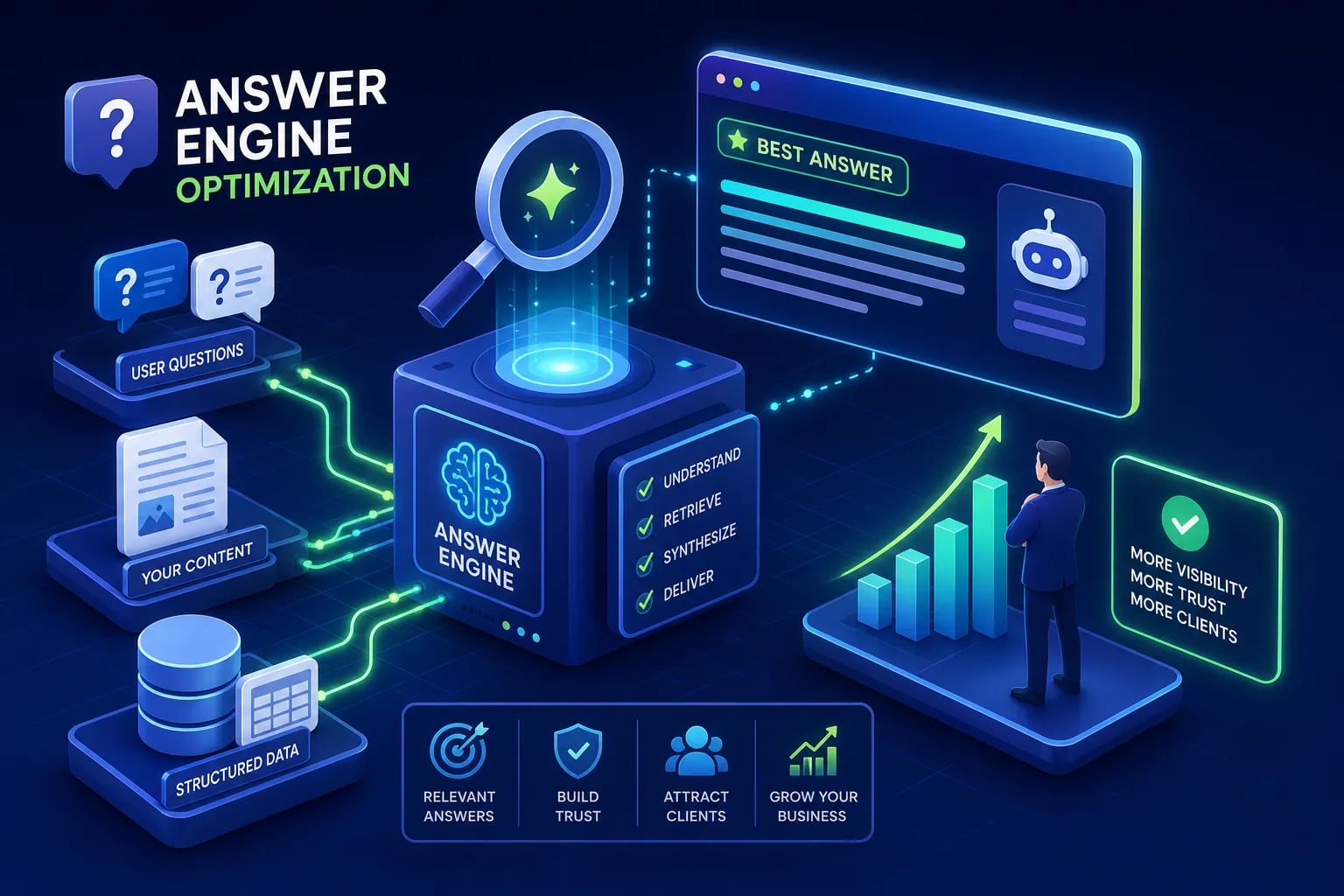
AEO isn’t a replacement for good SEO. It’s an extension of it, one that requires your content, schema, local signals, and authority signals to align clearly enough for an AI platform to trust your business and quote it. This guide follows the same diagnostic logic that TW3 Marketing applies through its Authority Framework™ across its client portfolio of service businesses: diagnose the gaps first, fix the highest-impact problems, then measure results with real data. By the end, you’ll know exactly how to audit your service pages, apply the right content and schema changes, and track whether those changes are earning you AI citations.
What answer engine optimization actually means for service businesses
Traditional SEO helps pages become discoverable and competitive in search. AEO extends that foundation by making accurate answers easier for search and AI systems to understand, extract, and cite. The distinction is structural. SEO optimizes for rankings; AEO optimizes for extraction. AI systems don’t browse pages the way humans do. They pull the clearest, most confident answer to a specific question and attribute it to a source. If your service page isn’t written and structured to be extracted, it won’t be cited even if it ranks well. That’s the gap this answer engine optimization guide for service businesses is designed to close.
For HVAC companies, plumbers, and general contractors, the search funnel is shifting faster than most realize. Homeowners are starting their search with a conversational AI query, “what should I expect to pay for a new water heater installation?” or “how do I know if my AC needs refrigerant?”, before they ever click a website. If your competitors’ pages answer those questions clearly and yours don’t, AI tools recommend them, not you. That’s what AI search optimization is really about: being the clearest, most credible answer in the room.
Several query types dominate for service businesses: cost estimation queries (“how much does X cost”), problem-diagnosis queries (“why is my furnace doing Y”), and provider comparison queries (“who should I hire for Z”). Each type calls for a different content structure that AI systems prefer. Understanding which type your service pages target determines how you write and structure the content.
Why most service pages fail the AI credibility check
Most service pages were built to convert visitors, not to inform AI systems. They lead with testimonials, phone numbers, and a contact form, which is fine for humans but nearly useless for an AI extracting an authoritative answer. AI platforms look for clear entity identity, structured factual content, and corroborating signals from third-party sources. When those elements are missing, the page gets skipped in favor of one that provides them.
TW3 Marketing’s Authority Framework™ identifies six signals that determine whether a business gets recommended by AI platforms: positioning clarity, proof of expertise, demonstrated expertise depth, multi-channel visibility, engagement evidence, and user experience quality. These are the signals that consistently surface in AI search optimization audits across service verticals. Many sites are weak on multiple signals at once. The result isn’t just poor AEO performance, it’s a credibility gap that affects human visitors too. A page that AI systems trust tends to be a page that converts better with real visitors, since the same clarity and specificity that helps machines also helps humans make a faster decision.
Structural patterns that commonly block AI extraction include dense paragraphs with no question-led headings, service pages that describe the business rather than answering customer questions, and pages with no FAQ blocks or structured data. These aren’t just stylistic issues, they’re extraction barriers. AI platforms prefer content that mirrors the structure of the question being asked. If your page doesn’t echo the user’s language and format, it won’t be selected as the answer regardless of how well it ranks.
Answer Engine Optimization Guide for Service Businesses: Auditing Your Service Pages
Pull up each of your core service pages and ask one question: does this page directly answer the most common question a homeowner would ask about this service within the first 60 words? If the page opens with “Welcome to our HVAC services” or a company history paragraph, it fails. An AEO-ready page leads with a concise, factual answer and then supports it with detail. Rewrite your opening paragraph as if answering the query directly, in plain language, before adding anything else.
How to check FAQ schema for service pages
Run each service page through Google’s Rich Results Test or Schema Markup Validator. Check whether you have Service schema, FAQPage schema, and LocalBusiness or Organization schema in place. Many service company sites lack complete schema coverage or only include a generic LocalBusiness snippet pulled in automatically by their website builder. The minimum viable stack for a service page is Service + FAQPage + Organization, with accurate areaServed, provider, and description fields populated. Without these, you’re asking AI systems to guess at details they need to cite you confidently.
How to audit local signal consistency
Audit your local signal consistency by checking whether your business name, address, phone number, and service area information match exactly across your website, Google Business Profile, and your top citation directories. Even minor variations, “St.” versus “Street” in your address, introduce ambiguity for AI platforms trying to confirm your entity. Run a NAP audit across your top five directories and flag every inconsistency before you build additional schema or content. Fixing these before you add new schema prevents you from locking in mismatched data at scale.
Content and schema changes that earn AI citations
The content pattern that earns the most AI citations is straightforward: lead with a direct answer in 40 to 60 words, then expand with supporting context in short, scannable sections. Each subsection should target a single question. Headings should be written as questions your customers actually ask, “How much does AC installation cost in [city]?” rather than “Our HVAC Pricing.” Question-led H2s and H3s help AI systems map a page’s content to specific queries because they mirror the exact phrasing those systems are trying to match.
For most service businesses, the practical schema stack breaks down like this. First, implement Service schema with name, description , provider, areaServed, serviceType, and offers fields. Second, add FAQPage schema with at least four to six question-and-answer pairs that mirror real customer questions. Third, include Organization or LocalBusiness schema with name, address, telephone, openingHours, sameAs, and logo. Implement all of this in JSON-LD format in the page’s . Valid, consistent schema removes ambiguity for AI platforms and increases the likelihood that your page is selected over a competitor’s.
Every service page should have a dedicated FAQ section with at least four questions. Write each answer as a standalone, self-contained response of 40 to 80 words that could be lifted verbatim into an AI answer without losing meaning. Avoid vague answers like “it depends on your situation.” Specific, factual answers with named ranges, timeframes, or conditions perform significantly better in zero-click search optimization contexts. These blocks also carry FAQPage schema, which explicitly signals to AI platforms that the content is structured for question-and-answer extraction.
Local authority signals that reinforce AI visibility
Your Google Business Profile is the primary local entity that AI platforms reference when forming recommendations about service providers. A complete, accurate, and regularly updated profile, with primary category, services listed, service areas, photos, and a populated Q&A section, gives these platforms more to work with. Incomplete profiles reduce AI confidence in your business’s legitimacy. Treat your GBP as a content asset, not just a map listing, and update it with the same discipline you apply to your website.
Review signals are the second most important local authority factor for AI visibility, and recency matters as much as volume. A business with 200 reviews but none in the past six months is less credible to AI platforms than a competitor with 80 reviews and a consistent monthly cadence. Encourage reviews that mention specific services by name, “they replaced our water heater in under three hours” is more useful than “great service”, because service-specific language reinforces your topical authority in those categories.
Clean, consistent NAP citations across authoritative directories (Google, Yelp, BBB, Angi, HomeAdvisor) signal to AI platforms that your business entity is verified and trustworthy. Start with those top-tier directories first, then work outward to industry-specific and local directories. A practical sequence: correct any mismatches in your GBP first, then move to Yelp and BBB, then to the niche directories relevant to your trade. This layered approach ensures your most-referenced sources are accurate before you expand your citation footprint.
Tracking AEO results and proving ROI
Track your AI citation rate by running a defined prompt set of 20 to 30 queries relevant to your services across ChatGPT, Perplexity, and Google AI Overviews monthly, recording how often your business or pages appear. Pair this with Google Search Console data on SERP feature impressions and click-through rates from featured snippet and AI Overview placements. For downstream impact, track AI referral traffic using UTM parameters, form submissions from AEO-targeted pages, and inbound call volume tied to those pages.
A practical service business dashboard covers three layers. Visibility: citation appearances, SERP feature impressions, and AI mention rate. Traffic: clicks, AI referral sessions, and CTR from AI surfaces. Conversions: form fills, calls, consultations booked, and conversion rate per page. Review it monthly. If citation rate is rising but conversions aren’t following, the issue is usually on-page trust signals or a weak call-to-action, not the AEO content itself.
If you’ve implemented the schema stack, restructured your content, and optimized your GBP and reviews but AI citations remain low, the problem is usually deeper authority gaps that content changes alone can’t fix. Tools like TW3 Marketing’s Authority Score™ Check are designed specifically for this diagnostic step, surfacing the authority signals holding your business back from AI recommendation so you’re fixing the right problems instead of guessing. Reach out to the TW3 Marketing team to learn more.
Where to go from here
Answer engine optimization isn’t a separate discipline from good marketing. It’s what happens when your content, schema, local signals, and authority all align clearly enough for an AI platform to trust your business and quote it confidently. Follow this answer engine optimization guide for service businesses to bring those elements into alignment, and to make AI search optimization a repeatable part of how you maintain visibility over time.
Start with your top three service pages. Audit them against the criteria in this guide: do the opening paragraphs lead with direct answers? Does the schema stack pass validation? Are your NAP citations consistent across your top directories? Then implement the schema stack, rewrite the page openings to lead with direct answers, and build your FAQ blocks. Run your first citation test in 30 days as an early indicator, not a final verdict, of whether the changes are registering. The businesses showing up in AI answers right now didn’t get there by accident. They built the authority signals that make AI platforms confident enough to cite them.
