
You search Google, and there’s your competitor, front and center in an AI Overview, getting recommended to customers who haven’t even scrolled yet. You’ve got reviews. You’ve got a website. You’ve run ads. And the AI keeps picking someone else. That’s not a glitch. That’s a signal problem.
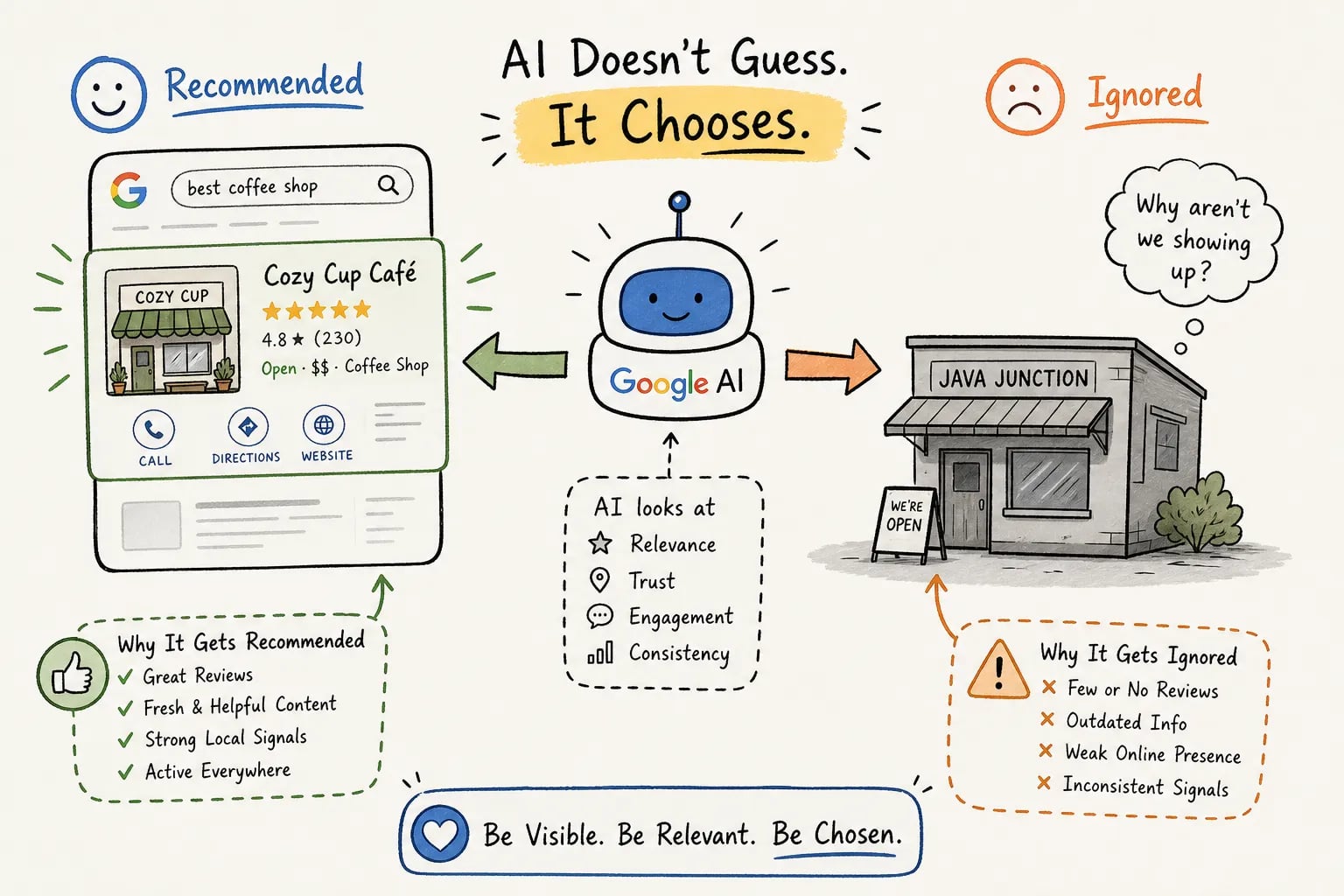
After auditing local service businesses at TW3 Marketing, the pattern is always the same. The businesses showing up in Google’s AI recommendations have consistent, readable authority signals across their entire digital presence. The ones being ignored have holes in that foundation. Google’s AI doesn’t guess, it evaluates indexed content and third-party signals, then decides. This article breaks down the six signals it’s evaluating and what to do when one of them is broken.
Why does Google AI recommend some businesses and not others?
Understanding why Google AI recommends some businesses and not others starts with clearing up a few persistent misconceptions. Google does not publish a fixed priority order for its local ranking factors. According to Google’s own documentation, standard Search eligibility determines AI Overview inclusion, there is no special AI-specific markup required, and paid ads have no documented effect on whether a business appears in AI Overviews. What that means in practice is that Google’s AI pulls from its index and from your broader digital footprint, including third-party directories, review platforms, and web content, to assess your business’s trustworthiness and relevance.
The businesses that appear are the ones where that assessment is clear, credible, and consistent. The ones that don’t appear have weak or conflicting signals somewhere in that foundation. Google’s public local-ranking guidance identifies relevance, distance, and prominence as the main factors, while its AI-feature guidance says normal Search eligibility and quality systems still apply.
Why proximity alone won’t get you recommended
A business can be physically closest to the searcher and still lose the recommendation to a competitor three towns over. Distance remains one of Google’s documented local-ranking factors, alongside relevance and prominence. A farther business can still appear when Google considers it a stronger overall match, but Google does not disclose a universal order for these factors. Proximity alone therefore cannot guarantee a recommendation.
The six authority signals Google AI evaluates
At TW3 Marketing, we frame these as six lenses: positioning, proof, expertise, visibility, engagement, and experience. Google’s system uses all six to assess whether a business is trustworthy enough to recommend. A weakness in any one of them can be enough to push you out of consideration, even if the other five look solid. The next three sections break all six down in pairs.
Positioning and proof: the first two signals Google AI checks
Before the AI can recommend you for anything, it needs to understand exactly what your business does, who it serves, and where it operates. That’s positioning. If your website, Google Business Profile, and directory listings send conflicting signals about your category, service area, or specialty, the system can’t confidently match your business to a relevant query. It moves on.
Proof is the second signal it checks, and this is where reviews carry the most weight. Volume, recency, sentiment, and whether the owner responds all factor in. A business with 14 reviews from three years ago is not sending a strong proof signal. Google confirms that review quantity and positive ratings can support local prominence, and that helpful owner responses can help a business stand out. Review freshness may also influence customer confidence, but Google does not state that recency universally outweighs total review count.
Why unclear positioning gets your business skipped entirely
Category selection on your Google Business Profile is not a minor detail. It’s one of the primary inputs Google’s system uses to determine what your business is and whether it’s relevant to a given search. When category, service descriptions, and business descriptions are vague or mismatched across platforms, the AI can’t confidently associate you with the queries you’re trying to win. Businesses with precise category and service-area signals consistently outperform those with generic or inconsistent profiles. This is a fixable problem, but only if you know it exists.
What Google AI counts as proof beyond star ratings
Star ratings are the surface. The deeper proof signals are review recency, keyword-rich review content, owner response rate, and sentiment trends over time. A business responding to every review, good and bad, signals active management and customer engagement, and practitioners who track local SEO for AI recommendations consistently observe that review response activity correlates with improved local visibility. Beyond Google reviews, third-party sources like BBB, industry directories, and local citations function as independent verification. Google’s system cross-references these sources to confirm that what your profile claims matches what the broader web says about you.
Expertise and visibility: how AI decides you’re the real deal
Expertise is about what your content and digital presence communicate regarding your depth of knowledge. Google AI surfaces businesses that have clearly demonstrated they understand their trade. That means FAQ content, service pages that answer real customer questions, and published content that reflects genuine subject matter authority. It’s not about publishing volume. It’s about whether your content reads like it was written by someone who actually knows the work.
Visibility is the third-party validation layer. Are your name, address, phone number, and business details consistent across the directories, review sites, and local data sources Google uses to cross-reference businesses? Inconsistent NAP data is one of the most common and most invisible authority gaps in local businesses. When Google sees conflicting details across sources, it treats your business as ambiguous. Ambiguous businesses don’t get recommended.
The expertise signals that should be on your site right now, and what local SEO for AI recommendations actually requires
Structured content, including FAQs, service descriptions written to answer real customer questions, and LocalBusiness schema using the most specific sub-type for your category, are the practical signals Google AI can extract and use when evaluating your site. Structured data for local search is not optional, it’s the difference between the AI having something concrete to cite and moving on to a competitor that gave it more to work with.
To illustrate what Business Profile optimization combined with expertise signals can do: an HVAC business that went through a full authority optimization, adding FAQ schema, local authority content, and a complete Business Profile overhaul, moved from a zero percent AI Overview citation rate to 71 percent in 75 days, according to agency-reported results. That outcome came from fixing expertise and positioning signals in combination across multiple changes, not from any single adjustment.
Why directory consistency matters more than most businesses realize
Google’s system cross-references business data across Yelp, BBB, industry directories, and other public sources to verify entity facts. When those sources disagree on your name, address, or phone number, confidence in your business drops. That split-signal problem doesn’t just weaken your ranking. It can push you out of AI Overview local results entirely because the system isn’t confident enough in the details to put your business in front of a customer. Citation consistency is unglamorous work. It’s also non-negotiable.
Engagement and experience: the two signals most businesses overlook
Engagement signals tell Google’s system whether real people are interacting with your business online. Photo freshness on your Business Profile, Q&A activity, post frequency, and response rates are all indicators of an active, legitimate operation. A dormant Business Profile reads as a dormant business. Low engagement suggests either the business isn’t active or customers aren’t interested, and neither conclusion helps you get recommended.
Experience is about what happens after the click. Does your website load fast? Is it easy to navigate? Does it clearly guide a visitor toward taking action? Google has long weighted on-page experience signals, and its AI systems use the same underlying quality assessments when deciding which businesses to surface. A well-optimized Business Profile attached to a slow, confusing website is still a liability.
What an active Business Profile actually signals to Google AI
Photo freshness, regular GBP posts, answered Q&As, and review responses all signal that someone is paying attention. Google reads this activity as evidence of a functioning business with real customer interactions. One agency-reported case study involving a personal injury firm in Tampa showed that a GBP overhaul combined with a steady review acquisition process generated 12,600 AI Overview impressions in 30 days and a 532 percent jump in organic traffic over three months. That result wasn’t from ads. It came from making the profile accurately reflect what the business was: active, engaged, and responsive. As with any multi-variable case study, the combination of changes makes it difficult to isolate a single cause, but the direction of the results is consistent with what Business Profile optimization research predicts.
The on-site experience signal that undermines strong profiles
A complete, accurate Business Profile brings people to your door. Your website is the door. If it loads slowly, buries your services, or doesn’t make it obvious what to do next, you’re losing customers that Google AI sent your way. Page speed, clear service descriptions, visible trust signals on the homepage, and an obvious call to action aren’t conversion niceties. They’re authority signals. Google assesses them. So do your customers.
How to find the authority gaps your business doesn’t know it has
Most local businesses have no idea which of these six signals is their weakest link. They invest in ads or traditional SEO without ever running a proper authority diagnosis first. The predictable result is more traffic to a profile or website that still doesn’t convert or get recommended because the underlying signals are broken. More spend doesn’t fix a signal problem. Diagnosis does.
The businesses that look solid on the surface are often the ones with the most dangerous gaps: weak proof signals, inconsistent citations, or underbuilt expertise content that gives the AI nothing to work with. This pattern shows up repeatedly across client audits, businesses that have marketed for years, sometimes at significant cost, never diagnosing the specific signals holding them back.
Why most local businesses score lower than they expect
The gap between how a business owner perceives their online presence and how Google AI actually reads it is usually significant. A business can have a decent website, a five-star rating, and a claimed Business Profile and still score poorly across positioning, expertise, and visibility signals. The surface looks fine. The structure underneath is where the problems are. Those problems are always diagnosable. Diagnosing them before spending more on marketing is what prevents wasted budget and predictable disappointment.
What a prioritized authority fix sequence looks like
The sequence matters as much as the fixes. Start with positioning, because everything else builds on clarity. If the AI can’t determine what you do and who you serve, no amount of reviews or schema will get you recommended. Then strengthen proof signals: reviews, response rates, and citation consistency. Then build out expertise content. Then address engagement and experience. At TW3 Marketing, this prioritized approach is structured through the 100-point Authority Audit, a process designed to show businesses exactly where they stand across all six signals and what to fix first, so nothing gets spent on the wrong problem.
The clearest path from ignored to recommended
So why does Google AI recommend some businesses and not others? It comes down to how clearly and consistently a business communicates six specific authority signals across its entire digital presence, not budget size, not ad spend, not proximity. The businesses showing up have stronger authority signals. The gap is diagnosable and fixable. But only if you know where to look.
If you don’t know your current authority score or which of the six signals is holding you back, that’s the right place to start. TW3 Marketing’s Authority Audit gives you a clear, prioritized picture of exactly where your business stands and what needs to change first. No guesswork, no generic recommendations.
You don’t need to overhaul everything, just fix the right things in the right order. That’s the whole game.
