
A homeowner in your city opens ChatGPT and types: “Who’s the best HVAC company near me for an emergency AC repair?” Your competitor’s name appears. Yours doesn’t. You never knew the lead existed, and you never got a chance to compete for it.
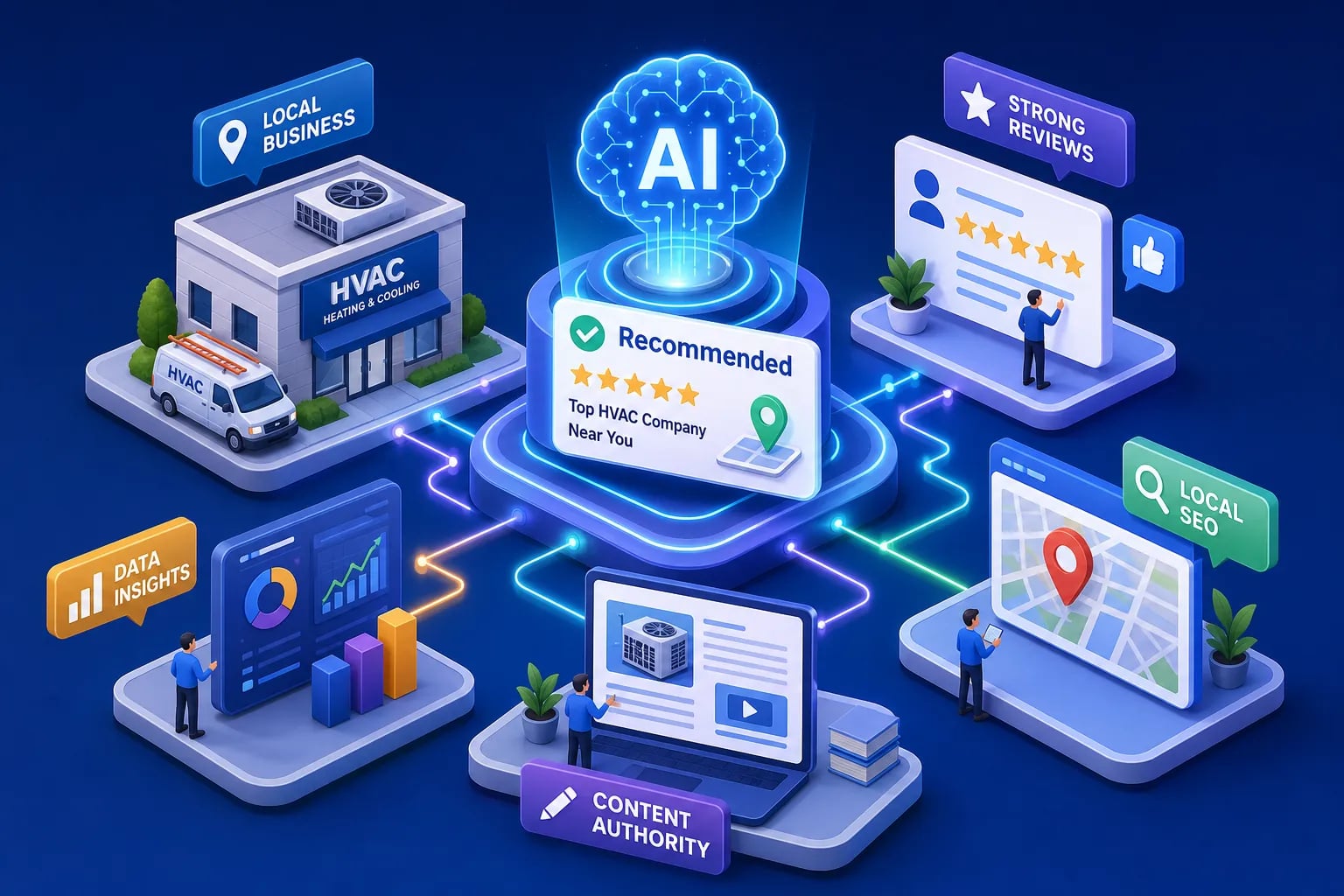
This is already happening across local markets. Homeowners are bypassing Google’s blue links and going straight to AI assistants for service recommendations. The businesses that show up in those answers are getting calls they didn’t have to advertise for. The ones that don’t are losing leads to a process they don’t fully understand yet. If you’ve been wondering what marketing strategies help HVAC companies get recommended by AI assistants in their local area, the answer comes down to seven specific, structural tactics, and most of your competitors haven’t touched them yet.
Through our work with HVAC companies at TW3 Marketing, the pattern is consistent: the businesses that win AI recommendations aren’t necessarily the biggest or oldest. They’re the ones with the clearest, most consistent digital authority signals. Here are those seven tactics.
How AI assistants actually decide which HVAC company to recommend
Google AI, ChatGPT, and Siri don’t randomly select local businesses. Each pulls from a specific set of data sources and evaluates your business against three core criteria: relevance, prominence, and consistency. Understanding what feeds those criteria is the starting point for any meaningful optimization.
The main data sources are your business website, Google Business Profile, review platforms, directory citations, structured data markup, and third-party mentions like local press. No single signal dominates, but gaps in any one of them weaken your overall case. Different assistants also weight these differently: Google AI leans heavily on GBP and Maps data; ChatGPT with browsing pulls from web pages and directories; Siri ties closely to Apple Maps and Apple Business Connect.
When your data is inconsistent across these sources, AI systems treat that as ambiguity. Conflicting business names, outdated phone numbers, or mismatched service descriptions across platforms signal low confidence. AI systems default to recommending a competitor with cleaner, corroborating evidence. The seven tactics below address each of these failure points directly.
What marketing strategies help HVAC companies get recommended by AI assistants
Two of the seven tactics are structural. They establish the verified identity and location signals that AI systems check before anything else. Without these in place, the remaining five tactics deliver a fraction of their potential impact. Think of them as your digital identity layer, the foundation that every other signal builds on.
Tactic 1: Treat your Google Business Profile like a living document, not a one-time setup
GBP is consistently described as the primary authoritative local data source for AI recommendation systems, particularly within Google’s ecosystem. That means every incomplete field is a missed signal. Complete your primary and secondary categories (the primary category is the single most important relevance signal for queries like “emergency AC repair near me”), list each individual service rather than just “HVAC services,” fill in your service area with the specific cities you serve, and upload photos that reflect your actual team and work.
The piece most HVAC companies miss is ongoing activity. AI systems use profile freshness as a signal of whether a business is actively operating. Audit your GBP at minimum once per quarter, update photos after notable jobs, and answer questions in the Q&A section with the same specificity you’d want in a review.
Tactic 2: Lock down NAP consistency across every platform where your business appears
Your name, address, phone number, and hours must match exactly across GBP, Yelp, Angi, HomeAdvisor, Apple Business Connect, Bing Places, Thumbtack, and any HVAC-specific directories. Not approximately. Exactly. AI systems cross-reference these sources to verify your business; inconsistencies don’t just create confusion, they actively reduce recommendation confidence.
Run a citation audit before investing in anything else. Identify every mismatch and correct it at the source. This is unsexy work, but it’s the foundation everything else depends on. One corrected citation inconsistency can unlock the value of dozens of other optimizations you’ve already made. This is also where AI local SEO for HVAC companies either gains traction or quietly stalls.
The review strategy that builds AI trust in your HVAC business
Reviews are among the heaviest trust signals AI assistants use for local recommendations. But the way AI systems evaluate reviews is more nuanced than most HVAC companies realize.
Tactic 3: Hit the review benchmarks that AI systems reward
Volume, recency, and rating all matter, and they interact with each other. There is no universal review-count or star-rating threshold for AI visibility. Compare review volume, rating, detail, and recency with direct local competitors, and focus on a steady flow of authentic feedback. For recency, research from BrightLocal indicates that roughly 74% of consumers only trust reviews from the past three months, and AI systems reflect this same weighting: a steady flow of recent reviews outperforms a large historical count that has gone quiet.
Review content matters just as much as volume. Reviews that mention specific services (“same-day furnace repair,” “AC tune-up”), city names, and outcomes give AI systems more context for query matching. A review that says “emergency HVAC repair in [city]” helps AI connect your business to that exact query. When requesting reviews, coach customers with a simple script that asks them to mention what service they received and where. Build a repeatable post-job review request process and build a sustainable request cadence based on your actual job volume. Respond to every review, positive and negative, that response activity is another signal that your business is actively engaged. Reputation management for HVAC companies is no longer just about star ratings; it’s about consistent, specific, localized review content that AI systems can actually use.
Content and FAQ structures AI assistants actually extract and cite
AI assistants don’t quote vague marketing copy. They extract specific, direct-answer content from pages that are clearly structured and locally specific. Two of the seven tactics involve restructuring your website so AI systems can parse, extract, and cite your business in response to homeowner queries.
Tactic 4: Build service pages designed for AI extraction, not just SEO
Generic “HVAC services” pages are too broad for confident AI recommendation. Each core service (AC repair, furnace installation, heat pump service, duct cleaning, etc.) needs its own dedicated page with a direct opening answer, local specificity, pricing range where possible, and a short “when to call” scenario. Lead every service page with a 40-word-or-fewer opening statement that includes the service, city, and a key differentiator: “We provide same-day AC repair in [city], with emergency service available 24/7 and upfront pricing before any work begins.” That single sentence does more for AI extraction than three paragraphs of marketing copy.
Tactic 5: Structure FAQ sections the way AI reads them
FAQ sections are among the most extractable content formats for AI assistants. The format that performs is: plain-language question, direct answer in one to two sentences, one supporting detail such as a price range, service area, or emergency availability. High-priority topics for HVAC FAQs include cost ranges by service, emergency availability and hours, the specific cities and neighborhoods you serve, brands serviced, and financing options.
Well-structured FAQ pairs can be quoted directly in voice or conversational AI responses. A question like “Do you offer emergency HVAC service in [city]?” followed by “Yes, we provide 24/7 emergency repair throughout [city] and surrounding areas, with same-day service for most calls” is exactly the kind of content an AI assistant can cite with confidence.
Technical credibility signals that confirm your authority to AI systems
The final two tactics involve signals that human visitors don’t see but that AI systems read clearly. Structured data markup and third-party external validation are machine-readable confirmation layers that reinforce everything else you’ve built.
Tactic 6: Implement LocalBusiness and FAQPage schema on your key pages
LocalBusiness schema tells AI systems what your business does, where it operates, its hours, and contact details, in a format that removes ambiguity. FAQPage schema makes your FAQ content directly extractable. Service schema on individual service pages clarifies the specific offering on each page. Schema doesn’t replace content quality; it confirms and clarifies what’s already on the page, making it easier for AI to reconcile your website data with your GBP and directory listings.
You don’t need to implement all of this at once. Start with LocalBusiness schema on your homepage and location pages, add FAQPage schema to pages with Q&A sections, and apply Service schema to your top three highest-revenue services first. Prioritize depth over breadth in the first pass.
Tactic 7: Build third-party mentions and local press citations
AI systems weigh prominence: how often a business appears in trusted external sources beyond its own website. A mention in a local publication’s “best of” list, a feature in a community newsletter, a partnership page on a manufacturer or supplier site, or a chamber of commerce membership all add data points that signal your business is real, established, and recognized. These citations work like votes of confidence, each one incrementally strengthening the evidence set AI systems use to evaluate your credibility.
Identify three to five local organizations or publications where a feature or mention is realistic and pursue one new citation per month. Twelve new citations over a year creates a reinforcing evidence layer most local competitors won’t match, and competitors who skip this step are far easier to overtake in AI recommendation results than in traditional paid search.
Start with a diagnostic, not a guess
Most HVAC companies that want better AI visibility don’t know which of these seven areas is costing them the most recommendations right now. Trying to fix all seven simultaneously without a baseline is slow, expensive, and hard to measure. Fixing one in isolation without understanding your full authority profile is like patching one duct while the rest of the system leaks.
The Authority Audit™ from TW3 Marketing is a 100-point diagnostic that scores your business across six authority signals: positioning, proof, expertise, visibility, engagement, and experience. These are specifically the signals that drive AI recommendation likelihood, not just traditional SEO metrics. What you get is a scored breakdown of where your digital authority stands today, which gaps are suppressing your AI recommendations, and a prioritized roadmap for fixing them in the right order.
If you’re not yet ready for the full audit, the Authority Score™ Check gives you a quick view of how your business currently appears in Google and ChatGPT within 48 hours, so you have a starting point before committing to a full strategy engagement.
The compounding advantage of moving now
The seven tactics covered here aren’t workarounds or hacks. GBP optimization, citation consistency, review volume and quality, service page structure, FAQ formatting, schema markup, and third-party mentions are the actual signals AI assistants use to decide who gets recommended when a homeowner asks who to call. Getting these right is what separates HVAC companies that show up in AI recommendations from those that never appear at all.
Every month without these optimizations is another month a competitor with stronger authority signals gets the call you should have gotten. The HVAC companies that move on this now build a compounding advantage that becomes harder to close over time. The gap between the businesses AI recommends and the ones it skips is not random. It’s structural, and it’s fixable. If you’re ready to understand what marketing strategies help HVAC companies get recommended by AI assistants in their local area, the Authority Score™ Check from TW3 Marketing is the fastest way to see exactly where you stand.
