
Many service businesses have no idea how they look to a stranger finding them online for the first time. They assume trust is implied by years in business, a decent website, or a stack of happy customers. It isn’t. Trust is built from specific, measurable signals. And if those signals are weak, broken, or missing, customers and AI search engines both move on without a second thought.
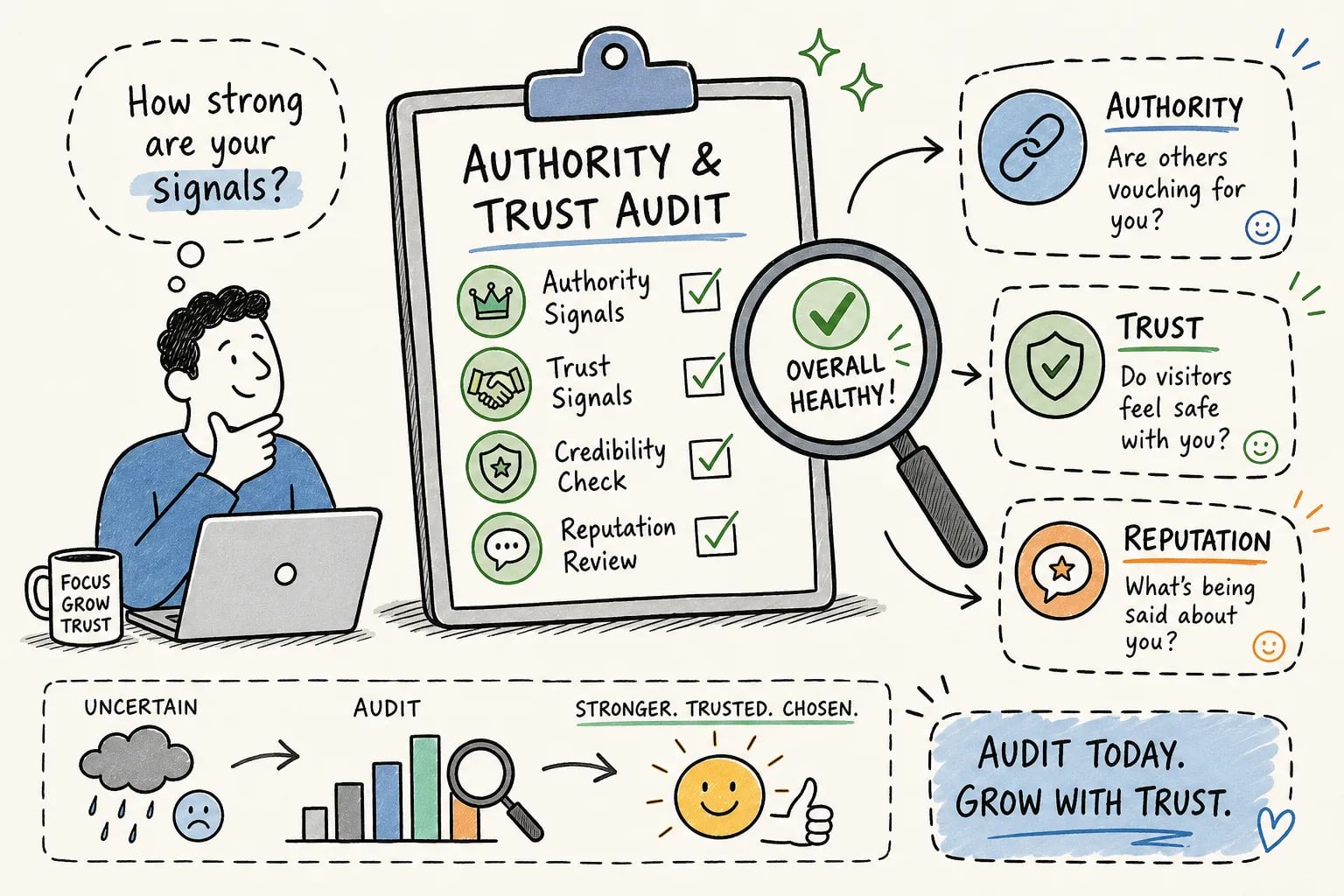
At TW3 Marketing, our authority audits repeatedly reveal gaps that business owners did not know were present. The pattern is consistent: business owners are surprised by what’s actually broken. They thought they were in good shape. The audit says otherwise. This guide exists to remove that surprise before it costs you leads.
What follows is a structured, area-by-area walkthrough of exactly what to check, what strong looks like versus weak, and what to fix first. If you’ve ever asked yourself how to audit your business’s online authority and trust signals, this is where you start.
What your authority audit is actually measuring
This isn’t a single-page checklist. An authority audit covers a bundle of signals that together tell customers, search engines, and AI platforms whether your business is worth trusting. Weakness in one area drags down the others. A business with great reviews and a broken website can still lose the trust battle when a skeptical visitor arrives on a slow, thin-content page.
The six areas that determine perceived authority are: reviews and social proof, website credibility, content expertise, citations and directory listings, off-site backlink signals, and AI search visibility. Each one is auditable right now with tools you already have access to. Our 100-point Authority Audit™ benchmarks all six in one pass using a structured scoring system built around the signals that actually move the needle, but this guide walks through each independently so you can start today.
The right audit mindset is simple: look at your business the way a skeptical stranger would. Not a loyal customer. Not your mom. A stranger who found you through a search and has thirty seconds to decide if you’re worth a phone call.
How to audit your business’s online authority: reviews and social proof
Reviews are the most visible trust signal for any service business. Before a stranger reads a single word on your website, they’ve already checked your star rating. Volume, recency, and platform spread all matter here, and each one tells a different part of the story.
Review volume, rating, detail, and recency should be evaluated against direct local competitors rather than universal thresholds. A smaller set of recent, specific reviews can be more persuasive than a larger set of vague or outdated reviews, but no fixed count or rating guarantees trust or visibility.
Platform spread is where most businesses have a real gap. Check your Google Business Profile first, then Yelp, Facebook, and any industry-specific platforms that serve your niche. A weak signal is all your reviews concentrated on one platform with no owner responses. A strong signal is a consistent presence across multiple platforms, with timely and professional replies that show a real person is paying attention. Pull your GBP Insights to see how many calls, direction requests, and profile views your listing is generating. That data tells you whether reviews are converting, not just decorating.
Checking website credibility and technical trust signals
Your website is the first place a skeptical visitor goes to verify you’re real. Most service business websites fail this test in at least two or three ways, and the owners have no idea.
On the on-page side, check for four things:
- An About page with real people, real names, and a genuine story. Generic marketing copy doesn’t count. If someone can’t tell who runs your business from reading your About page, rewrite it.
- Contact information that’s visible without hunting. Business name, phone number, address, and a branded email, not a Gmail address, in the header or footer.
- Author bios on any content pages. Named, credentialed, relevant to the topic. Anonymous content signals low authority to both humans and AI crawlers.
- A privacy policy and terms page linked from the footer. These aren’t optional; they’re basic transparency signals.
On the technical side, run through these checks:
- HTTPS. Confirm the site loads over a valid certificate and that HTTP redirects correctly to HTTPS. This is table stakes.
- Mobile usability. Run your key pages through Lighthouse, PageSpeed Insights, and real-device mobile testing and test them on an actual phone.
- Page speed. Run PageSpeed Insights on your homepage and top landing pages. Flag slow load times, oversized images, and render-blocking scripts.
- Structured data. Use Google’s Rich Results Test to check for Organization, LocalBusiness, or Person schema. Without it, AI systems need more inference to confirm who you are, which reduces the likelihood they’ll surface your business confidently.
Evaluating your content expertise signals
Content is where E-E-A-T, Experience, Expertise, Authoritativeness, Trustworthiness, either shows up clearly or doesn’t show up at all. For most service businesses, it doesn’t show up at all. The audit here is blunt: can a reader, or an AI crawler, tell who wrote this, why they’re qualified, and what evidence supports the claims?
Every substantive piece of content should have a named author with a visible bio that establishes credentials and experience. Thin content, short pages full of generic claims with no supporting specifics, reads as low-authority to both users and AI systems. “Industry-leading service” means nothing. A named technician with 18 years of HVAC experience explaining why certain systems fail in humid climates means something. That’s the difference between content that signals expertise and content that just fills space.
AI search systems specifically look for content that is extractable and verifiable. Are your statistics attributed to a named source? Are your claims specific rather than vague? Do your pages include enough context for someone, or something, to verify your expertise independently? Audit your top five content pages against these questions. If the answer is “no” more than a couple of times, you have a credibility gap that’s reducing your AI visibility.
Auditing citations and off-site authority signals
Off-site signals tell search engines and AI platforms that your business exists and that the details about it are consistent. Two pillars matter here: citation consistency and backlink quality.
NAP consistency, your business name, address, and phone number, must be identical across every directory. Google Business Profile, Yelp, Bing Places, Apple Maps, and any industry-specific directories all need to match. Inconsistencies, even small ones like “St.” versus “Street” or an outdated phone number, reduce entity trust for AI systems trying to confirm your business is real. A BrightLocal study found that roughly 73% of small businesses have some form of NAP inconsistency across major directories. Search your business name, scan the top ten results for listing accuracy, and use a tool like BrightLocal to automate the check across dozens of directories at once.
On backlinks, use Ahrefs (Domain Rating), Moz (Domain Authority), or Semrush (Authority Score) to assess your profile. Compare authority metrics with direct local competitors and track their direction over time. These third-party scores are relative indicators, not universal measures of trust or search performance. More important than the number is the quality of referring domains. One credible local or industry publication link outweighs fifty weak directory links. Also check your organic traffic trend in Google Search Console. Consistent growth is real-world evidence that search engines already trust the site.
Testing your AI search visibility
This is the newest and most overlooked dimension of an authority audit. Traditional SEO focuses on rankings. AI visibility is different. It’s about whether AI platforms can confidently surface your business when someone asks a question your business should answer.
AI systems ask four basic questions: Who are you? What proof do you show? Can I extract it cleanly? Can other sources confirm it? Audit your entity clarity first. Does your business name appear consistently across your site, social profiles, press mentions, and directories? Is there a clear, consistent description of what you do and who you serve? A business described differently across platforms, with different specialties or service areas listed in different places, sends a conflicting signal that reduces recommendation likelihood.
Next, check your structured data and machine-readable trust signals. Organization and LocalBusiness schema help AI systems confirm your entity with less guesswork. Key facts should appear in crawlable HTML, not embedded in JavaScript or image files. Also audit whether your service pages are specific enough to answer the exact questions AI systems are surfacing. Vague “we do everything” pages don’t get cited. Specific pages that answer specific questions do.
Walking through this audit yourself produces a useful snapshot. But without a scoring baseline, it’s hard to know whether a gap is minor or critical. Our 100-point Authority Audit™ benchmarks all six authority signals, positioning, proof, expertise, visibility, engagement, and experience, using a scoring framework built around what AI platforms actually use to recommend businesses. For owners who want a clear, prioritized roadmap rather than a DIY checklist, that kind of diagnostic eliminates the guesswork about what to fix first.
Set the baseline, then close the gaps
An authority audit isn’t a one-time event. It’s a baseline you set so you can measure improvement. The businesses showing up in AI recommendations, earning organic trust, and converting more visitors aren’t doing anything magic. They’ve closed the gaps that most businesses don’t even know exist.
Run through the six areas covered here: reviews, website credibility, content expertise, citations, off-site backlink signals, and AI visibility. Each one is auditable today with the right tools and the right benchmarks. If you want to know how to audit your business’s online authority and trust signals with a scored, structured picture of where you actually stand, reach out to our team at TW3 Marketing. The Authority Audit™ was built exactly for that conversation.
You can’t improve authority you haven’t measured. Start with what you can see today.
