
Improving your business authority score starts with identifying the trust signals that are helping or holding your business back. Domain metrics such as Moz Domain Authority or Ahrefs Domain Rating can provide useful context, but they do not tell the whole story. Reviews, demonstrated expertise, clear site structure, consistent business information, and credible third-party references all help people and digital systems understand whether your business is a trustworthy choice.
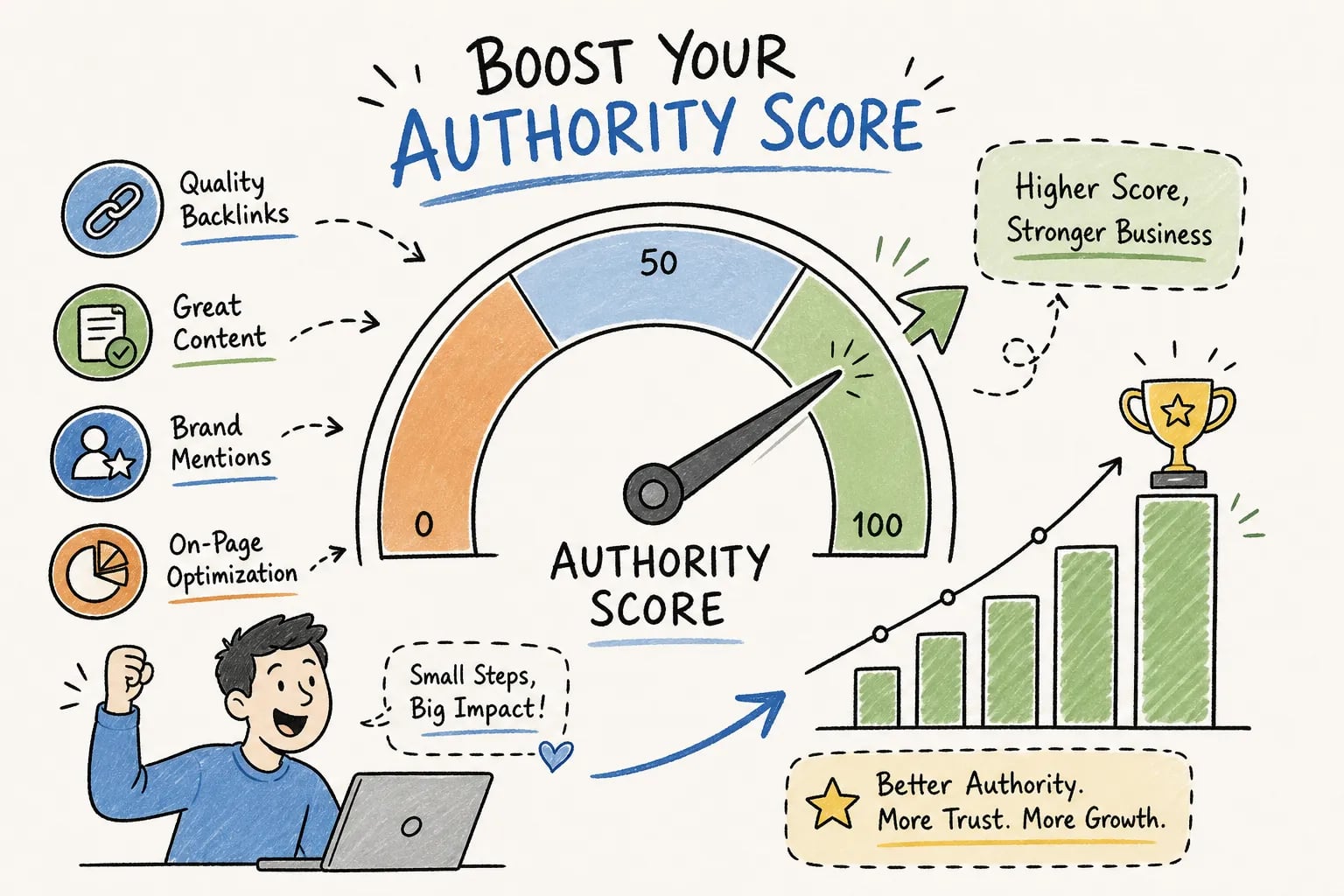
This article covers four core pillars: review signals, content expertise, AI-readable site structure, and citation consistency. By the end, you’ll have a prioritized, 90-day plan you can start executing this week, not someday when you have more time or budget.
How to Improve Your Business Authority Score in 2026, Start with an Audit
The most common authority-building mistake isn’t laziness. It’s starting with tactics before running a diagnosis. When you don’t know which signals are weakest, you end up spending months chasing backlinks or publishing content while the real problem sits untouched. In practice, most businesses that struggle to improve their authority score in 2026 are fixing the wrong things first.
Why guessing wastes months of effort
Picture a general contractor with solid how-to content and decent traffic who can’t figure out why competitors keep outranking them in local searches. The real issue: inconsistent citations across directories and zero schema markup on the site. The content isn’t the problem. The structural gaps are. Without a clear picture of where the authority score is actually leaking, that contractor could spend another year publishing articles that don’t move the needle.
What a proper authority audit actually measures
This is where the TW3 Marketing Authority Audit™ comes in. It evaluates six trust and authority signals across your digital presence: positioning, proof, expertise, visibility, engagement, and experience. Instead of guessing which tactic to try next, you get a clearer picture of which factors need attention first. That baseline helps you prioritize the work that is most relevant to your business.
Build a review system that compounds over time
Reviews are more than social proof. They provide current, third-party evidence of how customers experience a business. Review volume, recency, detail, and owner responses can help prospective customers evaluate credibility, while consistent review information gives search and AI systems additional context about the business. There is no universal review count or recency threshold, so compare your review profile with credible competitors in your market.
How Review Signals Help Improve Your Business Authority Score in 2026
Recent, detailed reviews on relevant platforms can help human visitors evaluate a business and give digital systems more corroborating information. Owner responses matter too because they show that the business is active and attentive. The goal is not to hit an invented threshold. It is to build a steady, ethical review process that reflects real customer experiences.
Where to collect reviews and how to ask consistently
For service businesses in 2026, Google Business Profile is the top priority by a wide margin. After that, focus on the industry-specific directories that matter in your vertical: Houzz and Angi for contractors, industry-specific platforms for insurance and home services. A straightforward system that practitioners consistently recommend: a post-job follow-up text, a short email sequence, and a direct review link that removes any friction. The goal isn’t a one-time push. It’s a steady drip that keeps recency signals strong month after month.
Create content that proves genuine expertise
Topical authority is one of the fastest-moving authority score factors right now. Content strategy research consistently shows that pillar-cluster systems outperform standalone long-form posts, especially when built around a tight, well-defined topic territory. A roofing company that covers storm damage repair, insurance claims, and material types in depth will consistently outperform one publishing broadly on “home improvement.”
The pillar-cluster structure that works in 2026
A useful pillar-cluster structure starts with one comprehensive page that answers the central buyer question, supported by focused articles covering related subtopics, comparisons, and common questions. Each supporting article should link naturally to the pillar, and the pillar should guide readers to the supporting material. The right length, number of articles, and publishing pace depend on the subject and the resources available. Completeness and usefulness matter more than an arbitrary word count.
Author credentials and expertise signals
E-E-A-T is not abstract. Add author bios with real credentials, link to professional licenses or certifications where applicable, and make sure every expert piece has a named human behind it. AI platforms that assess content quality look for signals that a real expert produced the work. A generic brand voice publishing content without any named author is a trust gap that’s easy to close and worth fixing early.
Structure your site so AI platforms can actually read it
A business website must work for human visitors while also making its information easy for search engines and other digital systems to interpret. Clear page structure, crawlable content, descriptive headings, accurate metadata, and consistent entity information reduce ambiguity. Technical barriers can prevent otherwise useful content from being discovered or understood.
Fix the technical blockers first
Start with crawl errors and 404s before anything else. Redirect chains, duplicate content, and sitemap hygiene come next. These blockers prevent even excellent content from being fully indexed and understood. After that, Core Web Vitals and page speed become the priority: faster sites can improve crawlability and indexing and send stronger quality signals to the AI systems assessing your site. Image optimization, reducing render-blocking scripts, and using a CDN are the highest-leverage fixes in that category.
Add structured data that tells AI who you are
Structured data can help search engines identify the entities and relationships represented on a page. Use the schema types that accurately match visible content, such as Organization or LocalBusiness, Service, Article, Person, and BreadcrumbList. Add FAQPage markup only when the same questions and answers are visible on the page. Schema improves clarity, but it does not guarantee rankings, citations, or inclusion in an AI-generated answer.
Fix citation consistency across every listing
Citation consistency means having the exact same business name, address, and phone number across every platform where your business appears. To a search engine or AI system cross-referencing business data, inconsistent listings look like separate entities. That fragmentation lowers confidence in your business as an authoritative, established presence and quietly works against every other tactic you’re executing.
Why conflicting listings quietly kill your authority score
A plumbing company listed as “Mike’s Plumbing LLC” on Google, “Mike’s Plumbing” on Yelp, and “Mikes Plumbing Services” on a contractor directory looks like three different businesses to an AI system. None of those versions gets the full trust signal that a single, consistent entity would receive. It’s a slow bleed on local authority that most businesses don’t even know is happening.
The platforms to audit first
Prioritize in this order: Google Business Profile, Bing Places, Apple Maps, Yelp, and the top industry-specific directories for your vertical. Use a citation audit tool to surface discrepancies, then correct them systematically. Treat NAP consistency the way you treat infrastructure maintenance: it doesn’t produce dramatic results overnight, but letting it slide actively undermines everything else you’re building.
Turn this into a 90-day authority improvement plan
Improving your business authority score in 2026 is not a campaign with a start and end date. It’s a compound process. The businesses seeing the fastest gains treat it as an ongoing operational system, not a one-time project they hand off and forget.
Set benchmarks against the businesses you actually compete with
Authority metrics are comparative indicators, not universal grades. Review your domain metrics, local visibility, content coverage, reviews, citations, and conversion evidence alongside credible competitors in the same market. A smaller local business can still outperform a national brand for relevant local searches when its service information, proximity, reviews, and local relevance better match the searcher’s needs.
How to Raise Your Authority Score in 2026, A Practical 90-Day Sequence
Month 1: Run the authority diagnostic, fix crawl blockers and 404 errors, and launch the review collection system.
Month 2: Publish your pillar page and the first batch of cluster articles, implement LocalBusiness and FAQPage schema, and begin citation cleanup across priority platforms.
Month 3: Build the first round of editorial backlinks from topically relevant referring domains, measure topical authority signals, and set a quarterly review cadence tracking Moz DA, Ahrefs DR, and Semrush Authority Score together. Running all three gives you the fullest picture, since each tool weights different inputs.
Start with what’s actually holding you back
Knowing how to improve your business authority score in 2026 isn’t about doing more. It’s about doing the right things in the right order. Review signals, content expertise, AI-readable structure, and citation consistency each reinforce the others. Execute them together with a clear sequence and the gains compound. Tackle them randomly and the results are slow and hard to interpret.
A diagnosis gives you a stronger starting point than a guess. The TW3 Marketing Authority Audit™ evaluates six trust and authority signals so you can see which areas deserve attention first and build a practical sequence for improving them.
Start with the free TW3 Marketing Authority Audit assessment. It helps you identify your current strengths and gaps before deciding which content, proof, visibility, or website improvements should come next.
