
Answer engine optimization for small businesses matters when buyers use AI tools to research local providers, compare services, and ask questions before making contact. Imagine a homeowner whose air conditioner stops working on a hot afternoon. She asks an AI assistant which HVAC companies serve her area. Several businesses may appear with short explanations. If yours is absent, you may never know that opportunity existed.
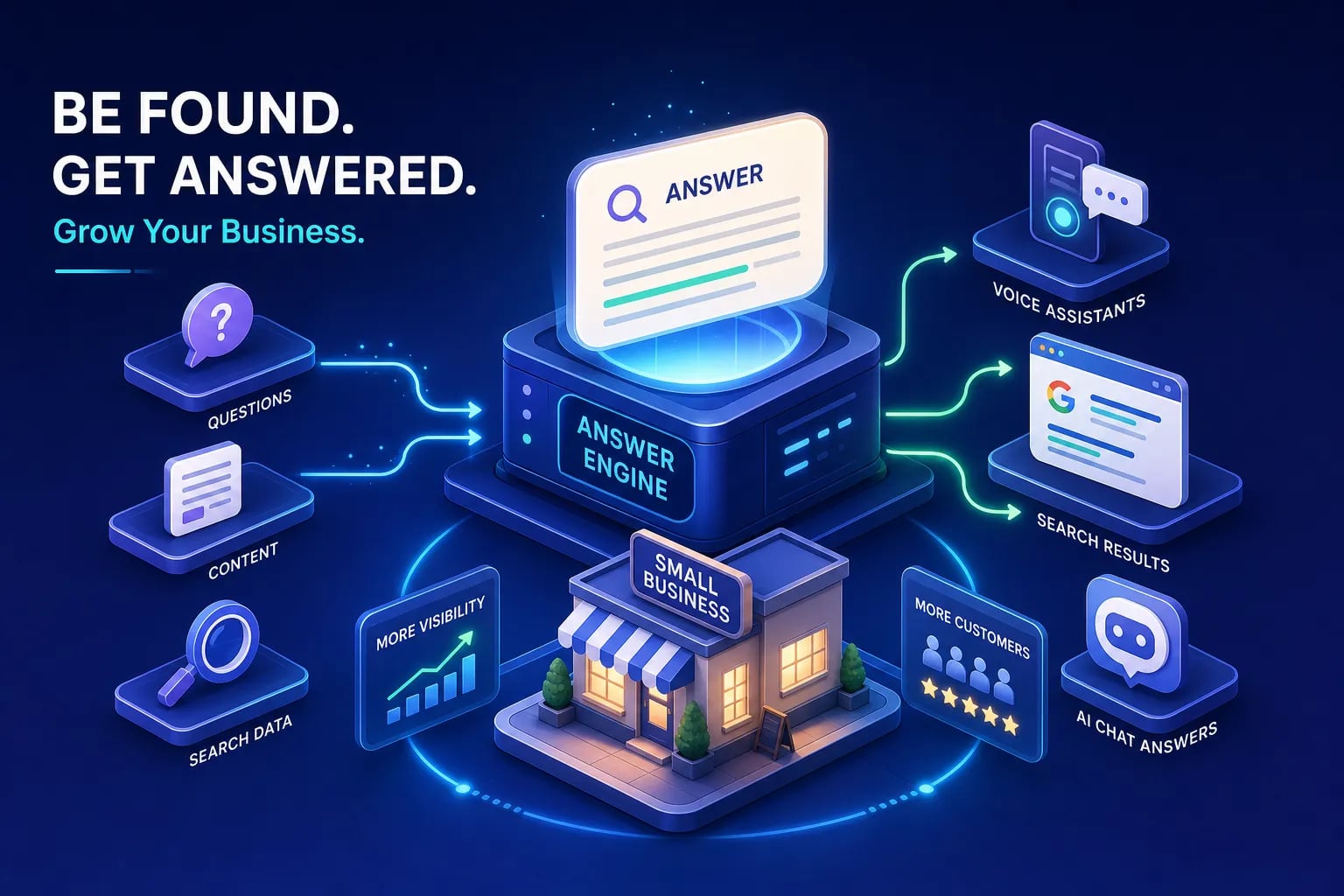
Answer engine optimization for small businesses is the practice of making your expertise, services, and trust signals easier for search and AI systems to understand and use when generating answers. AEO complements traditional SEO by emphasizing clear answers, consistent business information, credible evidence, and well-structured content. It can improve visibility, but no optimization can guarantee that a particular AI system will quote or recommend a business.
Across our work with service businesses, a recurring gap is not a single ranking trick. It is whether the business’s expertise, proof, identity, and service information are clear and consistent. This guide explains those signals and gives you a practical 30-day starting plan.
What answer engine optimization for small businesses means
AEO vs. traditional SEO: what’s actually different
Traditional SEO helps pages become discoverable in search results. AEO improves how clearly a page answers a question and how easily its supporting facts can be understood. Search and AI systems may use, summarize, or cite useful sources, but inclusion is not guaranteed. Your job is to publish accurate, well-supported information that is genuinely useful to the buyer.
Consider what changed between 2020 and 2026. A homeowner searching for a roofer in 2020 might click through ten websites before calling anyone. Today, that same person asks “What should I look for when hiring a roofer?” and the AI gives them a four-sentence answer, citing two or three sites by name. If your site isn’t structured to be quoted, you’re invisible in that moment.
How AI engines decide what to quote
AI systems scan content for direct, extractable answers. They favor pages that mirror the way people ask questions: a clear heading, a short direct answer right below it, and supporting detail after. This approach is sometimes called conversational search optimization or generative engine optimization (GEO), and it represents a real structural shift in how content needs to be written.
Pages that bury the main point make the reader work too hard. Put a concise answer immediately below a question-style heading, then add the qualifications, evidence, examples, and next steps the topic requires. There is no universal word count that guarantees extraction. The answer should be as short as it can be without becoming vague or misleading.
Why small service businesses are losing leads they don’t even know about
The invisible referral problem
Small business owners may never see the opportunities they miss when their business is absent from an AI-generated answer. There is no missed-call log that says an assistant did not mention you. That makes AI visibility worth measuring directly with a stable set of buyer questions rather than assuming that traditional rankings tell the entire story.
Customers in high-stakes, same-day situations, a broken furnace in January or a leaking roof after a storm, often ask AI before they search. If your business isn’t structured to be AI-discoverable, you’re simply not in that conversation. AI search optimization is replacing the traditional first-page click for a growing share of local queries, and that share is accelerating.
The trust gap AI is measuring
AI systems don’t pull random content. They pull from sources that look authoritative, consistent, and credible. A business with outdated hours on its Google Business Profile, inconsistent phone numbers across directories, and no structured content is sending weak signals. The AI interprets inconsistency as unreliability, and unreliable sources don’t get quoted.
Contrast that with a competitor who has a well-maintained profile, fresh reviews, and service pages built around real customer questions. The AI favors that business, not because it’s necessarily better, but because it’s clearer. That clarity is something you can build deliberately, and it’s more within your control than you might expect.
The local signals that tell AI whether to recommend your business
Your Google Business Profile is your AEO foundation
For many local service businesses, an accurate Google Business Profile is an important starting point for local visibility. Keep the primary category, services, hours, contact details, and description current. The profile gives Google structured information about the business, but maintaining it does not guarantee placement in an AI-generated recommendation.
“Complete” means more than filling in every field. It means your primary category is accurate, your service list uses the language your customers actually search, your hours are current, and your business description reads like an answer to “What does this company do?” A roofing company that lists “residential roof replacement” as a specific service is significantly more likely to appear when someone asks “Who does roof replacement near [city]?” than one that just says “roofing.”
NAP consistency and why it trips businesses up
NAP stands for name, address, and phone number. When these three details don’t match exactly across your website, GBP, Yelp, Angi, and other directories, AI systems treat it as an entity mismatch. The AI isn’t sure you’re the same business everywhere, so it loses confidence in citing you at all.
The most common errors are small ones: “Street” vs. “St.,” a suite number listed differently, or a tracking phone number that differs from your main line. These feel insignificant, but they fragment your authority signals. A deliberate NAP audit across your top 10 to 15 directory listings can fix this problem in a single afternoon. The payoff: citation signals from trusted local directories reinforce your identity to AI systems the same way references reinforce credibility for a job applicant.
How to write content AI can actually quote
The answer-first content structure
Most service business websites are written like brochures: company history up front, vague service descriptions, and a “contact us” button. AEO requires a different structure entirely. Each page should open with the direct answer to the question it’s meant to serve, then support that answer with specifics.
An HVAC company’s “AC Tune-Up” page should answer “What does an AC tune-up include?” in the first two sentences. A roofing company’s storm damage page should answer “What does storm damage roof repair cost?” before anything else. The heading above the answer should read like a question your customer would actually type. This structure improves AI extractability and tends to lift conversion rates with human readers as well.
Schema markup: three types that move the needle for service businesses
Schema markup labels the entities and relationships represented by visible content. For a service business, relevant types may include Organization or LocalBusiness, Service, Article, Person, and BreadcrumbList. Use FAQPage only when the same questions and answers are visible on the page. Structured data improves clarity, but it does not verify a business or guarantee rankings, citations, or recommendations.
You don’t need to code this manually. Most website platforms have plugins or built-in fields that generate schema automatically. The key is applying each type to the right pages: FAQPage schema on pages with Q&A content, LocalBusiness schema sitewide or on your homepage, and Service schema on individual service pages. Getting these three in place puts you ahead of the majority of small service businesses in your market.
A beginner-friendly 30-day AEO action plan
Days 1 through 15: fix your foundation first
The first two weeks are about getting your fundamentals right before building anything on top of them. Start by compiling a list of 10 to 20 questions your customers ask right before they hire someone, pricing questions, comparison questions, timeline questions, and “what’s included” questions. Then test those exact prompts in ChatGPT and Google AI to see what comes back and whether your business appears anywhere in the results.
From there, correct inconsistent business information and update your Google Business Profile with accurate categories, services, hours, and a clear description. Then improve the priority service pages so they open with direct answers to real buyer questions. Add a FAQ only when it helps visitors and the answers can be supported. These steps create a stronger foundation for both search visibility and AI readability.
Days 16 through 30: build the signals AI trusts
The second half of the plan shifts from content to credibility. Add FAQPage and LocalBusiness schema to your priority pages using your website platform’s schema plugin or a free generator. Then focus on review generation: ask recent customers directly, respond to every existing review (positive and negative), and secure two or three citations in local or industry directories you aren’t listed in yet.
On days 26 through 30, re-run the same AI prompts from day one and compare. Note whether your brand appears, whether the facts are accurate, and which pages are being cited. Keep what improved, refine what didn’t. This isn’t a one-time fix; it’s a measurement habit. Businesses that track their AI visibility consistently are the ones that stay in the results as AI tools continue to evolve.
How to find out where you stand right now
You can’t fix what you can’t measure
The biggest mistake small business owners make with AEO is starting without a baseline. Before you rewrite a single page or update a single listing, you need to know how your business currently appears in AI-generated answers. That means testing your brand in the tools your customers use, checking whether your content is being cited, and understanding which authority signals are strong versus which are dragging you down.
Without that picture, every action you take is a guess. Some businesses find they’re already being cited but with incorrect information. Others discover a competitor is being recommended using details scraped from their own website. You need the baseline before the strategy.
Start with the TW3 Marketing Authority Audit assessment
The free TW3 Marketing Authority Audit assessment helps you identify strengths and gaps across positioning, proof, expertise, visibility, engagement, and experience. It provides a useful baseline before you decide which website, content, review, or visibility improvements should come next.
If you are a contractor, advisor, or other service business trying to understand why competitors appear more often, the assessment gives you a concrete baseline. Start the free TW3 Marketing Authority Audit assessment and build your AEO plan from observed strengths and gaps rather than assumptions.
The shift is already happening
AEO reflects a broader change in how some customers research and compare service businesses. Traditional search still matters, but businesses should also make their expertise and service information clear enough to work in answer-driven experiences. The practical response is to strengthen the same fundamentals that help people evaluate trust.
The businesses winning in AI search aren’t necessarily the biggest or the longest-established. They’re the ones that structured their content clearly, kept their local signals consistent, and made it easy for AI to trust and quote them. That’s achievable for any service business willing to spend 30 focused days on the fundamentals.
Use this beginner guide to answer engine optimization for small business as your blueprint: fix your foundation, build your content, and measure what shifts. The businesses showing up in AI answers today started exactly where you are now. They just started.
