
Answer engine SEO is already changing how customers find local service businesses, and most companies haven’t caught up yet. A homeowner pulls out their phone and asks ChatGPT which HVAC company to call for a broken furnace. Thirty seconds later, they have a name, a phone number, and a reason to trust that business. They never opened a browser tab, never saw a search results page, and never considered your company, even if you rank on page one of Google. That scenario can happen today, and zero-click AI answer behavior is becoming more common across high-consideration service categories.
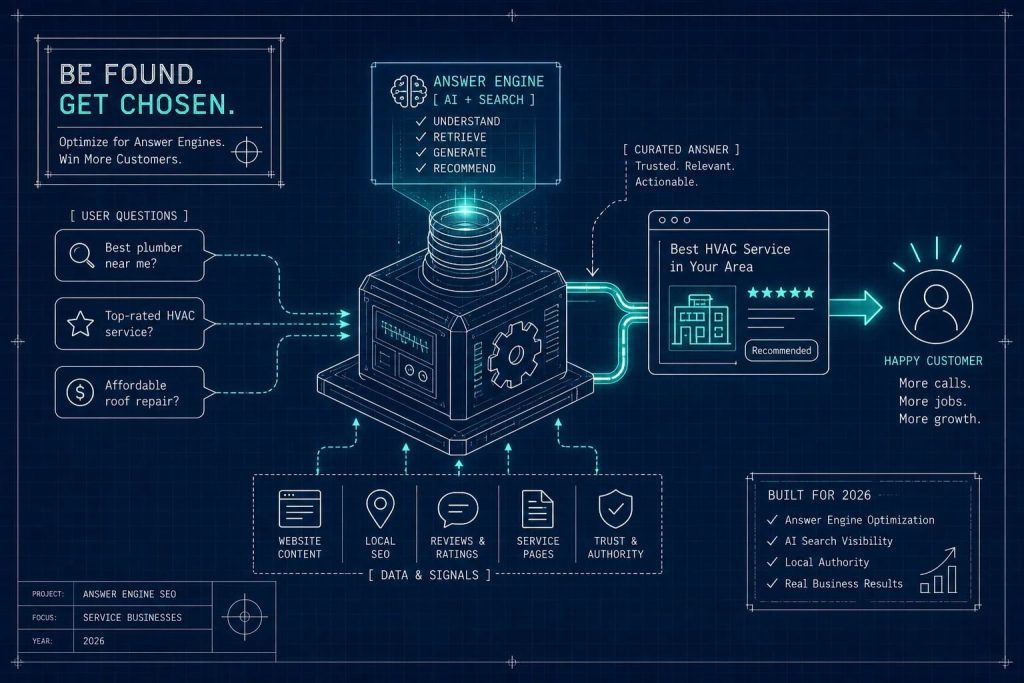
That’s the core problem answer engine SEO is built to solve. Traditional search optimization helps customers find your page. Answer engine optimization (AEO) determines whether AI systems use your page to answer the question outright. At TW3 Marketing, we’ve observed a recurring gap across service business audits conducted in 2026: businesses with solid Google rankings are often still invisible inside AI-generated responses. This appears to stem from structural and authority signal gaps that traditional SEO work simply doesn’t address.
By the end of this article, you’ll understand what AEO is, how it differs from what you’ve been doing, and where to focus first if you want your business to be the one AI recommends instead of skips.
What “answer engine SEO” actually means
The shift from ranking pages to being the answer
Traditional SEO is about earning a position in a ranked list of results. The user then decides whether to click your link. Answer engine SEO works differently: the AI decides whether to cite you, and the user often never sees any other options. When ChatGPT or Google AI Overviews surfaces a response, it may name only one or two sources before a user moves on. If that isn’t you, a competitor fills the slot.
AEO structures content so AI systems can extract, trust, and surface it as the direct response to a query. That’s a fundamentally different design goal than writing content to capture keyword rankings, and it requires a different approach to what you publish and how you structure it. Optimizing for AI answers means rethinking both content format and the authority signals that surround your site.
Which platforms make up the answer engine landscape in 2026
The platforms that matter most right now are ChatGPT, Perplexity, Google AI Overviews, and voice assistants. Each has its own sourcing logic. Google AI Overviews pulls from indexed content and structured data signals. When browsing is available, tools such as ChatGPT and Perplexity may consult and cite current web sources. Their sourcing behavior varies by product, query, and configuration.
What all of these platforms share is a common requirement: they need content that is structured clearly enough to parse, credible enough to cite, and specific enough to answer a real question. If your content doesn’t meet that bar, the AI moves to a source that does.
How answer engine SEO differs from traditional SEO
Different goals, different success metrics
SEO success looks like higher rankings, stronger impressions, and better click-through rates. AEO success looks different: citation rate, brand mentions inside AI-generated answers, AI share of voice, and sessions arriving from tools like ChatGPT and Perplexity. Neither set of metrics replaces the other, but confusing them leads to wasted effort.
A business can sit in position three on Google and still never appear in a single AI-generated response. That happens because traditional search and AI answer systems evaluate different signals. SEO rewards topical breadth, backlink equity, and keyword relevance. AEO rewards extractability, entity clarity, and structured proof signals. Measuring only the first set leaves you blind to the second.
What changes for content strategy
SEO has long rewarded comprehensive coverage and high word counts. AEO rewards tight, extractable answer blocks. Direct answers should be concise and complete, H2 and H3 headings should frame real user questions, and FAQ sections should be built for human usefulness as well as machine readability. This is the essence of zero-click answer optimization: make the answer so clear and accessible that an AI can lift it directly.
The practical difference shows up at the paragraph level. A generic section that wanders through several loosely connected points gets skipped by an AI system. A section that opens with a direct answer to a specific question, backs it up in two or three supporting sentences, and stops there is far more likely to be cited. Same information, different structure, very different outcome.
Why service businesses are losing leads to AI right now
The local search behavior shift that’s already underway
Customers in high-consideration service categories, including HVAC, insurance, roofing, and plumbing, are increasingly asking AI assistants “who should I call” instead of scrolling through search results. Broader AI search adoption trends support this direction, even if category-specific query data is still emerging. When AI answers that question, it typically names one or two businesses. If yours isn’t among them, a competitor gets the lead, and the customer rarely looks further.
This isn’t only a future consideration. Vendor-published AEO case studies describe improved visibility and lead activity after answer engine optimization work. Those examples are directional rather than independent proof or a guarantee of results, but they make the shift worth monitoring and measuring.
What AI systems evaluate when choosing a source
AI systems don’t select sources by keyword density or domain authority alone. They evaluate content across several dimensions. Extractability matters: is the content structured so they can pull a clean answer? Entity clarity matters: does Google understand who you are and what you do? Trust signals matter: do other credible sources reference your business? Each of these is a solvable problem once you know it exists.
For local service businesses, entity clarity is particularly important. Clear, consistent business information across directories, credible third-party reviews, and accurate service-area content can make a business easier for search and AI systems to identify and verify. The AI isn’t judging who is best; it’s selecting whoever is most discoverable and verifiable.
Content and technical moves that earn AI citations
Writing patterns that AI systems consistently extract
The content formats that surface most consistently in AI answers are question-led headings, answer-first openings, FAQ blocks, step-by-step guides, and short definition paragraphs for “what is” queries. These formats work because they map directly to how AI systems synthesize responses: find a question, find a clear answer, cite the source.
A practical example makes this concrete. Instead of opening a section with “There are many factors that affect HVAC installation cost,” open it with “HVAC installation cost varies based on system size and home square footage, your contractor can give you a project-specific range after an in-home assessment.” The second version is extractable and accurate without committing to figures that shift by region and year. That distinction, applied consistently across every section of every page, separates content that gets cited from content that gets passed over.
Schema markup for AI: signaling relevance to answer engines
Structured data doesn’t guarantee AI citations, but schema markup for AI readability improves machine parsing and entity clarity enough to move the needle. For service businesses, the most relevant schema types are LocalBusiness, FAQPage, HowTo, and Organization. LocalBusiness markup should include your name, address, phone number, service area, hours, and aggregateRating where you have verified reviews. Where FAQPage markup is appropriate, it should match visible answers to questions customers actually ask, such as pricing, service area, availability, licensing, and the booking process.
Here’s a minimal LocalBusiness JSON-LD example to illustrate the structure:
{
  "@context": "https://schema.org",
  "@type": "LocalBusiness",
  "name": "Your Company Name",
  "address": {
    "@type": "PostalAddress",
    "streetAddress": "123 Main St",
    "addressLocality": "Your City",
    "addressRegion": "TX",
    "postalCode": "75001"
  },
  "telephone": "+1-555-000-0000",
  "areaServed": "Dallas Metro",
  "aggregateRating": {
    "@type": "AggregateRating",
    "ratingValue": "4.8",
    "reviewCount": "142"
  }
}
A minimal FAQPage block follows the same pattern, wrapping each question-answer pair in mainEntity items. JSON-LD is Google’s preferred format for structured data, so implement your schema there rather than inline Microdata. The goal isn’t to game the algorithm; it’s to reduce ambiguity so AI systems can classify your business correctly and match it to relevant queries.
The entity and authority signals that matter alongside content
Entity clarity goes beyond your website. Does your business appear in Google’s Knowledge Graph? Are you cited by industry directories, local news sources, or trade publications? These external signals help AI systems confirm that your business is real, relevant, and trustworthy enough to recommend.
For most service businesses, the gaps here are more significant than the content gaps. A well-structured website that no one else references still looks thin to an AI system scanning for corroboration. Building a consistent, credible presence across third-party platforms matters as much as what you publish on your own site.
How to tell if your AEO efforts are working
The metrics that reflect AI visibility
Google Search Console won’t tell you how often your brand appears in AI-generated answers, that data simply isn’t surfaced there yet. Tracking AEO performance requires a separate measurement layer. The core metrics are:
- AI citation rate: how often your brand appears in AI responses to relevant prompts
- AI referral sessions: traffic arriving directly from ChatGPT and Perplexity
- Branded search lift: as AI mentions grow, direct brand searches tend to rise alongside them
- AI share of voice: how your citation rate compares to competitors across tracked prompts
Tools like Otterly.AI, AIclicks, and Semrush’s AI Visibility module make this trackable for small service businesses without enterprise-level budgets. Note that each tool tracks different things: some measure citation frequency, while others focus on referral traffic attribution. The most useful practice is tracking a fixed set of high-intent prompts monthly, things like “best HVAC company in [city]” or “licensed plumber near [neighborhood]”, and watching how your citation rate changes over time.
How does answer engine SEO affect local leads?
Attribution from AI channels is still developing, but a practical approach works well enough. Use UTM parameters where possible, add CRM source fields to capture how leads found you, and track which content assets are generating the most AI citations. Revenue impact from AI visibility tends to lag the visibility metrics by several months, so don’t expect immediate correlation.
Think of AI citation rate as a leading indicator and booked revenue as the lagging one. If your citation rate is rising and your branded search volume is climbing, revenue tends to follow.
Where most service businesses should actually start
The readiness gap most businesses don’t know they have
Most service business websites were built to rank on Google and look professional to humans. Those are different design requirements than being cited by an AI. The signals AI systems use to evaluate a source, structured content, entity clarity, demonstrable expertise, and consistent proof signals, are usually absent from a site optimized only for traditional search.
Before investing time in schema markup or content restructuring, the higher-leverage move is to understand what your current AI presence actually looks like. Which signals are working? Which are missing entirely? Without that baseline, you’re guessing at which fixes will move the needle.
What diagnosing your answer engine readiness actually involves
A genuine readiness assessment covers how your business currently appears in AI-generated responses, which authority signals are already in place, and what the highest-priority fixes are given your current position. TW3 Marketing’s TW3 Marketing Authority Audit™ is a 100-point diagnostic that scores your positioning, proof, expertise, visibility, engagement, and experience, six signal categories used to diagnose authority and visibility gaps. It applies the TW3 Marketing Authority Framework™ for closing the gap between where you rank today and where AI systems choose to send customers.
The audit gives you a clear picture of where you stand before any tactical work begins. That matters because the highest-ROI fix for one business often isn’t the same as for another. Some need structured content overhauls. Others need entity consolidation. Others need review signals built from the ground up. You won’t know which category you’re in without looking first.
The compounding advantage of getting this right in 2026
The question isn’t whether AI is changing how customers find service businesses. That’s already settled. The question is whether your business is positioned to be the answer AI gives, or the one it skips over. Answer engine SEO isn’t a replacement for traditional SEO; it’s a layer on top of it that requires different content structures, different trust signals, and a different way of measuring success. AI search optimization rewards businesses that invest in these signals early, before competitors lock in authority.
Every AI citation reinforces entity authority. Every entity authority signal makes the next citation more likely. That compounding dynamic, documented across multiple vendor case studies, though independent causal research is still limited, doesn’t kick in until the foundational gaps are addressed, which is why the starting point matters more than the individual tactics. Businesses that build this foundation now will hold an advantage that grows as AI search continues to displace traditional results. The window to establish that authority before your market gets crowded is open today and narrowing.
If you want to know exactly where your business stands, reach out to the TW3 Marketing team to request your TW3 Marketing Authority Audit™. The diagnostic uses the Authority Score™ to identify your highest-priority gaps and provide a prioritized roadmap, so your next move is clear rather than a guess.
