
Business authority ranking determines whether AI platforms will recommend your company when a potential customer asks for the best option in your area. You may have a decent Google ranking, solid reviews, and active ad campaigns, but when someone in your city opens ChatGPT and asks for the best HVAC company nearby, your business doesn’t come up. Your competitor does. The problem isn’t your marketing budget. It’s your authority ranking across the signals that AI platforms actually read. Based on diagnostic work across service businesses at TW3 Marketing, this gap shows up repeatedly, and closing it requires a more complete picture of authority than most business owners have.
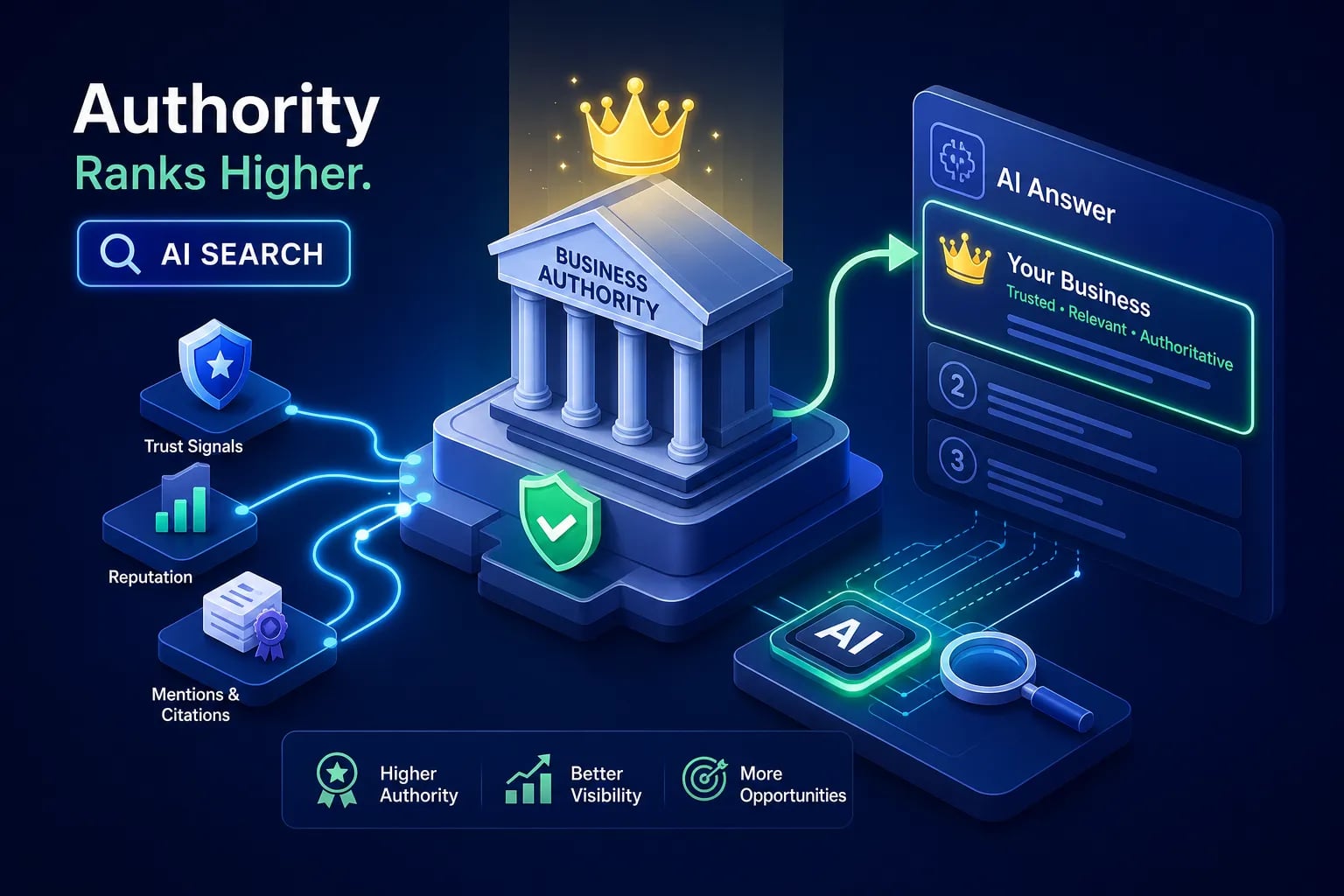
Business authority ranking, in the context of AI-driven search, is a composite measure of how credible, trustworthy, and expert your business appears across every signal that AI platforms synthesize before making a recommendation. That definition is meaningfully broader than a Moz Domain Authority score or a backlink count. A single number without context tells you almost nothing about what to fix or where to start.
What “business authority ranking” actually means today
Most business owners, when they hear “authority score,” think of third-party metrics: Moz Domain Authority (DA), Ahrefs Domain Rating (DR), and Semrush Authority Score. Each scores on a 0, 100 scale and measures something slightly different. DA uses a machine-learning model to predict ranking likelihood based on backlink profile and linking root domains. DR measures the strength of referring domains pointing to your site. Semrush Authority Score goes slightly broader by blending backlinks with organic traffic signals and spam detection. These are useful competitive benchmarks, but Google does not use any of these vendor scores in its ranking algorithm. They measure one piece of authority, not the whole picture.
In 2026, authority ranking means something much larger. It is the combined weight of every signal that tells an AI platform your business is the safe, expert, trustworthy choice to recommend. According to Google’s E-E-A-T guidance and research on how AI systems synthesize web signals, that includes experience, expertise, authoritativeness, and trustworthiness signals, brand mentions across the web, structured content, local SEO citations, review signals, and demonstrated topical expertise. DA and DR capture almost none of that.
How authority is measured, and where the gaps are
Backlinks and domain authority benchmarks
For local service businesses, backlink benchmarks are more accessible than many owners assume. Based on 2026 local SEO benchmark data, a local business sitting at DA or DR 20, 35 can compete well in most local markets, especially when proximity signals, Google Business Profile completeness, and citation consistency are strong. The competitive range for local small businesses sits roughly between DA/DR 25, 35. That’s a directional read on one dimension of your business authority ranking, specifically backlinks, and backlinks alone.
E-E-A-T and trust signals
The signals these tools miss are exactly the ones AI platforms weight most heavily. Domain authority does not measure whether your content demonstrates real expertise. It doesn’t capture whether your reviews signal consistent quality, whether AI systems can parse your positioning from your website, or whether your brand appears in authoritative third-party sources. These trust signals and E-E-A-T factors carry significant weight in AI recommendations. Research on AI signal synthesis shows that a lower-DR business with stronger E-E-A-T signals and a well-structured, citation-rich authority profile can outperform a higher-DR competitor in AI-generated recommendations, the backlink metric alone doesn’t decide the outcome.
Why your business authority ranking controls AI recommendations
AI search systems, including ChatGPT, Google AI Overviews, and voice assistants, often synthesize multiple sources rather than returning a traditional ranked list of pages. They look for corroboration: does this business appear consistently across directories and citations? Do authoritative sources mention it? Does its content demonstrate genuine expertise? Does review volume and sentiment hold up? A business that passes enough of those checks earns the recommendation. One that fails most of them gets skipped, regardless of ad spend.
The organic authority data behind this is concrete. Documented case studies show authority metric growth from DR 7 to 26 correlating with a 2,833% traffic increase and top-ranking positions for multiple target queries within five months. A separate B2B case showed a rise from DR 18 to 31 producing a 240% organic traffic increase over six months, with top-three keyword rankings more than quadrupling. These results reflect organic authority gains, and the E-E-A-T and citation signals that drove those outcomes are the same ones AI platforms use when deciding who to surface in an answer. Many of the businesses showing up in AI answers today improved their authority profiles systematically rather than relying on increased ad spend.
How to improve your business authority ranking
Moving from a score to an action plan
Knowing your DA or DR tells you your backlink competitive position. It doesn’t tell you which of your authority signals are weak, what competitors have that you don’t, or where to spend the next 90 days to move the needle with AI platforms. That gap between “I have a score” and “I know what to fix” is where most service businesses stall. They run the free tool, see a number, and have no clear direction on what action that number calls for.
TW3 Marketing Authority Audit™ is a proprietary 100-point diagnostic built specifically around the signals AI platforms use to decide who to recommend. It scores your business across six dimensions: positioning, proof, expertise, visibility, engagement, and experience. Each dimension is weighted and benchmarked against real competitors in your market. The output isn’t a single number, it’s a prioritized action list that tells you exactly which authority gaps to close first and why. If you want to know where your business authority ranking actually stands across all six dimensions, request your audit directly from our team.
The authority gap won’t close on its own
Business authority ranking in 2026 is not a single metric from an SEO tool. It’s the sum of every signal that tells AI platforms and customers your business is the credible, expert choice worth recommending. DA and DR are useful reference points, but they are not the full picture. Service businesses getting recommended by ChatGPT and Google AI today invested in closing authority gaps across all six dimensions, not just backlinks.
Start by knowing your actual authority ranking across all the signals that matter. From there, the path to stronger AI visibility becomes concrete and repeatable. The businesses that act on this now will be hardest to displace once AI search becomes the default way customers find and choose a service provider. That shift isn’t approaching. It’s already underway.
