
A homeowner opens ChatGPT and types: “Who’s the best HVAC company near me?” Within seconds, they get a short list of specific business names. One of them is your competitor, and yours isn’t mentioned anywhere in the response. That’s AI local search in action, and it’s already changing how customers in every service category decide who to call.
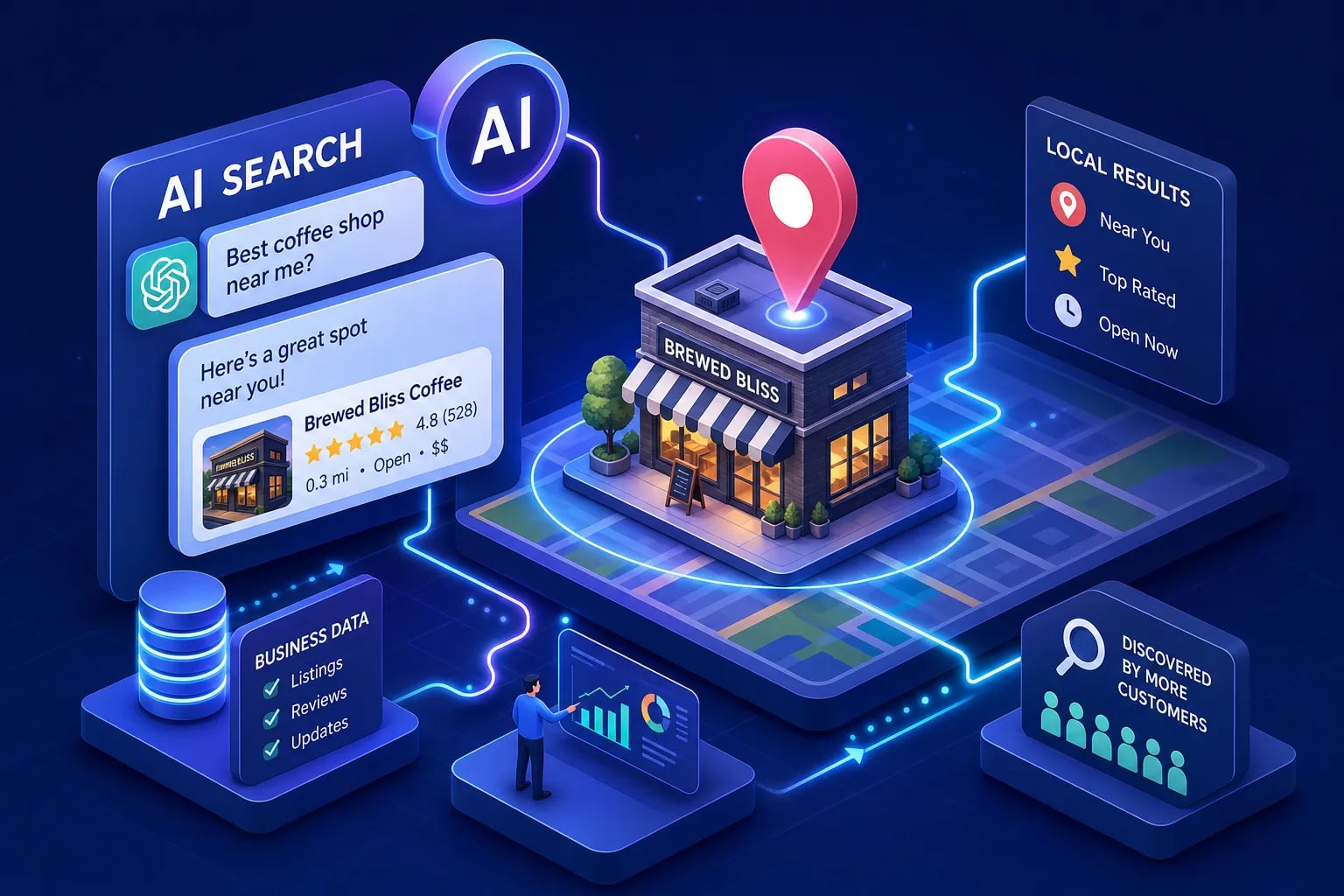
This scenario plays out thousands of times a day across the U.S., and it represents a genuine shift in how customers find local service businesses. AI local search doesn’t work like scanning ten blue links and picking the first result. ChatGPT and Google AI make the judgment call for the customer, naming specific businesses with the confidence of a trusted referral. The criteria for getting named are different from what earns a top Google ranking, and many businesses haven’t yet adapted to that reality.
The businesses that get recommended aren’t always the biggest or the longest-established. They’re the ones whose digital presence gives AI platforms enough structured, credible information to surface them confidently. Think of it like a neighborhood search or stochastic local search algorithm: the system keeps scanning available options, refining based on entity signals, until it lands on the most authoritative match. Businesses that show up clearly across multiple credible sources are the ones that clear that threshold.
From rankings to recommendations: what actually changed
Traditional search returns a list of results that users evaluate and click through. AI search makes the judgment call upfront, surfacing specific businesses by name in a response that reads like advice from someone who already did the research. That shift from visibility to credibility changes what winning local search actually means.
A business can hold a top position in Google Maps and still be completely absent from AI-generated answers if its website doesn’t clearly communicate what it does, who it serves, and why it’s trustworthy. Traditional local SEO focused on proximity, keyword density, Google Business Profile completeness, and backlinks. AI platforms factor all of that in, but they also weigh specific authority signals, third-party citations, schema consistency, review patterns, and topical depth, to assess whether a business is worth recommending. Thin websites, inconsistent business information, and generic content all send the same signal to AI: skip this one.
What ChatGPT is actually reading before it names a business
ChatGPT draws from indexed web content, websites, reviews, directories, and published articles, using live web retrieval to synthesize a response. It looks for businesses with coherent, clearly structured digital presences that consistently signal expertise and location. Businesses that are easy for AI to interpret are far more likely to be named than those with vague, thin, or contradictory content.
The businesses ChatGPT recommends tend to have a strong entity footprint. Their name, location, services, and areas of expertise appear consistently across multiple credible sources, not just their own website. A business that exists clearly only on its own domain is easy for AI to overlook. Review signals matter here too: volume, recency, and consistent patterns across platforms all help AI systems confirm that real customers have trusted this business, and understand what it actually does well.
How AI local search reads your service pages
Google’s traditional local pack surfaces results based on proximity, relevance, and profile completeness. Google AI Overviews work differently: they synthesize content from across the web to generate a response, pulling from websites that clearly demonstrate expertise on a topic. A business in the local pack isn’t automatically included in an AI Overview. Google AI is looking for trustworthy, well-structured information, not just a verified business profile.
Google AI places particular weight on E-E-A-T signals: experience, expertise, authoritativeness, and trustworthiness. That means detailed service pages, demonstrated credentials, real customer proof, and content that reads like it was written by someone who actually does the work. Generic content and thin websites rarely clear this threshold, even after years of traditional SEO investment.
When evaluating a service page, AI systems essentially run a local optimization pass, much like a metaheuristic evaluating candidate solutions. If the page clearly defines the service, the geography, the credentials, and the customer proof, the system has enough to work with. If any of those signals are missing or inconsistent, the algorithm moves on to a better-defined option.
AI local search signals: reviews, schema, and authority
If a website doesn’t clearly state what services it offers, where it operates, who it serves, and what qualifies it to do the work, AI systems fill those gaps with uncertainty, and uncertainty usually means looking elsewhere.
Schema and structured data
Schema markup is one of the most direct ways to communicate business identity to AI systems. A properly implemented JSON-LD block for a local service business should include @type: LocalBusiness, service area, business name, address, phone number, and relevant service types. Consistent NAP data (name, address, phone) across the web reinforces that signal and helps AI build an accurate picture of a business quickly.
Review signals
Reviews, case studies, before-and-after content, and specific project examples all strengthen the expertise signal AI platforms use when deciding whether a business is worth recommending. According to Rio SEO’s 2025 local search data, AI Overviews appeared in roughly 68% of local queries, and direction requests from AI-assisted searches rose 6.4% year over year even as website click-through rates declined. Customers are increasingly making decisions inside the AI answer itself, then calling or navigating directly, which means being absent from that answer significantly reduces your chances of getting the call.
Service-page architecture
Each core service should have its own dedicated page, not a paragraph buried in a general “Services” overview. Those pages should name the service clearly, define the service area, explain the process, include credentials or certifications, and feature specific customer outcomes. That level of structure gives AI systems the detail they need for confident retrieval.
How to make your business readable to AI platforms
Start by auditing how your business currently appears when someone asks ChatGPT or Google AI a question about your service area. Ask it yourself, use prompts like “Who’s the best [service] company in [city]?” or “Which [trade] contractors do you recommend near [zip code]?” If your name doesn’t come up, that’s the gap to close. From there, tighten your service content, reinforce your entity signals across the web, and make sure your site architecture gives AI a clear, confident picture of who you are and what you do.
TW3 Marketing’s AI Website Optimization service is built specifically for this problem. It restructures websites so that AI systems, including ChatGPT and Google AI, can clearly interpret a business’s expertise, location, and authority rather than guessing or skipping over it. The service addresses the structural gaps that cause businesses to be overlooked: unclear service-page architecture, missing entity signals, inconsistent off-site information, and content that doesn’t communicate genuine expertise. TW3 Marketing Authority Audit™ identifies exactly where those gaps are and what to fix first, so there’s no guesswork about where to start.
AI local search is already deciding who gets the call
AI local search isn’t a future concern. It’s already changing how customers decide which businesses to call, hire, and trust. Rather than producing a ranked list for users to evaluate, ChatGPT and Google AI synthesize available signals and recommend, and they recommend businesses that have given them enough structured, authoritative information to do so with confidence.
If your business isn’t showing up in AI-generated answers, the problem usually isn’t your reputation. It’s that your digital presence isn’t structured in a way AI platforms can easily read and trust. Fortunately, that’s a structural fix, starting with understanding what AI is actually looking for across your website, your reviews, and your off-site presence, then making sure all three tell the same clear, credible story. Reach out to the TW3 Marketing team to find out where your authority gaps are and what to do about them.
