
HVAC contractor marketing fails most often not because of the wrong ad channel, but because contractors are buying traffic before they’ve earned trust. Running ads on a weak digital foundation is like cranking up the thermostat when the system isn’t working. You’re spending money, but nothing’s actually moving.
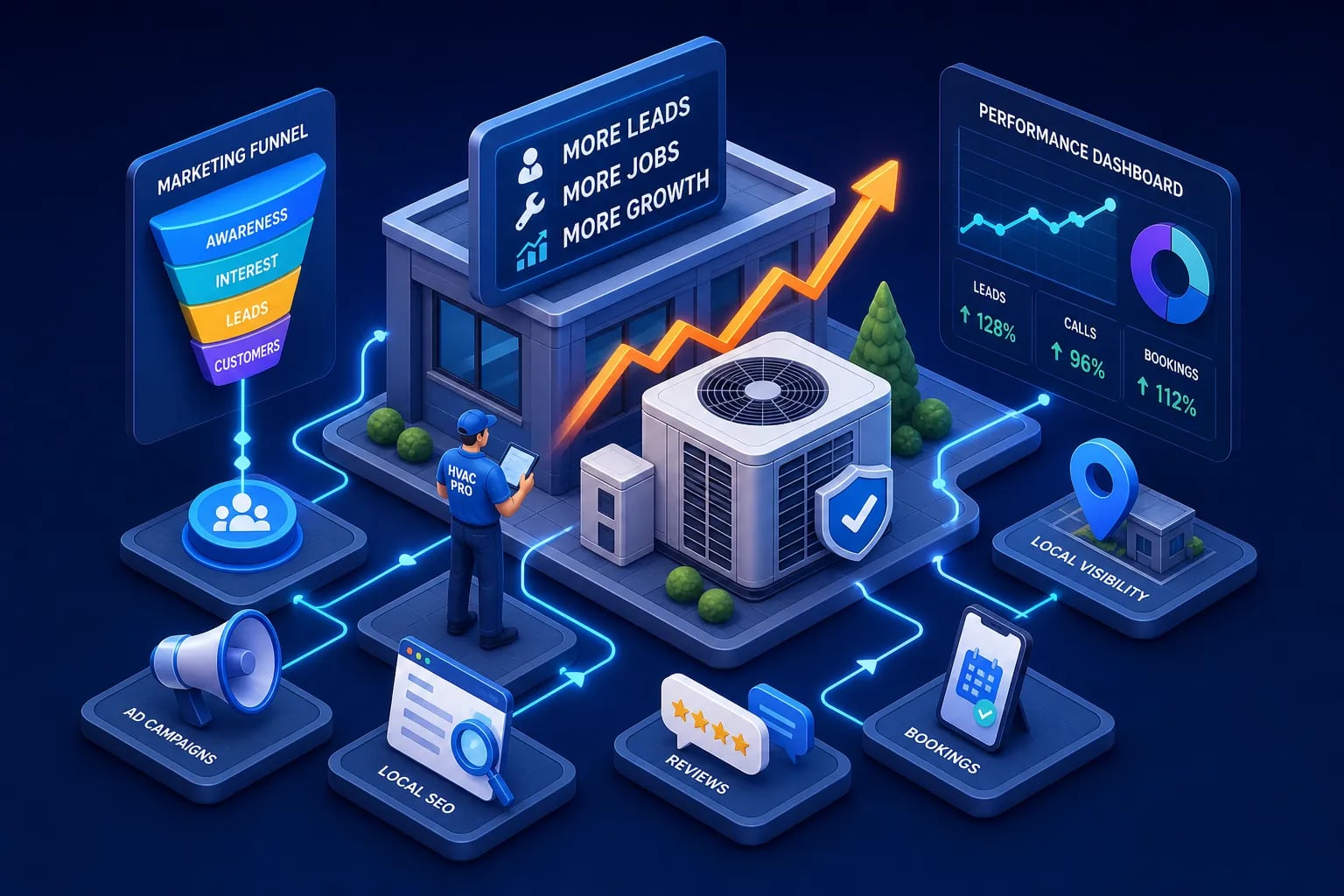
In 2026, marketing for HVAC contractors means more than Google Ads and a Facebook page. It means being findable, credible, and recommendable across every surface a homeowner might use, including AI assistants that now answer “who should I call for my AC?” through Google AI Overviews and voice search, often before a user ever scrolls to a traditional search result. The contractors winning leads aren’t always the ones with the biggest budgets. They’re the ones whose digital presence signals authority. That’s the lens this guide is built around, and it’s the same diagnostic-first philosophy that drives the work at TW3 Marketing.
Why most HVAC contractor marketing budgets don’t convert
The authority gap contractors keep ignoring
The real reason most HVAC marketing underperforms isn’t the channel. It’s that the authority signals underneath the ads are broken. Reviews are thin or inconsistent, the website doesn’t communicate expertise clearly, and the business has no visible positioning that sets it apart from the next contractor in the Google Maps pack.
When those signals are weak, even well-run ads bring traffic that doesn’t convert. Homeowners land on your site and leave. They call and don’t book. The problem gets blamed on targeting or seasonality, but the actual issue is that the business hasn’t earned enough trust to close the gap between a click and a booked job.
How AI search is changing HVAC lead generation in 2026
Homeowners increasingly ask AI assistants, including Google AI Overviews, ChatGPT, and voice search, who to call before they ever click an ad. Those systems recommend contractors based on relevance, reputation consistency, and digital corroboration: does your name, service area, hours, and expertise show up consistently across your website, Google Business Profile, and review platforms?
If the answer is no, you’re unlikely to appear. Ad spend alone won’t overcome inconsistent or missing business data. Build the corroborating signals first. The contractors who get recommended are the ones AI can best verify for a homeowner’s specific problem, location, and timing.
HVAC contractor marketing strategies that build authority
What TW3 Marketing’s Authority Framework™ actually measures
TW3 Marketing built its approach around one observation: contractors keep hiring agencies and switching channels without ever diagnosing the actual problem. The Authority Framework™ measures six signals that determine whether a business earns trust and gets recommended: positioning, proof, expertise, visibility, engagement, and experience. The 100-point TW3 Marketing Authority Audit™ makes those signals visible and shows contractors exactly how they appear in Google and ChatGPT searches, mapping each signal to measurable factors like Google Business Profile completeness, review velocity, and service page coverage by city.
Too many contractors have never had an honest audit like this. They’ve had reports showing impressions and clicks, not whether their business would actually get recommended when a homeowner asks an AI assistant for help. The TW3 Marketing Authority Audit™ closes that gap with a clear score across all six signals, not a dashboard full of vanity metrics.
Reputation management and content as lead-generation tools
Reviews, case studies, and expert content aren’t just marketing assets. They’re the signals AI platforms use to decide which contractor gets named. A contractor with a strong base of consistent reviews, a fully built-out Google Business Profile, and content that answers real homeowner questions can beat a competitor with a bigger PPC budget when someone asks ChatGPT who to call for a furnace replacement. The exact review count that matters varies by market and competitor baseline, but the pattern is consistent: more verified signals win.
The content formats that build authority for HVAC contractors include educational blog posts and service pages for search rankings, short technician videos for trust, and before-and-after job visuals for proof. These aren’t optional extras. They’re how AI systems verify that your business is real, relevant, and worth recommending.
HVAC contractor marketing channels worth your budget in 2026
Channels ranked by qualified lead quality
Not all leads are equal, and not all channels deserve equal spend. Here’s the honest hierarchy for local HVAC marketing based on lead quality and cost-per-lead benchmarks:
- Referrals: Highest close rates, lowest CPL. The most valuable lead source and usually the most neglected program in a contractor’s marketing mix. A simple follow-up system or incentive program can double output here.
- Google Local Services Ads: Fast, high-intent calls from homeowners ready to hire now. CPL typically runs $25, 75, making this one of the most efficient paid options for HVAC advertising for contractors.
- Local SEO and Google Business Profile: Durable, compounding lead flow for “near me” searches. CPL around $10, 30 once rankings are established, making it the strongest long-term channel for local HVAC marketing.
- Paid search (Google Ads): Controllable volume when campaigns are tightly targeted. Blended CPL runs around $104 across the industry, so campaign discipline matters.
- Email: The cheapest reactivation channel for past customers and maintenance pipeline. Even a basic monthly touchpoint drives repeat bookings at near-zero cost per lead.
- Social media: Useful for awareness and remarketing, not for immediate high-intent leads. Best paired with strong visual content from jobs in the field.
What a realistic HVAC marketing budget looks like
Industry coaches and trade associations generally point to 7, 10% of revenue as the right starting benchmark for HVAC digital marketing services spend. Where you land within that range depends on your situation:
- Established contractors holding market share: 5, 8% of revenue
- Steady growth targets: 7, 10% of revenue
- Aggressive expansion or new markets: 10, 15% of revenue
The right ROI target for a healthy HVAC marketing operation is 3:1 to 5:1 LTV-to-CAC, with strong operators consistently hitting 5:1 to 8:1. If your marketing isn’t producing in that range, the fix usually isn’t more budget. It’s authority first, then spend.
How to vet an HVAC marketing agency without getting burned
Questions that separate real agencies from vendors
Ask for HVAC-specific client references and request proof of booked-job results, not click reports. Find out who owns the ad accounts, website, and call tracking numbers when you leave. Confirm you’ll have raw data access, not just screenshots and PDFs, and get clarity on day-to-day account management before you sign anything. Contract terms and exit clauses should be transparent from the first conversation.
Red flags that cost contractors real money
Walk away from any agency that guarantees rankings or lead counts. Nobody can guarantee that. Reject vague success metrics like “improved online presence.” Those are placeholders for real accountability. If there’s no call tracking, no lead grading, and no raw platform access, you’re funding a black box with your marketing budget.
Watch for rotating account teams with no HVAC experience, hidden management fees, and long-term contracts with no performance clauses. The practical rule is simple: if an agency can’t explain how a lead becomes a booked job and what you keep when you leave, walk away.
Fix the foundation, then spend the money
HVAC contractor marketing in 2026 isn’t a channel problem. It’s an authority problem. Contractors who fix the foundation first, the reviews, the content, the AI visibility, the positioning, get more out of every dollar they put into lead generation. Those who skip the diagnosis keep cycling through agencies and budgets without understanding why nothing sticks.
If you’re not sure where your authority actually stands, that’s the right place to start. TW3 Marketing Authority Audit™ gives you an honest 100-point score across the six signals that determine whether your business earns trust and gets recommended by both customers and AI platforms. No guessing, no vanity reports. Just a clear picture of what’s working and what’s costing you leads.
Before you spend another dollar on ads or hire another agency, find out where you actually stand. Call our team and request your Authority Score™. It takes one conversation.
