
A homeowner opens ChatGPT and types “best HVAC company near me.” Three names come back. Yours isn’t one of them. You don’t have bad reviews. Your website isn’t broken. You’re just invisible to the answer. Understanding what answer engine optimization is, and why it matters for your business, is the first step toward changing that.
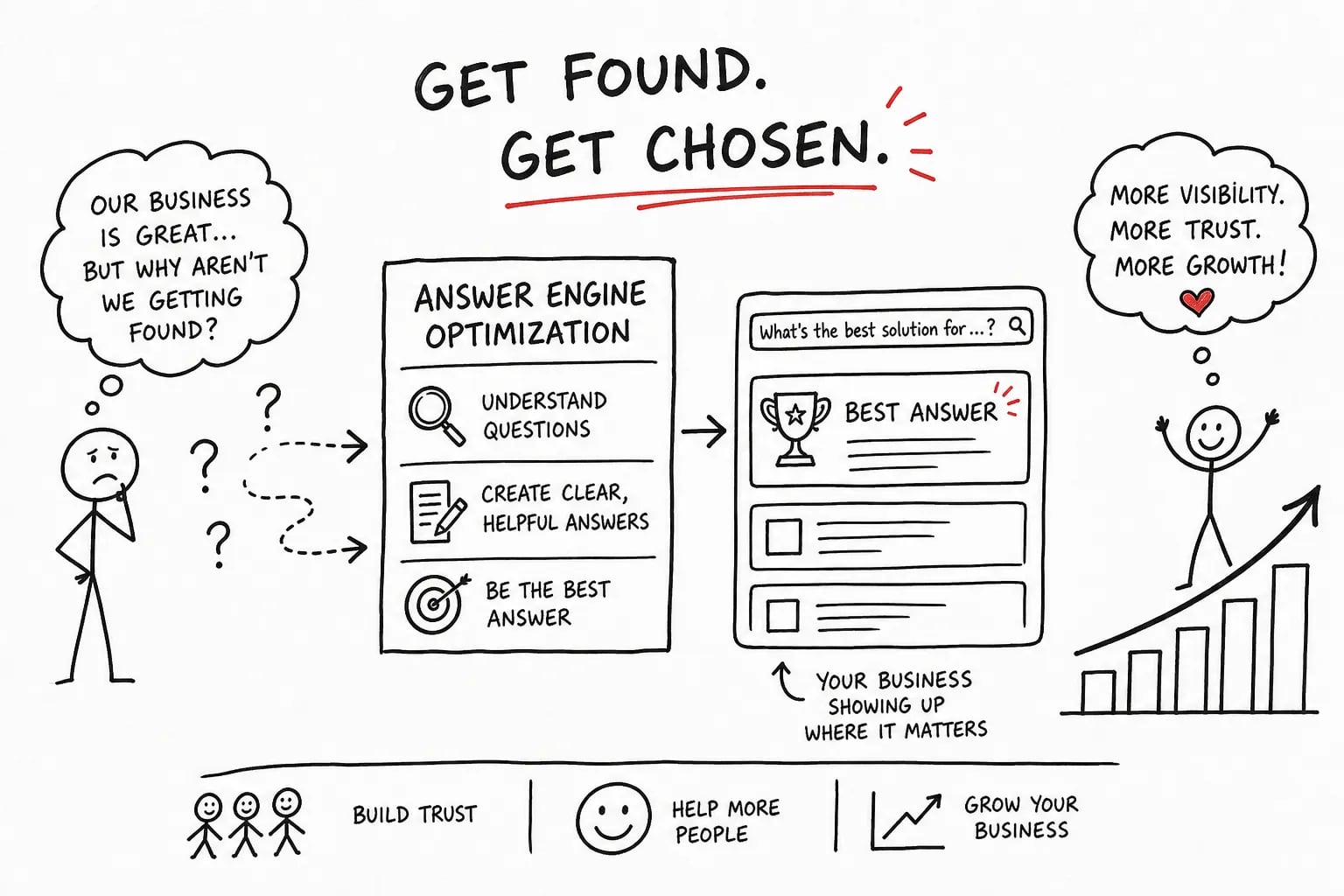
Answer engine optimization (AEO) is the practice of structuring your content so AI-powered systems can understand, trust, and cite your business when a user asks a direct question. It’s not about gaming an algorithm with keyword stuffing or backlink schemes. It’s about making your expertise readable to machines that increasingly decide which businesses customers even consider calling. Those are two very different problems, and only one of them responds to a bigger ad budget.
At TW3 Marketing, working across a wide range of industries, one pattern surfaces consistently: service businesses with strong reputations and solid websites are often absent from AI-generated answers, not because they’re doing bad work, but because their digital presence isn’t structured for how these systems retrieve and surface information. Here’s what that means, what it’s costing you, and how to start fixing it.
What answer engine optimization is (and what it isn’t)
The core shift from ranking to being the answer
Traditional SEO has one main goal: get your page onto the first page of search results and earn a click. AEO has a different goal entirely, be selected as the direct answer that AI systems return, often before a user ever sees a list of links. Those are two fundamentally different outcomes, and they require different content strategies.
AI answer engines work by retrieving candidate pages from their index, extracting the clearest passage that responds to the query, and surfacing it directly, sometimes with attribution, sometimes synthesized across several sources. The business with the most clearly structured answer wins the citation. The business with the most homepage traffic does not automatically qualify.
AEO and SEO aren’t opponents. Strong SEO authority still feeds AEO eligibility, and pages that rank well organically are cited in AI Overviews at a disproportionately high rate. But SEO alone no longer guarantees visibility in the places where buyers are increasingly asking their questions.
Where AI answers actually appear, and how often
Google AI Overviews, ChatGPT web-browse responses, Bing Copilot, and voice assistants all generate direct answers rather than a traditional list of links. Research on local service queries suggests roughly 72% of searches end in a zero-click outcome, meaning users don’t scroll past the AI-generated answer to reach organic results, though it’s worth noting that AI Overviews themselves trigger on only about 8% to 11% of local queries, with other zero-click factors (featured snippets, map packs) accounting for the rest. The practical takeaway holds: if your business isn’t named in the AI answer, many prospects never reach your site at all.
That coverage spans more surfaces than most business owners realize. A prospect might ask their phone’s voice assistant during a commute, query ChatGPT while researching options at their kitchen table, or read an AI Overview before ever clicking a link. Being structured for extraction means showing up across all of those moments.
Why AEO matters for your business: the real cost of ignoring it
What’s actually happening to HVAC contractors, roofers, and insurance owners
Picture an insurance agent with a clean website and strong Google reviews. A prospect asks ChatGPT “what’s the best type of life insurance for a small business owner?” ChatGPT cites a competitor’s FAQ page. The agent never had a chance to compete, because the competitor structured their content to answer that exact question directly.
The same situation plays out for roofing contractors when a homeowner voice-searches “who do I call for emergency roof repair” and gets two AI-recommended names. The contractor not mentioned never enters the consideration set. This isn’t a traffic problem or an ad budget problem, it’s an authority-structure problem. Paid ads may increase impressions, but they don’t address the underlying structure and entity signals that AI systems use to decide which businesses to recommend. Those require a different kind of work.
The numbers that make the business case
The case for answer engine optimization is getting harder to ignore. Agency-published case studies, with varying attribution methodologies, report that AI-referred sessions convert at roughly 2.3 times the rate of standard organic visitors, driven by the fact that the AI has already pre-qualified intent before the user lands on your site. One published example attributed $2.34 million in revenue directly to AI discovery, with a 16.9% conversion rate from AI-referred sessions. Those figures come from early-adopter campaigns and aren’t universal benchmarks, but they illustrate the intent quality of AI-referred traffic even at lower volume. For local service businesses, that pre-qualified intent is the compelling argument: visitors arrive already having been recommended.
What AI answer engines actually look for in your content
Content formats that get extracted and cited
AI systems favor structured, scannable content over narrative prose. FAQ blocks, numbered how-to sections, short definition paragraphs placed immediately under a heading, and comparison tables are the formats cited most frequently. A local contractor’s service page with a four-question FAQ block is far more likely to be extracted than one with three paragraphs of marketing copy describing how passionate the team is about roofing.
FAQPage schema has a well-documented positive impact on citation rates, some published analyses report up to 3.2 times higher citation likelihood compared to unstructured pages, though schema alone isn’t sufficient. Visible, answer-first content and overall trust signals matter too. Write questions the way customers actually phrase them in conversation, then answer each one in two to three direct sentences. That combination, conversational phrasing, direct answer, structured markup, is what makes a page extractable.
Technical signals and authority cues that matter
Beyond content format, the technical layer matters. Schema markup types that improve AEO standing include FAQPage, Article, Organization, and HowTo, each signals to the AI’s retrieval system what your content is and who produced it. At minimum, add Organization schema to your homepage and FAQPage schema to any page with Q&A content.
Authority signals matter just as much. Clear author credentials, consistent business name and entity data across the web, outbound citations to verifiable sources, and visible publication dates all factor into whether an AI system trusts your content enough to surface it. ChatGPT tends to recommend businesses that are most discoverable and most independently verifiable, not the ones with the biggest ad budgets.
How to start closing your AEO gaps right now
Four moves to make before anything else
For a local service business starting from scratch with AI optimization, these four actions represent the highest-yield starting points based on current evidence:
- Add an FAQ block to your top service pages. Write questions the way customers phrase them in voice search and conversational queries, then answer each in two to three direct sentences. This is the single fastest way to make your content extractable.
- Tighten your heading structure. Every H2 and H3 on your page should read as a standalone answer to a real question, not a marketing headline.
- Implement basic schema markup. Start with Organization schema on your homepage and FAQPage schema on any page with Q&A content.
- Strengthen your entity signals. Make sure your business name, address, service categories, and credentials are consistent across your website, Google Business Profile, and every directory that AI systems reference.
How to know exactly where your AEO gaps are
The challenge with answer engine optimization is that gaps aren’t visible from the outside. You can’t simply check your Google rankings and know whether ChatGPT would recommend you for a relevant query. The signals AI systems weigh are spread across your website, your reviews, your third-party mentions, and your schema markup, and a weak link in any one area can keep you out of the answer entirely.
TW3 Marketing’s 100-point TW3 Marketing Authority Audit™ is a proprietary diagnostic built to score six signals that AI systems weigh: positioning, proof, expertise, visibility, engagement, and experience. It gives service business owners a clear picture of exactly where they’re losing AI discoverability before they spend another dollar on marketing. Think of it as the diagnostic step, because improving your AEO standing starts with knowing your current score.
Why timing matters for AEO adoption
Answer engine optimization isn’t a future concern you can circle back to after your next slow season. It’s already changing which businesses customers find and call. Every time a prospect asks an AI “who should I hire for roof repair” or “best HVAC company near me” and your business doesn’t appear, a competitor gets that call.
Current trend data points toward AI-driven discovery playing a larger role in local service decisions over the next several years. The businesses best positioned to capture that visibility are the ones structuring their content, authority signals, and schema markup now. The technical bar isn’t impossibly high, but it requires intentional action. Run the audit. Then you’ll know exactly what to fix.
