
A homeowner pulls out their phone and asks ChatGPT which HVAC company in their area is worth calling. One business gets named. The other, with a better-looking website, more Google reviews, and years of service history, gets nothing. Not even a mention. That gap has a name: answer engine optimization, or AEO. AEO explained simply: it’s the practice of structuring your digital presence so AI platforms can find, trust, and cite your business when generating answers. At TW3 Marketing, we’ve observed this pattern repeat across local service businesses consistently. Strong SEO, invisible in AI answers. This article breaks down exactly what AEO means, how it differs from traditional SEO, and what your business needs to do before touching a single piece of content.
AEO Explained: What Answer Engine Optimization Actually Means
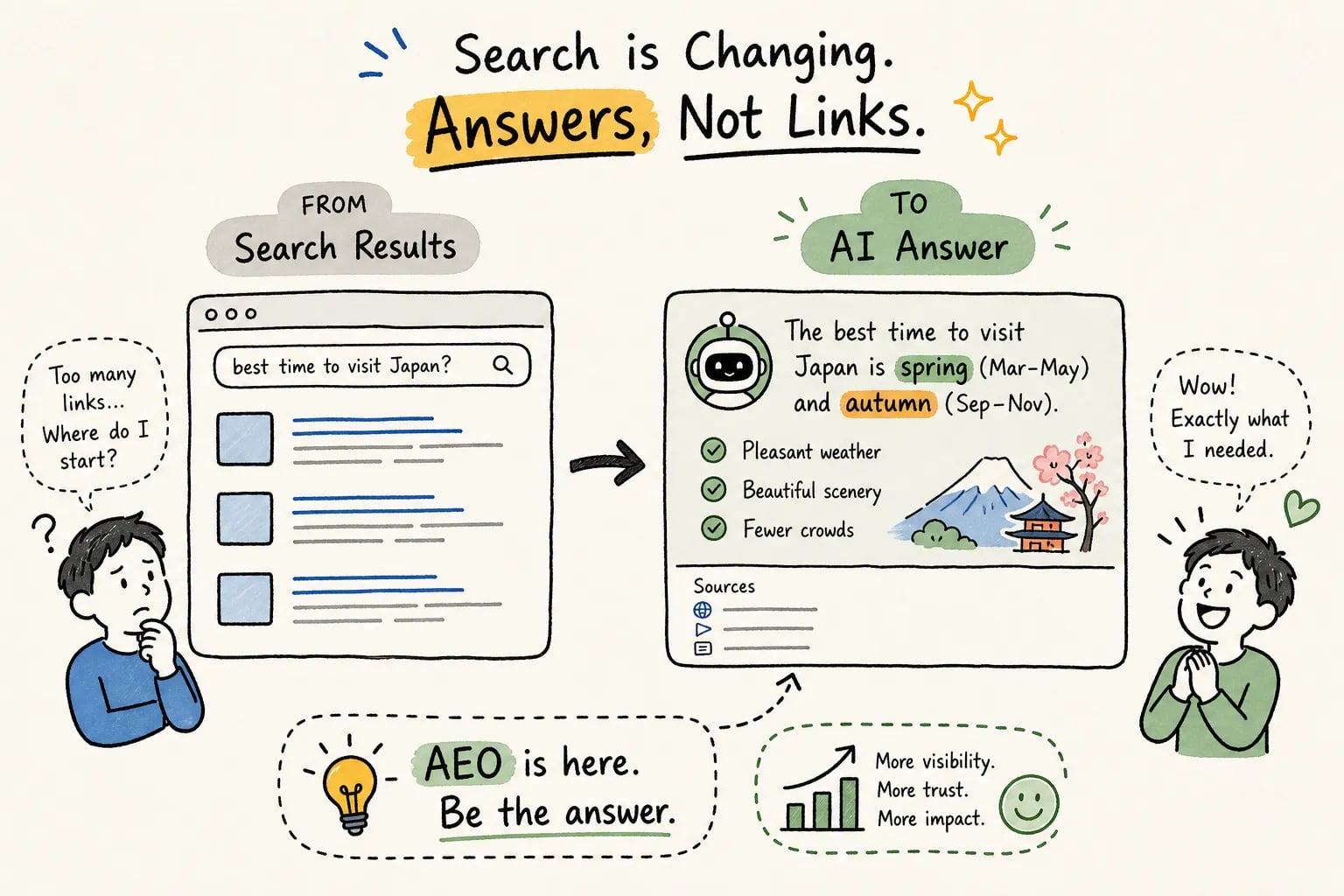
Answer engine optimization is the practice of structuring your content and digital presence so AI platforms can understand, trust, and cite your business when generating answers. Think of it as AI search optimization for the era of conversational search. The goal isn’t a ranking on a results page. It’s being named as the answer, full stop.
How Answer Engines Work Differently from Search Engines
Platforms like ChatGPT, Perplexity, and Google AI Overviews often synthesize information from sources they already trust and deliver one direct response, rather than presenting a traditional list of links to browse. The experience varies by platform and mode: Perplexity and Google AI Overviews commonly display source links alongside their answers, while ChatGPT cites web sources primarily when its browsing mode is active. What all these platforms share is a tendency to favor businesses they can already verify as credible and authoritative. Selection methods also differ by platform: Google relies heavily on Knowledge Graph signals and corroboration across the web, while tools like Bing Copilot and ChatGPT in browsing mode use live retrieval alongside pre-indexed signals. The practical takeaway is the same regardless of platform: if AI systems haven’t already processed your authority signals, you’re unlikely to be cited when someone asks for a recommendation.
The Shift from “Rank and Click” to “Answer and Cite”
Traditional search success means getting a user to click your link. AEO success means your content or your business name appears inside the AI’s response without the user needing to click at all. That fundamentally changes what you measure. Citations, mention rate, and share of voice in AI answers replace rankings and click-through rate as the metrics that actually matter. If you’re still measuring your AI visibility by Google position alone, you’re measuring the wrong thing.
AEO Explained: How It Differs from Traditional SEO
Both disciplines care about authority, crawlability, and clear content structure. That’s where the similarity ends. SEO helps users find your page. AEO helps AI extract your answer without the user visiting your site at all, and that shift changes what you need to build.
Different Goals, Different Signals
SEO is optimized around rankings, organic traffic, and click-through rate. AEO is optimized around citation rate, brand mention share in AI answers, and answer visibility across platforms. Conversational search optimization demands a different content architecture entirely. Keyword-dense pages built for rankings often perform poorly in AI retrieval because they lack the concise, extractable answer blocks that AI engines prefer. Research into AI answer ranking consistently points to the same formats: answer-first structure, question-based headings, FAQ blocks, and schema for AI answers are what AI systems are built to pull from. JSON-LD schema, in particular, is a widely recognized implementation for helping AI systems parse and surface business information accurately.
Where SEO and AEO Actually Overlap
Strong domain authority, E-E-A-T signals, structured data markup, and a logical heading hierarchy matter in both disciplines. A business with weak SEO fundamentals will also struggle with AEO because the underlying credibility signals feed both systems. SEO gets you on the page. AEO gets you in the answer. The foundation is shared, but you need to build beyond it to win in AI search.
Why Local Businesses Can’t Afford to Ignore AEO
Local businesses are losing customers to competitors who appear in AI recommendations. Not because those competitors deliver better service, but because they’ve built stronger authority signals online. AI platforms favor businesses they can verify through multiple consistent signals, rather than recommending purely at random. According to industry trackers including BrightEdge, roughly 48 percent of Google searches in 2026 trigger an AI Overview or generative answer instead of traditional organic results, and that share continues to grow across major service categories.
How AI Recommendations Are Changing Local Discovery
When someone asks Google AI or ChatGPT for a trusted local contractor, insurance agent, or solar installer, the AI pulls from businesses it can verify through consistent, structured, and authoritative signals across the web. Review volume, NAP consistency, service-specific content, third-party directory mentions, and structured website data all factor into who gets recommended. Businesses that haven’t built those signals simply don’t get considered, regardless of how polished their website looks or how long they’ve been in business. This is what AI search optimization actually addresses in practice.
The Trust Gap That Blocks Most Local Businesses from AI Visibility
Many local businesses have a scattered digital presence: inconsistent business information across directories, thin content that doesn’t demonstrate expertise, and no structured signals telling AI systems what they do or who they serve. Industry data on local business listings consistently shows these gaps are widespread. You can have five-star reviews on one platform and still be invisible to AI if your directory listings are inconsistent and your site lacks structured data to corroborate your credibility. That trust gap is what prevents AI recommendation, and it’s the real problem AEO implementation has to solve.
The Diagnostic Step Most Businesses Skip Before Implementing AEO
Before restructuring content, adding schema markup, or chasing AI citations, you need to understand your current authority baseline. Jumping straight into AEO tactics without that baseline is like repainting a house with a cracked foundation. The surface looks better but the core problem remains, and your results will show it.
Why Skipping the Baseline Is a Costly Mistake
Businesses that skip the diagnostic phase often invest in content changes that don’t address the actual gaps holding them back. They optimize headlines and add FAQ blocks without realizing their biggest problem is inconsistent entity data, weak proof signals, or no topical authority in their service category. Tactics applied to the wrong problems don’t move the needle. They just burn budget and time.
What a Proper Authority Diagnostic Covers
That’s why TW3 Marketing built the TW3 Marketing Authority Audit™: a 100-point diagnostic built around six authority signals that AI platforms consistently use to evaluate and recommend businesses: positioning, proof, expertise, visibility, engagement, and experience. This is TW3’s proprietary framework for assessing where trust gaps exist before any content or technical work begins. For any local business serious about AI visibility, that audit is the practical starting point, not a content calendar, not a new website, and not more ad spend on a presence that AI systems can’t confidently verify.
The Bottom Line on AEO Explained
AEO isn’t replacing SEO overnight, but it is changing what winning looks like in local search. The businesses showing up in AI-generated answers aren’t just the ones with the most backlinks. They’re the ones AI platforms can confidently verify as authoritative and trustworthy across multiple signals and sources.
If you’re a local service business, the question isn’t whether answer engine optimization matters. It’s whether your current digital presence gives AI any reason to recommend you. With AEO explained and the stakes clear, the next step is knowing exactly where you stand. Reach out to TW3 Marketing to get your Authority Score™ check and see precisely how your business appears inside Google and ChatGPT right now.
