
If you’ve ever Googled your business and come back with three different scores from three different tools, you already know how confusing this gets. Authority score explained for local business owners is rarely a clean, single answer, you’ll encounter Moz Domain Authority (DA), Semrush Authority Score, and the broader concept of local SEO authority in the same conversation, and the overlap creates paralysis instead of clarity.
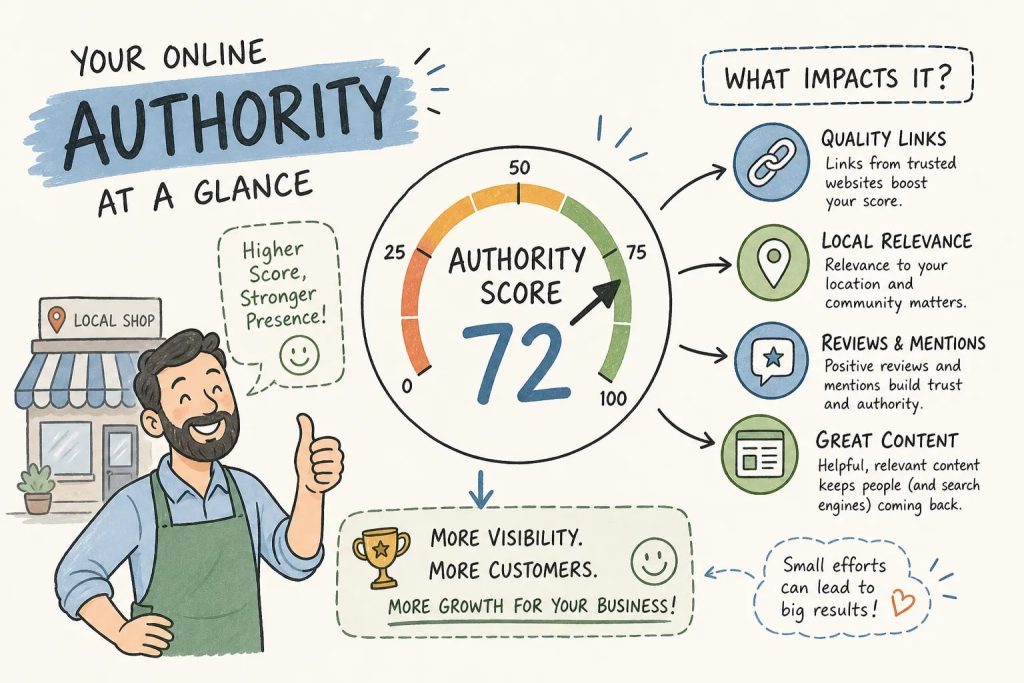
This article cuts through the noise with a plain-English breakdown of what each website authority metric actually measures, what realistic numbers look like for a local service business, and what to do about it. One thing worth noting upfront: in the AI search era, authority has expanded well beyond any single number, and that changes what you should prioritize.
What authority scores actually measure for local business owners
DA vs. Semrush Authority Score: a quick translation
Moz Domain Authority is a 0, 100 score that predicts ranking likelihood, based primarily on your site’s backlink profile strength. It’s logarithmic, so moving from 10 to 20 is far easier than moving from 60 to 70. Semrush Authority Score covers similar ground but also factors in organic traffic estimates and spam signals, making it a slightly broader domain health check. If DA tells you how strong your link profile is, Semrush AS tells you how healthy the domain looks overall.
The most important thing to understand about both: neither is a Google ranking factor. These are third-party proxy metrics, useful for competitive comparison but not direct measures of search performance, Google references no internal DA score when ranking your pages.
Why “local authority” is a different animal
Local SEO authority isn’t a score from Moz or Semrush. It’s a broader concept describing how trusted and prominent your business appears in a specific geographic area. The inputs are completely different: Google Business Profile signals, customer reviews, citation consistency, and locally relevant backlinks all feed into how Google perceives your local standing.
This distinction matters in practice. A business with a DA of 12 can easily outrank a DA-30 competitor locally because local authority signals carry weight that no backlink metric captures. If you’re focused on the wrong number, you’ll spend money in the wrong place.
Why the AI search era changes the equation
AI platforms don’t check your DA score
When someone asks ChatGPT or Google AI Overviews to recommend a local contractor, neither system looks up your Moz score before responding. They evaluate credibility across your entire digital presence: your Google Business Profile accuracy, review volume and sentiment, website content, and how consistently your business information appears across the web. The businesses getting recommended are the ones that look credible and consistent across multiple touchpoints, not just the ones with the most backlinks.
The case for a complete authority diagnostic
Standard DA and Authority Score tools were built for SEO comparison, not for diagnosing the trust gaps that affect AI visibility and local credibility. TW3 Marketing Authority Audit™ was built specifically for local businesses, covering 100 data points across six trust signals: positioning, proof, expertise, visibility, engagement, and experience. The difference between checking your blood pressure and getting a full physical is real. One number tells you something; a complete diagnostic tells you what to fix and in what order.
For local business owners who want to know exactly where they stand, the TW3 Marketing Authority Audit™ delivers a scored breakdown tied to the signals AI platforms actually use, not just the signals traditional SEO tools track.
Realistic benchmarks for local service businesses
What scores actually look like by competition level
In practice, local business owners tend to significantly overestimate the scores they need to compete. According to data from sources like BrightLocal and Moz, here’s what functional authority scores actually look like:
- Non-competitive local niches: A DA or Authority Score of 10, 20 is often enough to compete for hyper-local terms.
- Moderate competition (HVAC, roofing, plumbing): 20, 35 is a realistic and functional target for most markets.
- High competition (legal, dental, insurance): 25, 40 gives solid footing when your local signals are also strong.
Most local service businesses competing effectively sit in the 15, 35 range. You don’t need to hit 50. That benchmark belongs to national brands and media publications, not your local plumbing company.
The right way to benchmark your score
Don’t compare yourself to national brands. Pull the DA or Authority Score of the top three competitors already ranking for your target local keywords. If your score is within 5, 10 points of the ranking sites, your backlink profile isn’t the bottleneck. Look at your local signals instead. If you’re 15 or more points below the competitors ranking above you, link building and authority development deserve focused attention before you spend more on ads or content.
How to improve your local SEO authority in 6, 8 weeks
The priority action order
Work through these four steps in order, each one builds on the last:
- Optimize your Google Business Profile. It carries an estimated 20, 32% of local pack ranking weight, according to BrightLocal’sLocal Search Ranking Factorsresearch, making it the single highest-leverage action available for most local businesses. Complete your categories, services, photos, hours, and contact information accurately and consistently.
- Build a systematic review process. Volume, recency, and sentiment each matter. Reviews account for roughly 16, 20% of local ranking weight, so a repeatable ask-and-respond routine pays dividends fast.
- Pursue locally relevant backlinks. Chambers of commerce, local directories, partner businesses, and community organizations are your best starting points for geographically relevant link equity.
- Clean up your citations. Eliminate NAP inconsistencies across directories to reinforce trust signals. Treat this as ongoing maintenance rather than a one-time fix, citations alone won’t move rankings significantly, but inconsistencies will quietly drag them down.
What to expect on the timeline
Early movement in authority metrics can appear in 4, 8 weeks, particularly on established sites in lower-competition markets. Meaningful, measurable score gains typically take 3, 6 months of sustained effort. Track your progress monthly, not weekly. Authority scores move slowly, and chasing short-term fluctuations leads to reactive decisions instead of a steady, compounding build that moves the needle over time.
The plain-English takeaway: authority score explained for local business owners
DA and Authority Score are useful directional metrics, not performance verdicts. They tell you something about your backlink profile strength but don’t capture the full picture of what drives local rankings or AI recommendations. Competing locally doesn’t require a sky-high number, it requires being stronger than the businesses already ranking in your specific market and maintaining trust signals that hold up across every channel AI platforms evaluate.
If you want a complete picture of where you actually stand across all six authority signals, request a TW3 Marketing Authority Audit™. Stop guessing at a single number. Get a scored, actionable diagnostic, and a real plan.
