
Many service businesses try to raise their authority score by doing more: more content, more backlinks, more reviews. That’s not wrong, but it’s premature. You can’t fix what you haven’t measured, and most small business owners have no idea which signal is actually broken. When you don’t know, you end up patching the roof while the foundation cracks.
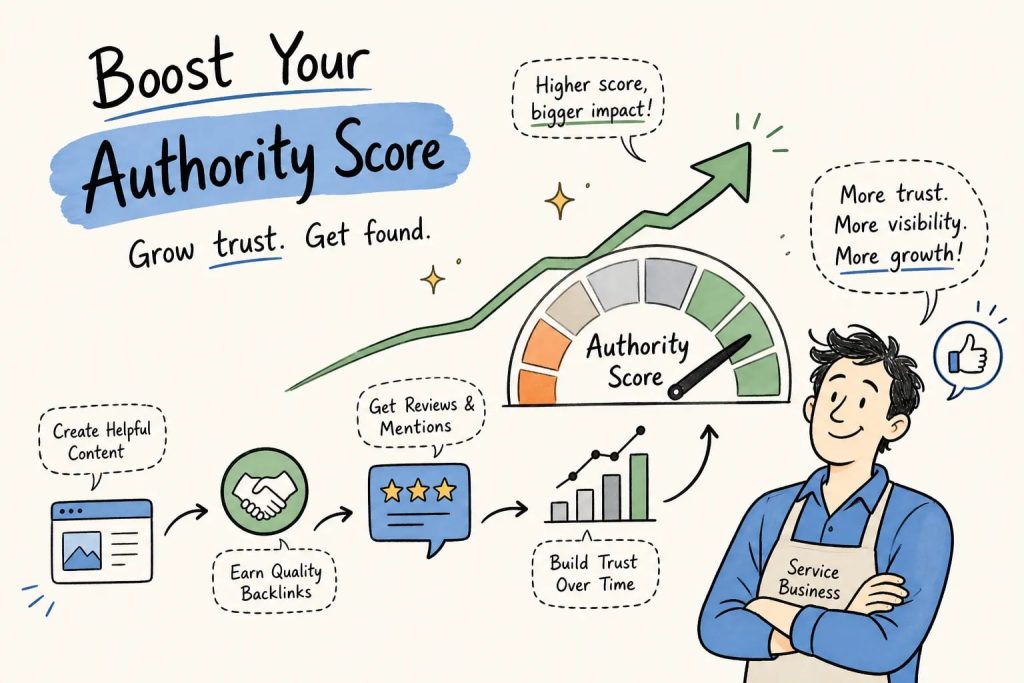
This guide covers how to improve authority score for small service businesses by diagnosing six key signals first, then acting on them in the right order. Here’s what that looks like, and what realistic improvement actually delivers when you target the right problems.
How to improve authority score for small service businesses: Start with a diagnosis
Positioning, proof, expertise, visibility, engagement, experience. Many small service businesses are strong in one or two of these and leaking badly in the others. The problem is they usually don’t know which ones. So they run ads, build links, and chase reviews, and the needle barely moves. The improvement work only sticks when it’s aimed at the right signal.
TW3 Marketing built the TW3 Marketing Authority Audit™ specifically to solve this problem. It’s a 100-point proprietary diagnostic scoring system that measures all six signals across a business’s entire digital presence and tells you exactly where you’re losing authority. Before launching any tactic, before spending a dollar on content or outreach, getting that baseline score is one of the highest-leverage steps you can take. Everything after it becomes more precise and less wasteful.
Positioning and proof: the two signals most businesses neglect
Positioning is not a tagline. It’s how clearly you communicate who you serve, what you do, and why you’re different. AI platforms like ChatGPT and Google AI scan for exactly this information when deciding which local service business to recommend. If your website uses vague language like “quality service you can trust,” those systems have nothing specific to work with. They’ll surface a competitor who stated it plainly.
Proof is the other half of that equation. A stack of five-star reviews is a start, but real proof signals include case studies, specific client outcomes, before-and-after results, and concrete numbers. The more specific your evidence, the more credible you appear to both customers and the AI systems recommending local providers. Generic claims are easy to make. Specific results are harder to fake, and both humans and algorithms treat them differently.
Expertise and visibility: being found and actually believed
Expertise isn’t something you claim. It’s something you demonstrate through consistent, specific content. This means detailed service pages that explain your process, FAQs that answer the actual questions your customers type into search, and published knowledge that shows real depth. Schema markup on service pages helps search engines categorize that expertise accurately and surface it when it’s relevant. Without it, even genuinely expert content can be miscategorized, reducing the likelihood it appears at the quality level it deserves.
Search engines increasingly evaluate content through E-A-T signals, Expertise, Authoritativeness, and Trustworthiness, and small service businesses are competing on all three fronts simultaneously. Domain authority and domain rating (the metrics used by tools like Ahrefs and Moz to quantify your backlink strength) factor into that equation as well. Building clean, relevant inbound links alongside strong on-page content is how your domain rating climbs over time.
Visibility covers more ground than Google rankings. It includes local citation consistency, your Google Business Profile completeness, directory presence, and whether your business name appears in the sources AI systems draw from when making recommendations. Citation consistency and GBP optimization are among the fastest wins available to most small service businesses because they directly affect local authority. A business with mismatched name, address, and phone data across directories is signaling to search engines that it can’t be trusted to get the basics right.
Engagement and experience: the signals that close the trust gap
Engagement tells AI systems that real people are actively choosing your business. Review volume matters, but review recency and owner response rate matter more than most businesses realize. Recent, specific, responded-to reviews carry significantly more weight than a pile of old generic ones. Direction requests, phone calls, bookings, and messages on your Google Business Profile are also engagement signals. They register as high-intent customer behavior, not just passive browsing.
Experience is the signal that gets ignored most often. It covers how fast your website loads, how clearly it explains what you do, and how easy it is for a visitor to find the information they came for. A confusing or slow website doesn’t just frustrate customers, it signals distrust at the algorithmic level. Poor user experience reduces the likelihood that AI platforms recommend you, even when your other signals are solid. Clean navigation and a direct path from interest to contact aren’t aesthetic choices. They’re authority infrastructure.
What realistic authority improvement actually looks like
The first 30 to 90 days typically show movement in local visibility, GBP impressions, and citation consistency. If you start with GBP optimization and citation cleanup, early signs often appear within weeks. Meaningful ranking shifts and broader authority score gains for small service businesses usually follow between months three and six. Compounding results, where leads become more predictable and authority becomes defensible against competitors, come closer to the six-to-twelve-month mark.
To know your numbers are moving, track referral domains, organic impressions, GBP views, review velocity, and your baseline authority score from day one. You may see movement across multiple indicators within 90 days if your targeting is correct. If nothing is shifting, it typically means you haven’t addressed the weakest signal yet, which brings everything back to the diagnosis.
How to improve authority score for small service businesses: the sequence matters more than the tactics
Improving your authority score for a small service business isn’t complicated. It’s sequential. Fix the right signal at the right time and the improvements stack on top of each other. Skip the diagnosis and you’ll spend real money on tactics that don’t move the metric that actually matters.
The fastest path to measurable improvement starts with a clear picture of where you stand today across all six signals. That’s exactly what the TW3 Marketing Authority Audit™ is built to provide. Start there, and every dollar you spend after it has a specific target and a reason to work. Contact TW3 Marketing to get your audit and find out which signal is holding your business back.
