
You’re spending money on marketing, but when a homeowner in your service area asks ChatGPT “who’s the best HVAC company near me,” your business doesn’t show up. That’s not a content volume problem. That’s an authority problem, and many content agencies lack the trade-specific local SEO expertise to solve it.
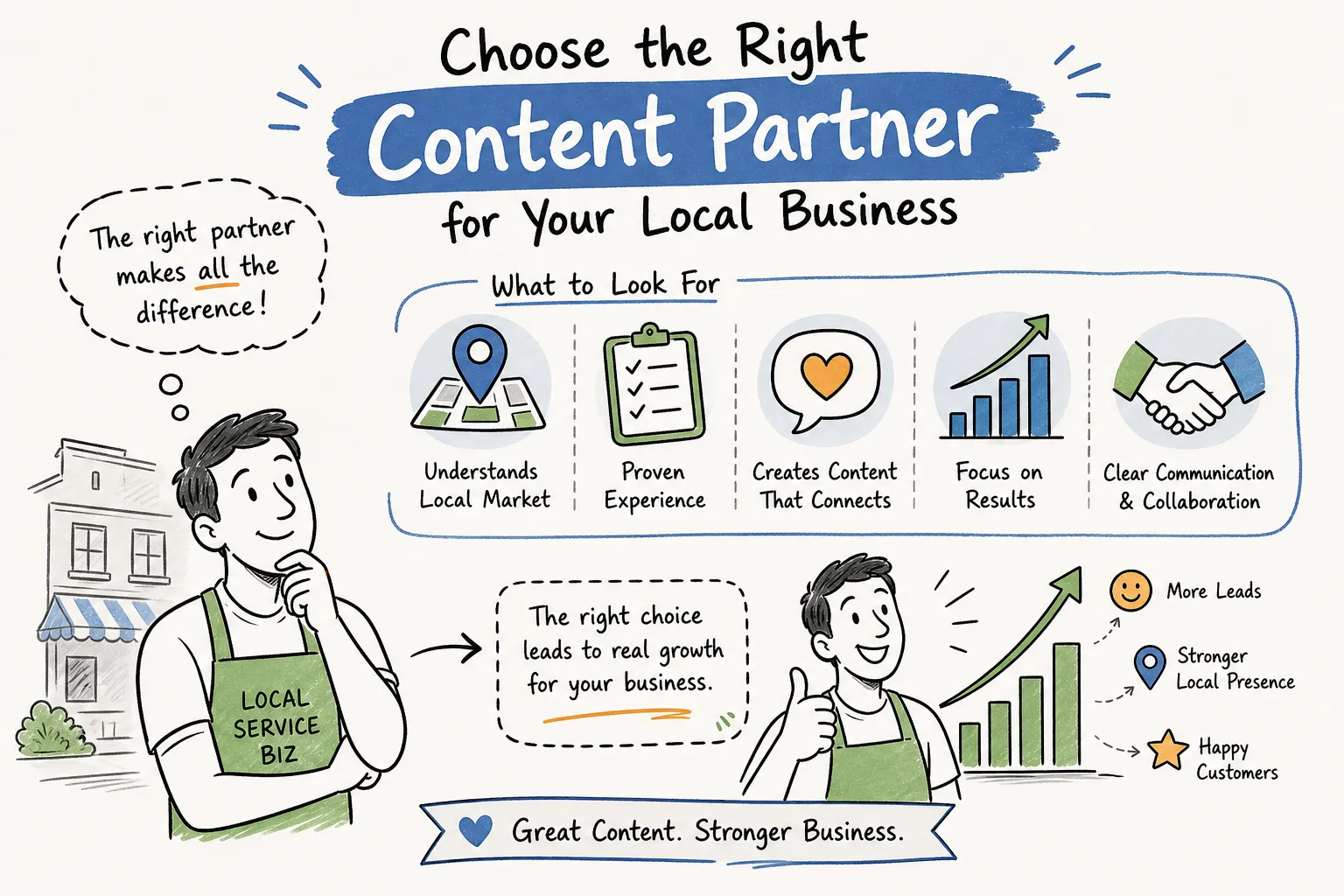
Picking the right content agency for a local service business is a different decision than it is for a SaaS company or an e-commerce brand. You need a partner who understands trade industries, knows how local trust signals work, and builds content specifically for how AI-driven search operates in 2026. TW3 Marketing was built around exactly this challenge: helping service businesses become the first choice for both customers and AI recommendation systems. But before you call anyone, you need a clear framework for evaluation.
This article gives you that framework. You’ll get the criteria that separate the right content agency from a generic one, the questions to ask before signing anything, a realistic look at pricing, and a practical process for shortlisting vendors and starting without overcommitting.
What a content creation company actually does for local service businesses
Beyond blog posts: the full scope of modern content services
A serious content production company does far more than publish articles. For a local trade business, the deliverable mix should include website copy, service and location landing pages, case studies, FAQ content, email sequences, video scripts, and structured data markup. Volume matters less than the right asset mix. An HVAC contractor needs local service pages and trust-building case studies, not thought-leadership whitepapers designed for a tech audience.
Why generic content agencies often miss the mark for trades
Many national content marketing agencies are built primarily for B2B software or e-commerce clients, a pattern visible across major agency directories and industry rankings. Their playbooks don’t account for how homeowners actually make hiring decisions. When someone needs a roofer or an electrician, they’re looking for proof, credibility, and reviews, not long-form editorial content. The gap between what a generic creative content studio produces and what actually generates phone calls for a contractor is significant, and it costs you money every month you’re working with the wrong partner.
The shift toward authority-first content strategy
The stronger content creation services have moved away from the old “publish more, rank more” model. Leading agencies now organize their work around authority-building frameworks that combine content, review signals, structured site architecture, and topical depth, a shift documented across multiple 2026 agency benchmarking reports. For local service businesses competing for AI-recommended results, adapting to this shift isn’t optional. It’s the entire game.
Why AI-powered search changes what content needs to do in 2026
How Google AI Overviews and ChatGPT surface local recommendations
When someone asks Google or ChatGPT for the best HVAC company in their area, the result doesn’t typically come from whoever published a blog post last week. Based on available research into how AI Overviews operate, these systems appear to favor businesses with strong, consistent authority signals across their website, content, and external mentions. That includes a complete and accurate business profile, recent and specific reviews, clear service pages with schema markup, and consistent business information across the web. Google has not published a definitive ranking formula, but the pattern across verified results points clearly to authority over volume.
What this means for your content strategy right now
A content creation company that isn’t thinking about AI discoverability is building for a search landscape that no longer exists. The agencies that move the needle in 2026 understand how to structure content so AI systems can parse what your business does, where it operates, and why it’s credible. That means clear entity definition, layered service and location content, and content formats that AI systems can actually cite. If your current or prospective agency can’t speak to this directly, that’s your answer.
The authority signals AI systems look for
The key signals break down into four categories: clear entity definition (who you are, what you do, where you operate), consistent expertise signals across pages, structured service and location content, and a review profile that reinforces credibility. These are outputs a good content agency should be producing for you systematically, not as one-off projects. Miss any of these four and you have gaps in your authority foundation that content volume alone won’t fix.
How a content creation company builds local authority: the real evaluation criteria
Industry experience in trades: why it’s non-negotiable
A content agency for hire that has never written for an HVAC company, roofing contractor, or solar installer will spend your retainer learning your industry. That’s your money funding their education. Ask for specific examples of work in home services or trade businesses, and look for agencies that understand seasonal demand cycles, job-ticket language, and the trust signals homeowners actually respond to. If their portfolio is full of SaaS brands and direct-to-consumer products, keep moving.
Authority-building outcomes you can measure, not just traffic metrics
Monthly pageviews and social impressions don’t pay invoices. The right content production company ties its work to measurable authority outcomes: improvement in local AI visibility, increase in qualified calls or form submissions, growth in review volume, and expansion in topical keyword coverage. Ask upfront how they measure the authority impact of content, not just reach. If the answer is a traffic dashboard, that’s a yellow flag.
Pricing benchmarks to set realistic expectations
For local HVAC and contractor businesses, expect these approximate tiers:
- Basic content-only supportruns roughly $800 to $1,500 per month.
- A growth content program that includes multiple service pages and blog posts lands around $1,800 to $3,500 per month.
- Full content plus local SEO packages typically run $3,500 to $6,000 or more per month.
- Broader full-service agency retainers range from $5,000 to $15,000 per month.
- Per-post pricing ranges from $200 to $2,000 or more depending on depth and specialization.
Knowing these ranges protects you from overpaying for generic output or underpaying for work that won’t move the needle.
How TW3 Marketing approaches content for local service authority
The TW3 Marketing Authority Audit™: diagnosing before producing
Most content agencies jump straight to production. TW3 Marketing starts with the TW3 Marketing Authority Audit™ that scores your business across six trust signals: positioning, proof, expertise, visibility, engagement, and experience. This diagnostic-first approach gives local service businesses a clear picture of where their authority gaps are before a single piece of content is written, and it prevents the most expensive mistake in content marketing: producing content that doesn’t address the root problem.
AI content and website optimization built for local trades
TW3’s content creation services are structured around AI discoverability from the ground up. That means optimizing website architecture so Google and ChatGPT can understand what your business does and where it operates, then producing content that acts as layered authority signals: service pages, case studies, FAQs, and location content, all structured to be cited and recommended by AI systems. This is content strategy built for how search actually works in 2026, not how it worked five years ago.
A real example: HVAC contractor case study
An HVAC contractor came to TW3 with strong ad spend and solid reviews but weak organic authority. They were spending on traffic but not showing up when it mattered. After the TW3 Marketing Authority Audit™ identified gaps in expertise signals and AI-structured content, TW3 implemented targeted content and website optimization across service pages, location content, and FAQ architecture. Within the first 90 days, the client reported roughly 30% more organic calls and a measurable improvement in local AI visibility. The audit made the difference because it pointed to the right problems first.
Selecting a content creation company: how to shortlist and start without overcommitting
Building your shortlist of 3 to 5 candidates
Start by filtering for agencies with documented experience in home services or trade verticals. Check Clutch and G2 ratings, but weight review volume over score: a 4.8 with 40 verified reviews is more reliable than a 5.0 with four. Look for agencies that show actual results tied to organic traffic, lead volume, or AI visibility, not just impressions and engagement numbers. Shortlisting five candidates before running them through your evaluation criteria is a manageable starting point. If you need a more targeted search, “content studio near me” filtered by industry vertical can surface smaller regional specialists worth considering alongside larger firms.
Questions to ask before signing a contract
These are the questions that separate the right agency from one that sounds right. Ask each candidate the following before committing to anything:
- How do you measure content performance beyond traffic?
- Have you worked with HVAC, contracting, or home service businesses, and can you show results?
- How do you structure content for AI search visibility?
- Who actually writes the content: in-house team, freelancers, or subcontractors?
- What does onboarding look like, and how long before we see measurable results?
- Who owns the content and account data if we end the engagement?
The answers will tell you quickly whether you’re talking to a generalist or a specialist.
Starting with a pilot to reduce risk
Most reputable content agencies will agree to a 90-day pilot scope before you commit to a longer retainer. Use that window to evaluate communication quality, content caliber, and whether the work is moving measurable authority signals, before committing to a 6- to 12-month retainer. If an agency pushes back hard on a pilot and insists on a long-term commitment upfront, that’s worth noting.
The decision framework that matters most
The right content creation company for a local service business isn’t the one with the longest client list or the lowest per-post rate. It’s the one that understands trade industries, builds content with AI discoverability built in, and measures success by leads and authority, not clicks and impressions. That combination is rarer than you’d expect in the agency market.
If you want to start from a clear picture of where your authority actually stands before spending a dollar on content, the TW3 Marketing Authority Audit™ is the logical first step. The diagnostic scores your business across six trust signals and gives you a concrete roadmap that any content agency should be working from anyway. Getting that clarity upfront saves you from producing content that fills a calendar but doesn’t fill your pipeline.
Before you shortlist any content creation company or sign any retainer, reach out to the TW3 Marketing team to schedule your TW3 Marketing Authority Audit™. The diagnostic puts you in a far stronger position to evaluate every vendor conversation that follows, and to hold any agency accountable from day one.
