
Most small business owners check their Moz DA or Ahrefs DR once, feel vaguely good or vaguely worried about the number, and then have no idea what to actually do with it. The problem is not the tool. The problem is that a single backlink metric captures only one slice of what makes a business credible online. What factors determine a small business’s authority score online? The honest answer is that customers rely on visible signals, reviews, listings, content, and site experience, not raw link counts. Neither do AI platforms like ChatGPT or Google AI Overviews. They weigh multiple trust signals simultaneously, and most businesses are guessing at all of them.
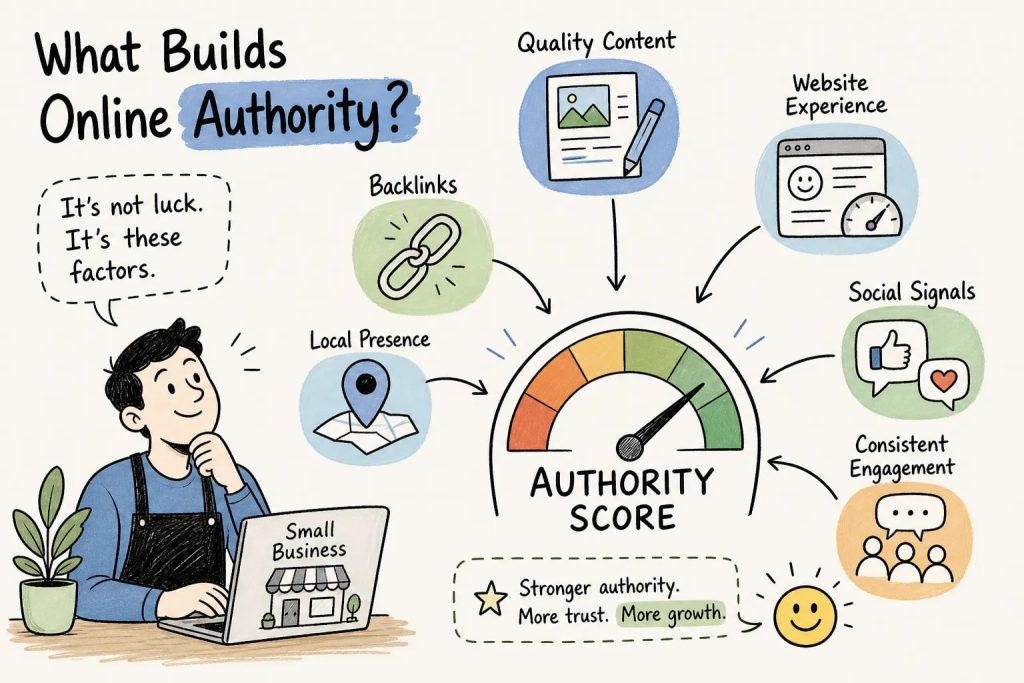
At TW3 Marketing, we built the Authority Framework™ specifically because no third-party score was telling our clients the full story. The framework defines, weights, and measures six key factors in a single 100-point diagnostic called the TW3 Marketing Authority Audit™. By the time you finish this article, you will know what each factor covers, where most service businesses lose points, and what to prioritize first. If you would rather skip ahead, request a free Authority Score check from our team and we will show you exactly where your business stands.
Why domain authority scores only tell part of the story
Moz Domain Authority, Ahrefs Domain Rating, and Majestic Trust Flow are all primarily backlink metrics. Moz DA explicitly uses a machine-learning model; Ahrefs DR focuses on backlink-profile strength; and Majestic Trust Flow measures how close your domain sits to a set of manually verified seed sites in the link graph. Each produces a useful competitive benchmark, but none of them measures content quality, local trust signals, review consistency, or how clearly your business positions its expertise. They are narrow instruments being asked to answer a much broader question.
For local service businesses, HVAC companies, contractors, independent insurance agencies, a typical DA or DR falls between 20 and 35. That range is sufficient to compete locally if the other trust signals are strong. A business with a DA of 28 and a well-optimized Google Business Profile, deep topical content, and 120 recent five-star reviews can often outperform a competitor sitting at DA 40 with weak local signals. Local SEO research consistently shows that GBP optimization and review signals heavily influence local-pack visibility and perceived authority. The backlink score reflects one dimension. A small business’s full authority score online is built from several.
AI platforms make this gap even more apparent. When ChatGPT or Google AI surfaces a local business recommendation, it is synthesizing information from reviews, structured data, third-party corroboration, and content relevance, not auditing your link profile. The businesses that get recommended are the ones most consistently and credibly represented across multiple signals. That is exactly the gap the Authority Framework™ was built to close.
Factors that determine a small business’s authority score online
TW3’s Authority Framework™ organizes the signals that shape online authority into six weighted factors. The first three, positioning, proof, and expertise, cover how your business presents itself and documents its credibility. The second three, visibility, engagement, and experience, cover how broadly that credibility reaches customers and whether it converts.
Positioning: the clarity signal
Positioning answers one question for both customers and AI systems: who do you serve and why are you the right choice? A business with vague or generic messaging scores low here even if its backlink profile is healthy. Specificity signals authority because it gives search systems and human visitors something concrete to match against a query. “We serve homeowners in the Dallas metro area with emergency HVAC repair and same-day service” is authoritative. “We provide HVAC solutions for all your needs” is not.
Proof: your visible track record
Proof covers documented evidence of your track record: Google reviews, case studies, client outcomes, years in business, certifications, awards, and media mentions. Volume and recency both matter. Consistent NAP citations, name, address, phone number, across reputable directories reinforce this factor as a machine-verifiable trust signal, because AI systems check whether your business data is coherent across sources before surfacing a recommendation. Businesses with strong positioning but weak proof tend to attract traffic without converting it. Visitors show up, feel uncertain, and leave.
Expertise: content that proves knowledge
Expertise measures whether your content demonstrates genuine knowledge or just fills space. Google’s E-E-A-T framework, experience, expertise, authoritativeness, trustworthiness, is the clearest public proxy for this factor. In practice, expertise shows up in authorship transparency, topical depth, accurate sourcing, and structured coverage of questions your customers are actually asking. A service page that answers the five most common homeowner questions about HVAC efficiency signals expertise. A page that lists services and a phone number does not.
Visibility, engagement, and experience: the reach factors
Visibility: how broadly you appear
Visibility captures how consistently your business shows up where customers are searching. This includes organic search rankings, Google Business Profile optimization, referring-domain diversity, website authority, and presence in AI-generated answers. Referring domains, unique sites linking to you, correlate more strongly with authority than raw backlink volume because they signal breadth of third-party endorsement. A contractor with links from a local chamber of commerce, two regional news outlets, and a trade association carries more authority signal than one with twenty links from a single directory vendor. Organic traffic growth over time is one of the clearest indicators that visibility improvements are taking hold.
Engagement: real responses from real people
Engagement reflects whether your online presence generates genuine responses: branded searches, time on site, direct traffic, return visits, and review-response consistency. According to Google’s own guidance, user engagement and signals of genuine relevance factor into how content is evaluated. For local service businesses, this often shows up in how consistently you respond to reviews and whether customers search for you by name rather than just by category. Branded search volume is a strong indicator in many cases that your authority-building is working.
Experience: what happens after the click
Experience measures what a visitor encounters when they land on your site or find your listing. Core Web Vitals, HTTPS security, mobile responsiveness, citation flow, and clear on-site trust signals, contact information, About page, privacy policy, all fall under this factor. A business can score well on backlinks and content but still lose authority conversions because the site creates friction or doubt. A slow page with no visible contact details likely signals low credibility to both visitors and search systems, regardless of how strong the rest of the profile looks.
How the TW3 Marketing Authority Audit™ turns these signals into a measurable score
The TW3 Marketing Authority Audit™ is our proprietary methodology for scoring each of the six factors and combining them into a single 100-point Authority Score™. Instead of knowing only that you have a DA of 28, you see exactly which factor is dragging your score, and what closing that gap would mean for organic traffic, visibility, and lead generation. The abstract becomes actionable.
Based on our audits to date, service businesses most often score reasonably well on positioning and site experience but drop significantly on proof, expertise, and engagement. The pattern we observe across industries: businesses invest in a decent website and then stop building the trust infrastructure that converts visitors into clients and earns AI recommendations. The audit surfaces those gaps so you invest in the highest-ROI improvements first rather than spending budget on ads over a weak trust foundation.
Our Authority Score™ Check examines publicly available signals, GBP optimization, reviews, site audit, and backlink snapshot, and delivers results within 48 hours, giving you a clear picture of where your business stands across both Google and AI platforms like ChatGPT. Reach out to our team to get yours and see exactly what to fix first.
Start closing the gaps that matter
What determines a small business’s authority score online is not a single metric but several interlocking signals. No tool that measures only backlinks or only reviews gives you the full picture. The practical path forward is a structured audit that scores each factor separately, so you know exactly where to focus your time and budget.
A 100-point framework gives you something actionable rather than just a number to monitor. Businesses that identify and close their authority gaps now are more likely to earn AI recommendations and organic trust when customers search without ad budgets. That advantage belongs to businesses that measure what actually matters, starting now.
Frequently asked questions about small business authority scores
What factors determine a small business’s authority score online?
Authority online is shaped by multiple signals working together: how clearly your business is positioned for a specific audience, how well your track record is documented (reviews, citations, case studies), how much topical expertise your content demonstrates, how broadly you appear across search and AI platforms, how actively your presence generates real engagement, and how smooth the on-site experience is for visitors. Backlink metrics like Moz DA capture only one piece of this picture.
Is a DA of 28 good enough to compete locally?
For most local service categories, yes, provided the other authority signals are strong. Local SEO research shows that GBP optimization, review volume and recency, and citation consistency can heavily influence local-pack visibility even when domain authority is modest. A DA of 28 with strong local signals can often outperform a DA of 40 with weak ones.
How does AI decide which local businesses to recommend?
AI platforms synthesize reviews, structured data, third-party corroboration, and content relevance rather than auditing raw link profiles. Businesses that are consistently and credibly represented across multiple signals are more likely to surface in AI-generated recommendations than those that rely on a single strong metric.
How quickly can I improve my Authority Score?
Some factors, like responding to reviews, updating NAP citations, and adding HTTPS, can move within weeks. Others, like building referring-domain diversity and deepening topical content, take months of consistent effort. An audit that identifies your lowest-scoring factors lets you prioritize the improvements with the fastest meaningful impact.
