
A homeowner’s furnace dies at 9 p.m. She opens ChatGPT and types: “Who’s a reliable HVAC contractor near me?” One company gets mentioned. A competitor with 15 more years of experience and better pricing doesn’t make the list. That gap isn’t about quality. It’s about verifiable signals, and understanding what signals AI uses to decide which local businesses to recommend to customers is the first step to closing it.
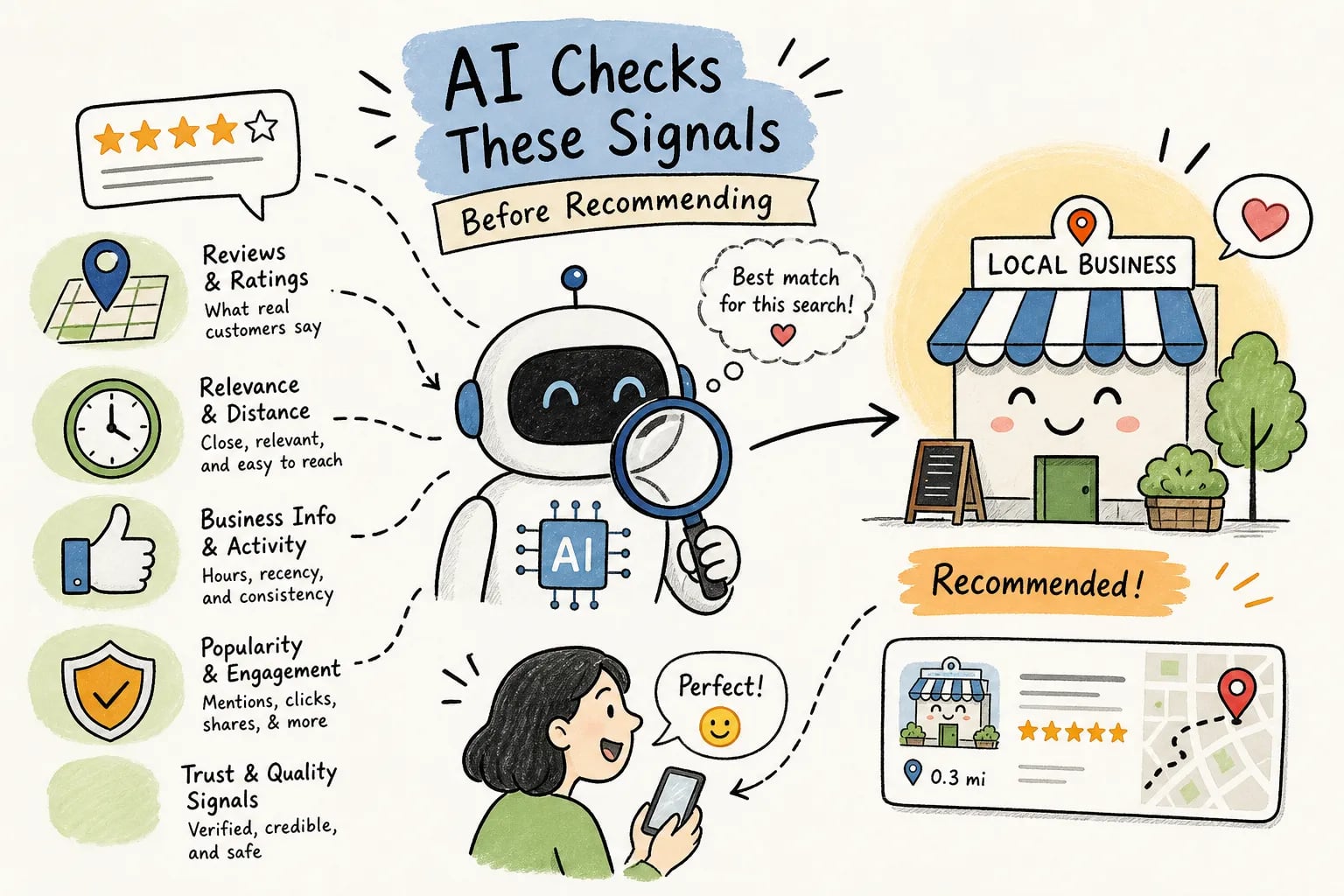
AI systems like ChatGPT, Google AI Overviews, and voice assistants don’t guess when they recommend a local business. They cross-reference a specific set of trust, proof, visibility, and expertise signals before surfacing any name. If your business can’t be verified across those signals, you get skipped. Full stop.
This is exactly the problem TW3 Marketing Authority Audit™ was built to solve. The scoring system decodes each signal category and shows service businesses precisely where they stand and what needs fixing. Before you can fix anything, though, you need to understand what AI is actually checking.
Trust signals: the first thing AI tries to verify
Why reviews are more about recency than volume
Reviews are the most consistently cited trust signal across AI recommendation systems, but the way most businesses think about reviews is wrong. Raw volume matters less than recency. A business with 40 reviews from the last 90 days signals active, current customer experience. One with 400 reviews from 2021 looks stale to an AI system that’s trying to confirm the business is still operating and still good.
Industry practitioners and local search analysts generally put the recency window at around 90 days. Reviews within that window carry significantly more weight than older ones, regardless of star rating. Star rating acts more like a floor than a deciding factor. A 4.7-star average with stale reviews can lose to a 4.5-star business with consistent, fresh activity. For HVAC specifically, where customer experience can vary dramatically by season, recency signals current relevance.
Your Google Business Profile is the anchor, not just another signal
Your Google Business Profile is the second major trust signal, and it functions differently from everything else. GBP gives AI systems structured facts: service categories, service areas, hours, photos, and Q&A responses. An incomplete or inactive GBP doesn’t just hurt your visibility, it signals to the AI that the business may not be current or worth recommending. Many local service businesses go months without updating their GBP, and that inactivity registers.
Visibility signals that confirm your business is real
NAP consistency: the verification layer AI cross-references
NAP consistency, your business name, address, and phone number, is the visibility layer AI systems use to confirm you’re a verified entity across the web. ChatGPT and Google AI cross-reference your GBP against Yelp, Bing, Foursquare, industry directories, and other sources. When those sources disagree, the AI faces ambiguity and often resolves it by recommending a competitor with cleaner data, a pattern practitioners have documented repeatedly in prompt testing and local search audits.
The most common version of this problem: a roofing contractor moved locations two years ago but never updated their Yelp listing or HomeAdvisor profile. The AI sees conflicting address data, lowers its confidence that the business is a verified entity, and skips the recommendation. Many business owners may be completely unaware this is happening, because there’s no alert, no error message, just silence in AI search results.
Schema markup: the machine-readable label on your website
Schema markup, specifically the LocalBusiness JSON-LD format, is the structured layer that lets AI read your website at a glance. Think of it as a label on the outside of your site that tells AI systems exactly what your business is, where it operates, what services it offers, and what your customers say about it.
The properties that matter most are areaServed, openingHoursSpecification, aggregateRating, and sameAs. These aren’t optional extras for tech-savvy marketers. They’re the machine-readable verification layer that confirms everything else you’re claiming about your business. Here’s a minimal example of what that markup looks like in practice:
{
  "@context": "https://schema.org",
  "@type": "LocalBusiness",
  "name": "Your Business Name",
  "areaServed": "Austin, TX",
  "openingHoursSpecification": {
    "@type": "OpeningHoursSpecification",
    "dayOfWeek": ["Monday","Tuesday","Wednesday","Thursday","Friday"],
    "opens": "08:00",
    "closes": "18:00"
  },
  "aggregateRating": {
    "@type": "AggregateRating",
    "ratingValue": "4.8",
    "reviewCount": "112"
  },
  "sameAs": [
    "https://www.yelp.com/biz/your-business",
    "https://www.facebook.com/yourbusiness"
  ]
}
Proof and authority signals that separate recommended from skipped
Third-party mentions: independent editorial validation
Third-party mentions function as independent editorial validation, and AI systems treat them accordingly. A local news article that mentions your HVAC company in the context of emergency preparedness carries more weight than a dozen entries in low-authority directories. These mentions tell AI systems that someone other than you has confirmed your business is legitimate and capable, a fundamentally different signal than anything you post on your own site.
Quality beats quantity here. A few consistent, high-authority mentions from local media, trade associations like ACCA for HVAC companies, or manufacturer partner pages outperform dozens of generic directory listings. AI systems reward businesses that are repeatedly confirmed by independent, trusted sources, not businesses with isolated or scattered mentions.
Credentials and certifications: making expertise verifiable
Credentials and certifications are especially important in regulated service categories. Licensing details, trade certifications, and clear service specialization can function like gating signals for AI recommendations in categories such as HVAC and contracting, particularly where verifiable credentials improve AI confidence in recommending a business. AI systems favor businesses whose expertise is specific and verifiable over generalists with thin digital footprints. The fix is straightforward: make your credentials visible and prominent on your website, not buried in a footer or tucked into an “About” page that most visitors skip past.
How to find out which signals your business is failing
Why guessing which signals to fix becomes expensive fast
Most HVAC and contractor businesses assume their online presence is “good enough” because they have a website and some Google reviews. The problem is that AI systems evaluate all of these signals together, and a weak link in any one category can drop you from consideration entirely. You might have strong reviews but broken NAP data. You might have a complete GBP but no schema markup on your site. Fixing what you can see while ignoring what you can’t leaves the core problem untouched.
This is where guessing becomes expensive. Businesses spend money on ads and SEO while the underlying authority signals that AI uses to make recommendations remain broken. More ad spend doesn’t fix NAP inconsistencies, and more blog posts don’t add schema markup. The only way to know what’s actually missing is a structured diagnostic.
A structured way to audit your AI visibility
TW3 Marketing Authority Audit™ scores your business across six authority signal categories, positioning, proof, expertise, visibility, engagement, and experience, that map closely to the commonly cited signals AI systems evaluate when deciding which local businesses to recommend. The Authority Score™ Check is designed to show you how your business currently appears in Google and ChatGPT, so you know what to fix before you spend another dollar on marketing. Think of it as a diagnostic first: know your score, then prioritize what actually moves the needle.
If you’d rather start with a quick self-audit, work through this checklist:
- Are your business name, address, and phone number identical across Google, Yelp, Bing, and all major directories?
- Has your Google Business Profile been updated, posts, photos, or Q&A, within the last 30 days?
- Do you have
LocalBusinessJSON-LD schema implemented on your website? - Have you received at least several new reviews within the past 90 days?
- Are your licenses and certifications clearly displayed on your website (not just the footer)?
- Does your business appear in at least one local news article, trade association page, or manufacturer directory?
The businesses that get recommended are the most verifiable ones
Understanding what signals AI uses to decide which local businesses to recommend to customers reveals a clear pattern: AI recommendations aren’t random, and they aren’t pay-to-play. They follow a signal-verification process built on trust, visibility, proof, and expertise. Every signal in that process can be measured and improved once you know where you stand.
The HVAC contractor who gets recommended at 9 p.m. didn’t get lucky. They have consistent NAP data across directories, recent reviews on Google and Yelp, a fully completed GBP, LocalBusiness schema on their site, and a handful of solid third-party mentions that give AI systems enough verification to surface them with confidence.
Before you adjust your marketing spend or launch a new campaign, the highest-leverage move is knowing your current signal score. The businesses that get recommended by AI in 2026 aren’t the most experienced ones, they’re the most verifiable ones. TW3 Marketing Authority Audit™ gives you a clear number and a prioritized action plan so you’re fixing what actually matters.
