
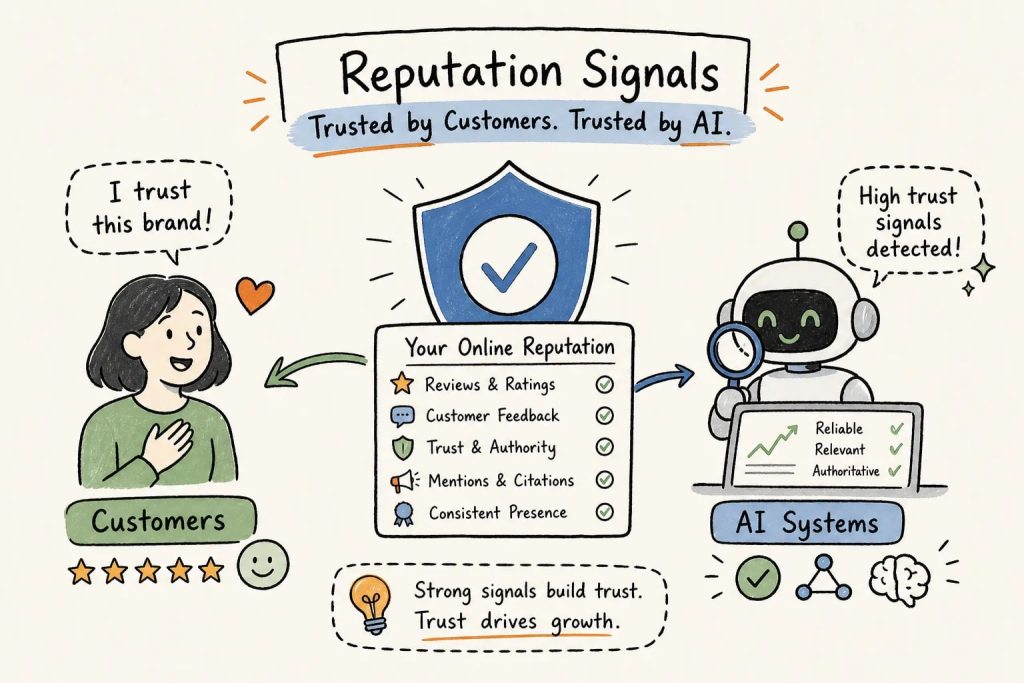
Online reputation signals are more than just star ratings, many service businesses focus primarily on review counts, which is too narrow a view. The credibility indicators that determine whether a customer chooses you, and whether an AI platform recommends you, span far more than a single metric. They include how you respond to feedback, what third-party sources say about you, how your website signals expertise, and how consistently your business information appears across the web. At TW3 Marketing, working with service businesses across 70+ industries has revealed a consistent pattern: the businesses losing leads aren’t necessarily doing bad work. They’re missing specific digital reputation signals that build credibility with both human buyers and AI systems.
Online reputation signals that actually move buyers
Not all online reputation signals carry equal weight. Some drive trust and purchase decisions directly. Others drive visibility and awareness. Businesses that treat them as equivalent end up spreading effort across the wrong things. Across client work in competitive local service markets, the ranking holds up consistently: reviews and ratings sit at the top, followed by recency and response behavior, then backlinks and authoritative brand mentions, then sentiment patterns, and finally social engagement. Follower counts and social likes matter far less than most business owners assume, they function as awareness indicators, not direct trust signals.
Trust-driving signals vs. visibility signals
The distinction matters more than most people realize. Trust-driving signals, star ratings, review volume, and review responses, directly influence whether a prospect converts. Visibility signals, backlinks, press mentions, and brand citations, influence how easily a business surfaces before that conversion moment even happens. Both matter, but they fix different problems. A business with low visibility needs more authoritative coverage. A business with visibility but low conversion needs stronger review signals and on-site credibility markers. Many businesses conflate the two and end up solving the wrong problem entirely.
Why review signals sit above everything else
Reviews are the dominant conversion signal because they’re the fastest proxy for trustworthiness a stranger can find. Star rating, volume, and freshness all matter. For HVAC and plumbing contractors, the 2026 benchmark puts competitive businesses at 4.52 to 4.55 stars with consistent review velocity of 8 to 15 new reviews per month. Response behavior amplifies the signal further: businesses that respond to negative reviews within 24 hours recover to above-average ratings at twice the rate of those that don’t. In client work, a 90-day improvement in response consistency commonly produces a 0.2 to 0.4 star lift.
How AI platforms read your online reputation signals
Most businesses optimize for how their reputation looks to humans. That’s necessary but no longer sufficient. AI platforms like Google AI and ChatGPT apply their own criteria when deciding which businesses to surface or recommend. These systems don’t just scan star ratings; they evaluate a combination of expertise and trust signals, sentiment patterns across review text, brand authority indicators, and the quality of citations pointing to the business. It’s worth noting that neither Google nor OpenAI has published an exhaustive list of these factors, the patterns described here reflect observed behavior and current industry research.
What Google AI and ChatGPT look for in a local business
Google’s AI Overviews and ChatGPT’s local recommendations are built on authority and trust layers, not just volume. They look at the consistency of a business’s name, address, and identity across citations; the sentiment themes running through review text; whether the business appears in trusted third-party sources; and whether the website clearly signals expertise in a specific service category. A strong review count paired with thin content elsewhere won’t satisfy an AI recommendation threshold the way it might satisfy a casual browsing customer.
The gap between looking credible and being recommended
A business can look credible to a human visitor but still be invisible to AI recommendations. The gap usually lives in unstructured data: review text that doesn’t reinforce specific service expertise, website content that doesn’t clearly signal authority in a niche, and a citation profile that lacks prominent third-party mentions. Closing this gap requires treating your digital reputation signals as a strategic system, not a collection of individual tactics you check off when you remember to.
Measuring where your online reputation signals actually stand
Before fixing anything, you need a clear signal baseline. The most useful tools for service businesses are Brand24 for mentions, sentiment, and share of voice; ReviewTrackers for review aggregation and sentiment breakdowns by location; and Meltwater for competitive mention intelligence and overall prominence tracking. Each surfaces reputation management signals and credibility markers rather than vanity metrics, which makes prioritization actionable instead of guesswork.
Benchmark targets that actually mean something
For home service contractors, a 4.4-star rating represents a practical minimum floor, with top performers in HVAC and plumbing typically sitting at 4.5 and above, industry data places the competitive range for these trades between 4.4 and 4.6 stars. Review velocity should target at minimum 8 to 12 new reviews per month to maintain recency signals. Response time should be under 48 hours for all reviews and faster for negative ones. These aren’t aspirational targets; they’re the thresholds where your social proof signals start working in your favor rather than quietly costing you leads.
A realistic plan to fix weak signals
Fast wins come from review response systems and policy-based content removals. Sustained improvement in branded search results and AI visibility takes 3 to 6 months minimum. Building signal strength takes time, and businesses that expect overnight results typically abandon the effort before it compounds, which is exactly the window their competitors use to pull ahead.
The first 30 days
Start with review responses. Set up templates, get response times under 24 hours for negative reviews, and begin a systematic ask-for-review workflow for recent customers. File removal requests for reviews that violate platform policies; these can resolve in days to a few weeks. Fix technical indexing issues on the website so that positive content gets surfaced and crawled correctly. None of this is glamorous, but these are the moves that shift your visible trust signals the fastest.
Building sustained signal strength from month one to month three
The 90-day window is where authority-building work starts to compound. This means publishing service-specific content that reinforces expertise, building citations in relevant directories, and earning coverage in local and industry publications. These moves improve the quality of reputation management signals that AI platforms weigh when deciding who to recommend. If branded search results are dominated by unfavorable content, suppression through consistent content creation becomes part of the plan, with realistic expectations that meaningful page-one changes take three to eight months for most local service businesses.
Where to go from here
Online reputation signals aren’t a single number to chase. They’re a system of interconnected data points that customers and AI platforms both read, often differently. The businesses that grow consistently through word-of-mouth and AI-driven discovery aren’t luckier than their competitors. They’ve built stronger credibility markers, tracked them, and fixed the weak ones before they became real problems.
Start with your review profile and work outward from there, measuring mentions, sentiment, and the gap between how you appear to human buyers versus AI recommendation systems. If you want to see exactly where your online reputation indicators stand right now, TW3 Marketing Authority Audit™ gives you a clear baseline and a prioritized roadmap so you’re fixing the right things in the right order.
