
Picture this: a roofing contractor ranks in the top three of Google’s Map Pack, pulling in solid leads every month. Then a homeowner opens ChatGPT and types, “Who’s the best roofer near me?” The business doesn’t show up at all. If you’ve ever wondered what is the difference between SEO and AI optimization for a local contracting business, that scenario captures it precisely, two separate visibility channels, two separate sets of rules. The contractor didn’t do anything wrong. They just optimized for one channel and left the other completely unaddressed.
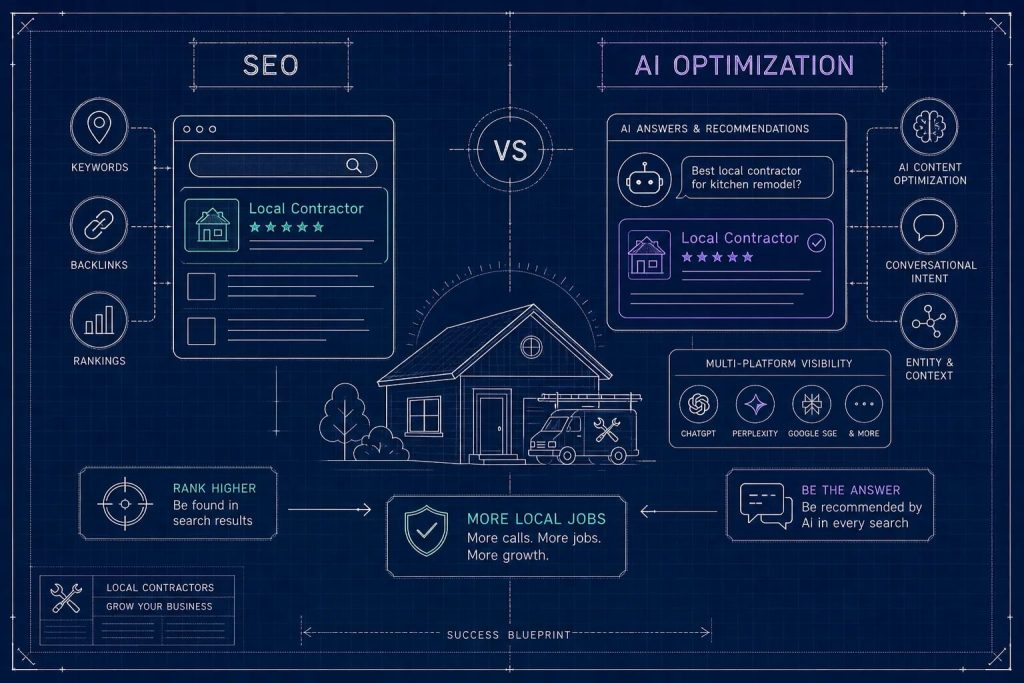
Traditional local SEO and AI optimization aren’t the same discipline, and treating them as interchangeable is how marketing dollars get misallocated. This breakdown covers what each strategy actually does, where costs and risks differ, and how to prioritize both without guessing.
What is the difference between SEO and AI optimization for a local contracting business?
To understand how these two approaches diverge, it helps to start with what each one is actually optimizing for, because the target audiences aren’t identical.
What traditional local SEO does for your contracting business
Traditional local SEO is built around Google’s ranking algorithm: your Google Business Profile, on-page keyword signals, citation consistency (NAP data across directories), inbound links, and review volume. These signals tell Google’s crawler what you do, where you do it, and why you’re credible. Get them right, and you show up in the Map Pack and organic results when someone types “HVAC repair near me” into a search bar.
The Map Pack captures roughly 44% of clicks on local search results pages, a plurality that makes it the highest-value traditional placement for service businesses. Businesses appearing in the top three local positions also generate 93% more user actions, such as calls and direction requests, than those ranked outside that group. The channel rewards consistency: a fully built-out GBP, clean citations across major directories, location-specific service pages, and a steady flow of genuine reviews all compound over time.
How AI optimization (AEO) works differently
AI platforms like ChatGPT, Google’s AI Overviews, and voice assistants don’t crawl and rank pages the way Google’s traditional index does. They pull from structured data, third-party mentions, review sentiment, and content that directly answers conversational questions. When a homeowner asks “who’s the best plumber near me,” the AI isn’t scanning keyword density, it’s looking for a business it can confidently cite as an authority.
Answer Engine Optimization (AEO) tactics reflect this difference. FAQ content written in natural question-and-answer format, LocalBusiness and Service schema markup, and plain-language service descriptions that match how customers actually speak all outperform keyword-stuffed copy in AI-generated answers. Contractor-specific schema subtypes, such as GeneralContractor, RoofingContractor, or HVACBusiness, tell AI systems exactly who you are and what you offer. Strong review signals matter here too, but the AI is reading sentiment and consistency, not just star ratings.
AI Overviews appear on over 80% of broad local service queries in 2026, but that rate drops to roughly 12% on highly local “near me” searches, where the traditional Map Pack still dominates. Neither channel is going away. They serve different moments in the customer’s search behavior, which is precisely why contractors need both.
Where tactics, costs, and risks diverge for local contractors
A traditional local SEO retainer for a contracting business typically runs $500 to $3,000 per month depending on market competition. AI optimization services generally carry a comparable or slightly higher price tag in 2026, often $1,500 to $5,000 per month for managed services, though the ranges overlap substantially at the lower end. The difference isn’t always about cost, it’s about what you’re buying. Agency retainers deliver consistent execution across multiple channels. AI-focused tools offer lower upfront costs but require more content restructuring work on your end.
The risks also split differently. Going all-in on traditional SEO while ignoring AI search means you’re invisible to a growing share of how homeowners find contractors. But using AI tools carelessly to populate your GBP or service pages introduces a different problem: hallucinated service details, wrong business hours, and generic thin content that can suppress your local visibility or erode customer trust. Google doesn’t penalize content simply because AI wrote it, but low-quality, inaccurate, or near-duplicate content still performs poorly and can trigger review suppression or local ranking drops. Neither channel rewards shortcuts.
How to decide what to prioritize, and measure both at once
The biggest problem contractors face isn’t choosing between SEO and AEO. It’s not knowing where their authority stands across both channels before spending another dollar. Most businesses have blind spots: strong GBP presence but weak structured data, or solid keyword rankings but zero visibility in AI-generated answers. Spending on tactics before diagnosing those gaps is exactly how marketing budgets get wasted.
That diagnostic gap is what a structured audit is designed to close. TW3 Marketing Authority Audit™ addresses this directly. It’s a 100-point diagnostic that scores your contracting business across six authority signals, covering both traditional SEO factors (GBP completeness, citations, reviews, on-page signals) and AI optimization dimensions (structured data, content clarity, trust signals, third-party mentions). Instead of running two separate audits and reconciling the results yourself, you get one clear score showing exactly where to invest first for maximum visibility across both Google’s traditional index and AI recommendation engines. You can request an Authority Score check and see how your business currently appears in Google and ChatGPT.
Your practical starting point
Understanding the difference between SEO and AI optimization for a local contracting business is the first step, but knowing where you stand on both channels is what actually moves the needle. The Map Pack captures the largest share of local clicks for contractor searches (roughly 44% according to multiple local-search studies), while AI-powered answers are a fast-growing channel that rewards businesses with strong authority signals and clear, structured content.
A solid 90-day starting point looks like this: audit where you stand on both channels, fix your GBP and schema gaps first (they serve both channels simultaneously), then build FAQ content around the exact questions your customers ask AI assistants. If you’re not sure where to start, start with diagnosis. Spending on tactics before you know your authority score is like buying materials before you’ve read the blueprint.
