
ChatGPT visibility determines whether your business gets named when a prospective buyer asks an AI assistant for a local service recommendation. Buyers used to Google “best estate planning attorney in Austin” and scan a list of results. Now a growing share of them open ChatGPT, ask the same question, and wait for a name. If you’re not the name that surfaces, that buyer moves on without ever knowing you exist. The shift isn’t coming. It’s already here.
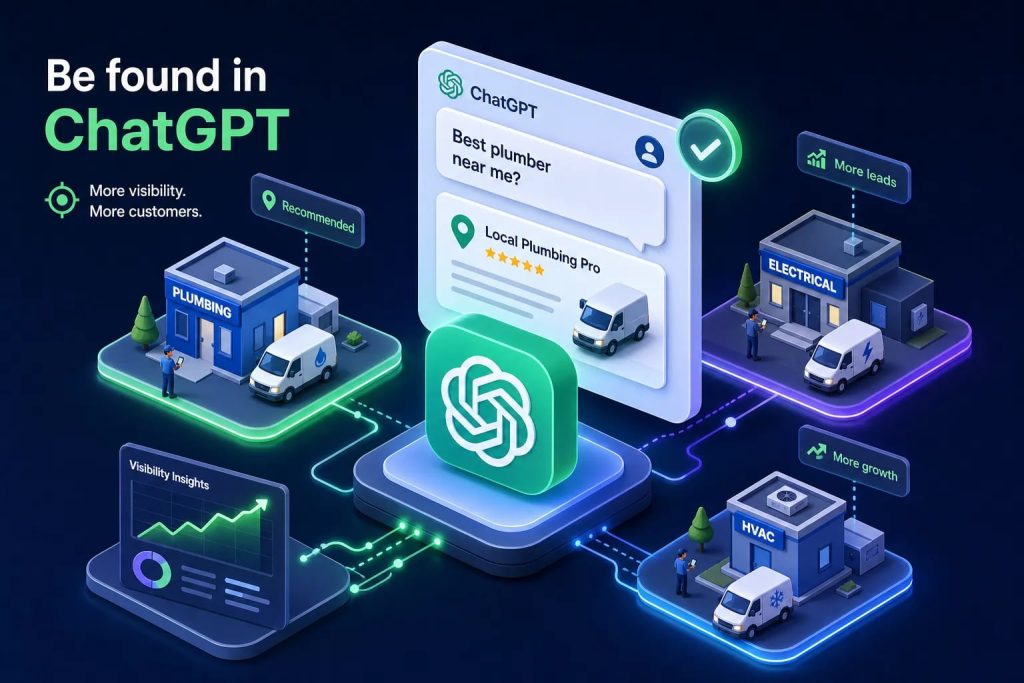
Visibility on ChatGPT is separate from your Google ranking. A first-page Google result doesn’t automatically translate into an AI recommendation. The two systems use different signals and produce different outputs.
At TW3 Marketing, we see established firms get passed over by AI systems consistently, not because they lack real expertise, but because that expertise isn’t structured in a way AI can read, verify, and trust. This article breaks down exactly what drives AI recommendations for local service businesses, which authority signals carry the most weight, and how to start closing the gap.
What ChatGPT visibility actually means for a local business
Google returns a list of links. ChatGPT synthesizes evidence from across the web and surfaces specific names based on what it can verify. Getting visible in that system means your business earns mentions or ChatGPT citations inside those synthesized answers, not just a slot in a ranked results page.
For local service businesses, this plays out in precise, high-stakes moments. Someone asks, “What insurance agency should I use for my small business in Denver?” or “Who’s a good estate attorney in Charlotte?” The AI either knows your name and recommends you, or it doesn’t. There’s no position three to fall back on, and no second-chance impression if you’re absent from that answer.
Buyers using AI assistants for vendor research tend to be further into the decision process. They’re not browsing casually; they’re narrowing. A recommendation in that moment carries real weight. This isn’t about traffic volume. It’s about being named when a buyer is ready to reach out.
How ChatGPT decides which businesses to surface
ChatGPT doesn’t use a fixed local ranking formula. What it does is interpret the buyer’s request, retrieve current information from websites, directories, and review platforms, then synthesize a shortlist based on the best available evidence. The firms that make that shortlist aren’t necessarily the closest or the highest-rated. They’re the ones whose information is clearest, most consistent, and most independently corroborated.
Key signals that drive AI recommendations
Entity clarity is a foundational signal. Your business name, service description, category, and location need to appear consistently across your website, Google Business Profile, directories, and third-party mentions. When those signals conflict or remain vague, AI systems struggle to connect your firm to a specific buyer need. Specificity wins here: “independent insurance broker specializing in commercial liability for construction firms” outperforms “full-service insurance agency” every time.
Third-party sources carry more weight than self-published claims. For local businesses, the sources that matter most include platforms like Expertise.com, Angi, the BBB, Thumbtack, industry-specific directories, and earned media coverage. Review platforms with detailed, recent reviews also factor in. Recency matters: stale profiles reduce reliability signals, and an outdated listing can actively work against your LLM search visibility.
Tracking your ChatGPT visibility baseline
Before making any changes, establish a baseline using AI citation tracking tools like Otterly.AI, Peec AI, or Semrush’s AI visibility features. Each tool works by running a defined set of prompts across AI platforms and measuring how often your business is mentioned and cited. Pick 20 to 30 high-intent prompts relevant to your category and location. That baseline is what you’ll measure every improvement against.
Authority signals that influence AI recommendations
AI systems consistently favor evidence that is independently verifiable. Detailed, current reviews on credible platforms, accurate directory listings, and third-party editorial coverage signal that your business is real, active, and trustworthy. A local firm with 80 specific Google reviews and a presence on a niche industry directory will often outperform a competitor with a polished website but a thin third-party footprint.
Your own website also matters, but only when its content directly answers the kinds of questions buyers ask. FAQ sections, clearly structured service pages, and content that addresses fit, process, and pricing context give AI systems extractable, citable answers. Generic “about us” language and feature lists rarely get cited. Content structured around buyer questions gives AI systems something useful to surface.
Schema markup supports this work. LocalBusiness schema, FAQPage markup, and Service schema help AI systems understand what your business does, who it serves, and where it operates. To illustrate, a basic LocalBusiness schema block would declare your business name, address, phone number, service area, and business category in structured data that AI systems can parse directly. Schema alone won’t lift your AI search citations without strong underlying content, but combined with answer-ready page structure, it improves how accurately AI systems describe your firm.
How to start improving your AI discoverability
Most firms make the mistake of jumping straight to content creation without understanding where the gaps actually are. You can publish FAQ pages and refresh your Google Business Profile indefinitely, but if you don’t know which signals are missing or inconsistent, you’re optimizing blind.
A structured audit is the right starting point, and not just because it saves time. Understanding exactly where your authority signals break down keeps you from investing in tactics that won’t move the needle. TW3 Marketing Authority Audit™ is a 100-point diagnostic that evaluates your positioning, credibility signals, content structure, and ChatGPT visibility across search and AI systems, then delivers a prioritized roadmap before any implementation begins. You know exactly what to fix and why before spending a dollar on content or optimization.
Once you know the gaps, the implementation work centers on making your expertise legible to AI systems. That means consistent entity information across every platform where your business appears, structured content that directly answers real buyer questions, and a strategy for building third-party presence through reviews, directories, and earned coverage. TW3’s AI website optimization work is built specifically for this: aligning your site’s structure, content, and positioning with how AI systems evaluate and surface local businesses, built around your specific authority context, not a generic template.
Measuring your progress over a 90-day window
After 90 days of consistent implementation, compare your mention rate and citation rate against the baseline you established earlier. For most local professional firms starting from limited AI visibility, a realistic early goal is reaching a 10 to 20 percent mention rate on tracked prompts. Moving above 20 percent on high-intent queries signals competitive traction. These aren’t guarantees; they’re directional targets that reflect what’s achievable with structured, consistent work.
Track both your mention rate (how often your firm appears in AI answers) and your citation rate (how often your website or a third-party source is cited alongside your firm). A business can be mentioned without being cited as a source, and that distinction matters for understanding where the gaps are. A solid ChatGPT visibility tracker setup, even a simple spreadsheet logging weekly prompt results alongside your tool output, gives you the trend data needed to make confident decisions about where to invest next.
Closing the gap starts with understanding where you stand
ChatGPT visibility isn’t a technical trick. It’s the result of building the kind of documented, specific, independently validated authority that AI systems can trust enough to recommend. The firms that show up in AI recommendations aren’t necessarily the most polished or the most advertised. They’re the ones whose expertise is visible, verifiable, and legible to the systems making the call, built on consistent entity signals, credible third-party presence, and content structured around real buyer questions.
If you want to improve your ChatGPT visibility and aren’t sure where your firm stands today, start with the TW3 Marketing Authority Audit™. It’s the fastest way to get a clear picture of your current authority signals and a prioritized roadmap for closing the gap. Reach out to our team to learn what that diagnostic could surface for your business.
