
Buyers are increasingly turning to AI assistants for professional recommendations, asking which consultant, insurance agent, or real estate firm to hire. Unlike traditional search, these systems don’t simply match keywords and return a list. They weigh entity confidence and multiple corroborating signals alongside query matching to decide whether a business has earned enough credibility to be surfaced as a recommendation. Many firms treat a website and a Google Business Profile as the baseline, but additional corroborating signals are typically needed to show up in AI assistant recommendations. Understanding what authority signals help businesses appear in those results is the real challenge.
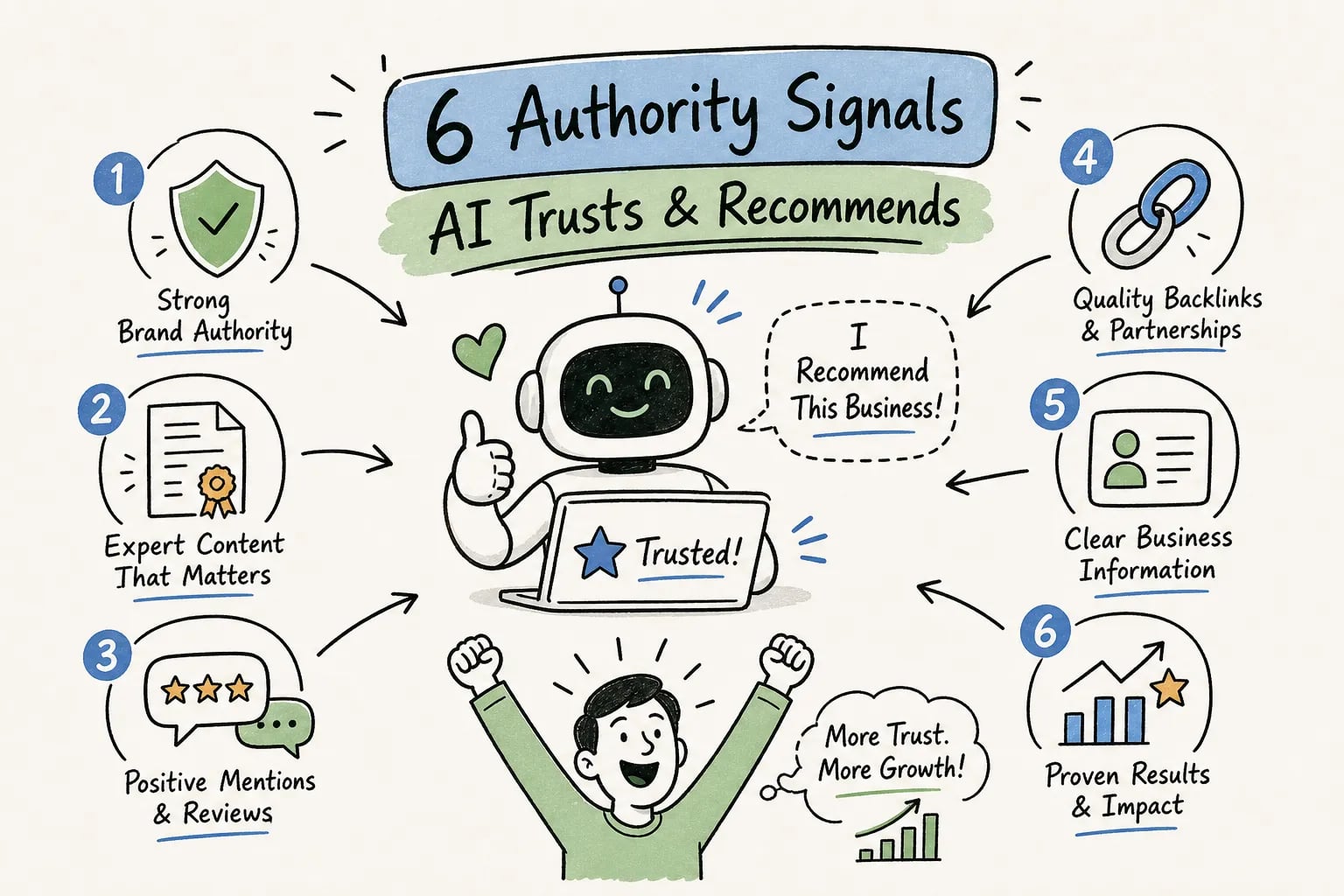
TW3 Marketing’s Authority Framework identifies six specific signals that determine whether AI systems recognize a business as recommend-worthy. Understanding these signals is the first step toward improving your visibility where more buyers are now starting their search.
How AI assistants actually evaluate businesses, and what authority signals they rely on
AI assistants operate on entity confidence, not keyword rankings. They cross-check whether a business is real, relevant, and consistently described across independent sources. A firm with inconsistent directory information, a thin website, and few external mentions may be substantially less likely to be recommended by these systems, even after significant investment in traditional SEO.
The foundational principle is independent corroboration. An AI assistant grows more confident recommending a business when multiple trustworthy, unrelated sources agree on what it is, what it does, and how clients experience it. One strong website is one signal. Several independent sources saying the same thing is authority. That distinction explains why firms with strong reputations in their markets still don’t appear when buyers search through AI tools.
The six authority signals that shape AI assistant recommendations
The first three signals form what you might call the “what you know and who you are” layer.
Positioning is how clearly a business communicates its specialization, ideal client, and differentiation. A management consultant who serves mid-market manufacturing firms signals more precisely than one who “helps all businesses grow.” Specificity reduces ambiguity, and AI systems reward clarity.
Proof covers reviews, case studies, editorial mentions, and third-party coverage. Sentiment specificity in reviews matters more than star averages because AI extracts attributes like “helped us through a complex claim” or “knows the luxury market” and matches those phrases to buyer queries. Review sentiment and AI discovery are closely linked, the more descriptive your reviews, the more an assistant can match your firm to specific buyer needs.
Expertise is demonstrated through published content, credentials, association memberships, and speaking engagements that AI systems can find and verify from multiple locations.
The second three signals represent what the outside world sees.
Visibility includes consistent citations across Google Business Profile, industry directories, and authoritative publications, along with schema and structured data that connect the business entity to its services, people, and location. These entity signals help AI assistants recognize and categorize your firm with confidence.
Engagement is the pattern of review recency and velocity. A steady stream of fresh, detailed reviews across multiple platforms signals an active, trusted business far more convincingly than a large but stale review history.
Experience is what a buyer encounters on the website itself: clear service pages, staff credentials, answered questions, and a logical path from research to a qualified conversation. AI systems read these elements as legitimacy signals, not just sales copy.
What these signals look like for professional service firms
An independent insurance agency with detailed Google reviews mentioning “explained all our coverage options clearly” and “responded fast after the claim” gives AI assistants specific attributes to match against buyer queries. The assistant doesn’t just see a four-star rating. It sees a firm associated with responsiveness, clarity, and claims support.
A boutique real estate team with consistent Realtor.com and Zillow profiles and local press mentions is far easier for an AI to recognize and recommend. A website that plainly states the neighborhoods and price ranges they serve only strengthens that signal, especially compared to a firm with a generic homepage and scattered directory listings.
A fractional CFO whose LinkedIn articles, podcast appearances, and association memberships all reinforce the same specialization earns expertise signals that an AI can verify across sources rather than accepting on faith.
The gap most professional service firms face is not a lack of effort. It’s a lack of structure. A firm might have strong reviews on one platform but thin coverage elsewhere. Its website might describe services in general terms while its directory profiles say something slightly different. These inconsistencies lower entity confidence, and lower entity confidence reduces the likelihood of a recommendation. The fix starts with knowing exactly where the gaps are.
How TW3 Marketing Authority Audit™ measures all six signals
TW3 Marketing Authority Audit™ evaluates all six authority signals from the Authority Framework against a 100-point scale. Each signal category is assessed for evidence, consistency, and competitive context. The result is a concrete Authority Score paired with a documented gap analysis that shows exactly which signals are weak and why. Firms get a clear picture of how AI systems are likely perceiving them right now, before any changes are made.
The audit output includes a prioritized roadmap that sequences improvements based on impact and feasibility for the specific firm’s situation. The roadmap identifies which signal gaps are suppressing AI visibility most and which corrections will compound across multiple signals, so you’re not trying to fix everything at once. Firms in TW3’s Momentum or Domination programs implement from that roadmap with ongoing support, so authority building becomes a structured system rather than a series of disconnected tactics.
Where to go from here
AI assistants are not mysterious. They evaluate authority signals the same way a careful buyer does: by checking whether multiple credible, independent sources agree on who a business is and what it delivers. Improving these six signals, positioning, proof, expertise, visibility, engagement, and experience, is how you address what authority signals help businesses show up in AI assistant recommendations. Any firm can move the needle on these. The starting point is knowing your current score.
TW3 Marketing Authority Audit™ gives you that score and the roadmap to act on it. If you’re ready to see where your firm stands across all six signals, reach out to our team to get started.
