
A trust gap assessment starts with a deceptively simple question: why did that prospect hire someone else? A buyer found your firm online, read your website, checked your reviews, maybe even looked up your team, and then chose a competitor. Not because that other firm does better work, but because they looked more credible at every point where the buyer was forming a judgment. That gap between what your firm genuinely delivers and what a buyer can independently verify is exactly what a structured trust evaluation is designed to surface. TW3 Marketing built its entire diagnostic process around closing that gap for established professional firms, and this article explains what that process uncovers and why the findings matter.
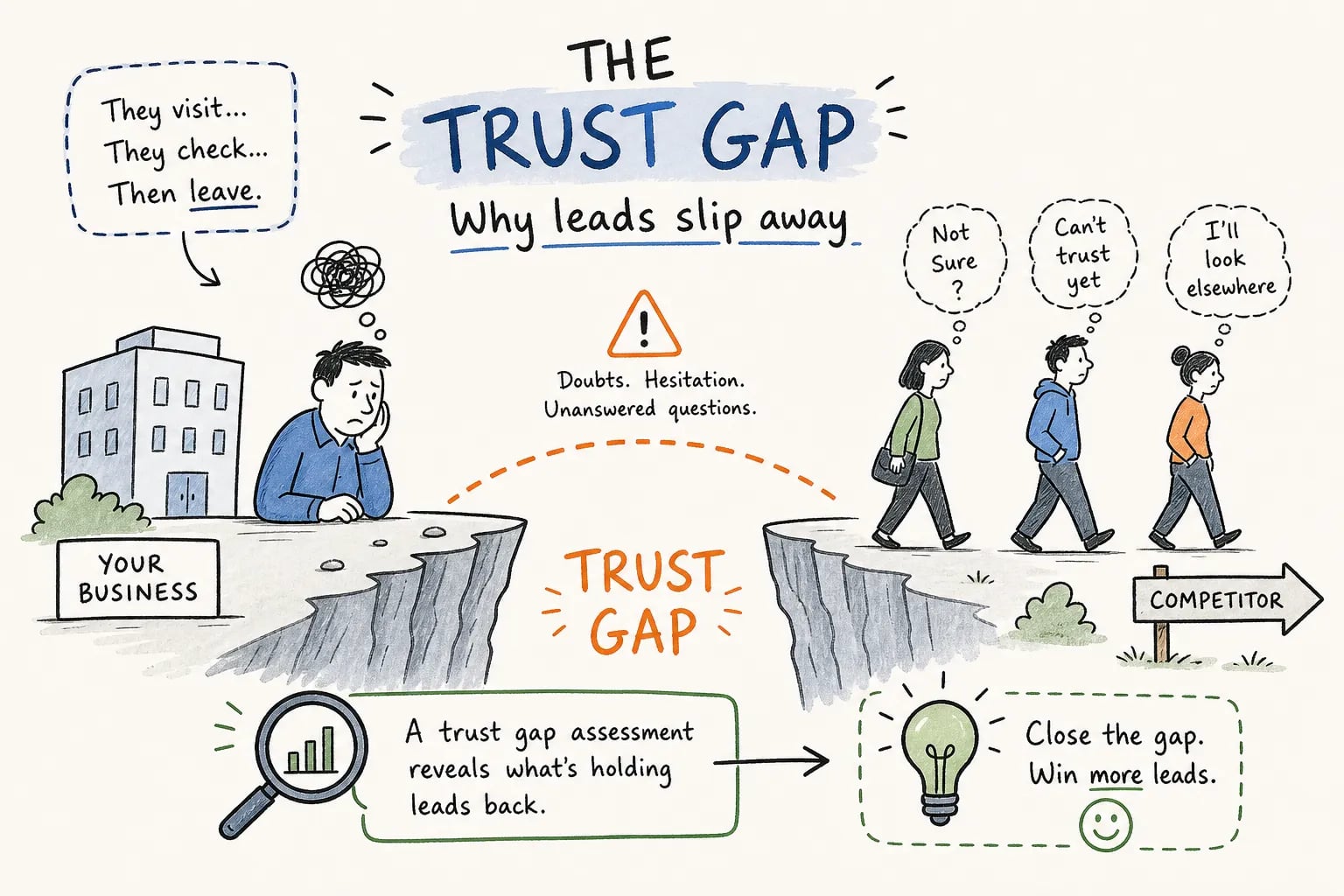
Many firms focus on price or prospect intent rather than diagnosing their perceived credibility after losing a lead. The real question is simpler: at the moment that buyer was comparing options, did your digital presence make the credibility case clearly enough? A trust gap analysis answers that question with evidence, not guesswork, replacing speculation about what went wrong with a specific, actionable picture of where your authority signals fell short.
What a trust gap actually is
A trust gap is the distance between the expertise a firm genuinely holds and the evidence a prospective buyer can independently verify before ever reaching out. It exists not because the firm lacks capability, but because that capability is invisible or unconvincing in the places buyers look during the research phase. Think about how you evaluate a vendor or referral: you visit the site, scan for proof of relevant work, look for reviews from clients who sound like you, and form a rapid judgment about whether this firm seems right for your situation. That informal checklist is where trust gaps either close or widen.
Established firms often have the most severe gaps, and the reason is counterintuitive. Firms that built their reputation through referrals and relationships earned real trust, but they did it without creating visible, documented proof online. A newer competitor with a well-structured digital presence can look more credible to a first-time buyer who has never met either firm. The buyer cannot assess expertise they cannot see. They default to the firm that makes the credibility case most clearly.
How a trust gap forms quietly over time
Trust gaps do not appear overnight. They accumulate as a firm’s digital presence falls out of sync with how buyers actually research decisions. A website built several years ago with generic copy, a thin review profile, no published thought-leadership content, and an “About” page that leads with company history rather than client outcomes is a gap that compounds every month. The firm keeps doing good work while its digital presence keeps drifting further from what buyers expect to find.
Buyers in professional services run a fast, informal checklist before making contact. Is this firm’s specialization clear? Are there reviews from clients who look like me? Can I find evidence of how they approach problems in my situation? Does the site feel current and authoritative? Every one of those questions left unanswered is a point where the buyer may quietly move on. They are not being unreasonable. They are protecting themselves from a bad hire, and they use the signals they can verify to make that judgment. A competitor with specific positioning, visible client outcomes, consistent reviews, and published answers to common buyer questions is not necessarily more skilled, they are simply more legible. Legibility, not capability, wins the lead at that stage of the decision.
What a trust gap assessment actually examines
A useful trust assessment focuses primarily on the evidence buyers encounter at each stage of the research and decision process rather than on branding aesthetics or a technical SEO crawl alone. It identifies where that evidence is absent, weak, or inconsistent, then maps what buyers expect to find against what your digital presence actually delivers.
A thorough trust gap assessment covers six dimensions, each with its own failure modes:
Positioning clarity
Does your firm’s specialization register immediately, or does the homepage feel generic? Unclear positioning forces the buyer to work too hard to determine whether you are relevant to their situation.
Demonstrable expertise
Is there published evidence of how your firm thinks and solves problems? Credentials listed on a bio page are not the same as accessible demonstrations of judgment and approach.
Visible client proof
Can a researching buyer find reviews, case outcomes, or testimonials from clients who look like them? Social proof that feels distant or generic does not close the trust gap.
Website experience and messaging
Does the site guide a researching buyer toward a clear next step, or does it leave them uncertain about whether to reach out? A site can be visually polished and still fail to convert interest into a booked consultation.
Reputation signals
How does the firm appear in third-party reviews, directory listings, and external mentions? Thin or inconsistent reputation signals undermine even a strong website.
Search and AI visibility
Does the firm appear where buyers are actually looking, including in AI-generated search results? This dimension is increasingly important as more buyers begin their research through AI-assisted queries rather than traditional search alone.
The output of a well-run gap analysis is not a vague directive to “improve your content.” It is a specific finding for each dimension: here is what is missing, here is how a buyer experiences that absence, and here is what closing it requires. That specificity is what separates a useful trust scorecard from a generic report, and it is why a gap assessment framework built around buyer behavior produces more actionable results than a standard website audit.
TW3 Marketing Authority Audit™: how the diagnostic works in practice
TW3 Marketing Authority Audit™ is a paid diagnostic built around the six-dimension Authority Framework described above. It produces a 100-point Authority Score that reflects where a firm stands across positioning, proof, expertise, visibility, engagement, and experience. The score is not a vanity metric. It is designed to benchmark the firm’s current buyer-facing signals against how professional firms in that market are actually evaluated, identifying where the gaps are largest relative to that competitive context, based on evidence review and competitive comparison rather than internal self-assessment.
Each dimension is evaluated through evidence review, competitor comparison, and buyer-perspective analysis. The score identifies not just the overall gap but where the highest-priority deficiencies live, so remediation starts where it will have the most impact on buyer perception and lead conversion. After the audit, TW3 delivers a prioritized roadmap that reflects the firm’s specific market, ideal clients, and competitive context, connecting diagnosis directly to action rather than leaving the firm to interpret findings on its own.
Where to start
A trust audit answers a question most professional firms never think to ask: not “are we good at what we do,” but “can buyers verify that we are?” Those are two different questions, and the second one determines who gets the lead. If your firm has strong expertise but inconsistent or incomplete digital proof, a trust gap assessment is where to start. It puts a number on the gap, names the specific weaknesses, and maps the path to closing them.
Piecemeal fixes without a clear diagnosis waste time and resources. Start with the diagnosis. If you want to understand where your firm’s authority gaps are before committing to a full program, reach out to the TW3 Marketing team and ask about the TW3 Marketing Authority Audit™. The findings will tell you more about why you are losing leads than any amount of incremental adjustments to your website ever will.
