
What a 100-point authority audit reveals about your digital credibility is rarely what professionals expect. Most assume an audit spits out a single number that tells them if they’re doing “well” online. That’s not what a credible audit does. A well-built 100-point authority audit maps exactly where buyers, search engines, and AI systems can’t verify your credibility, and why that gap is costing you better-fit clients.
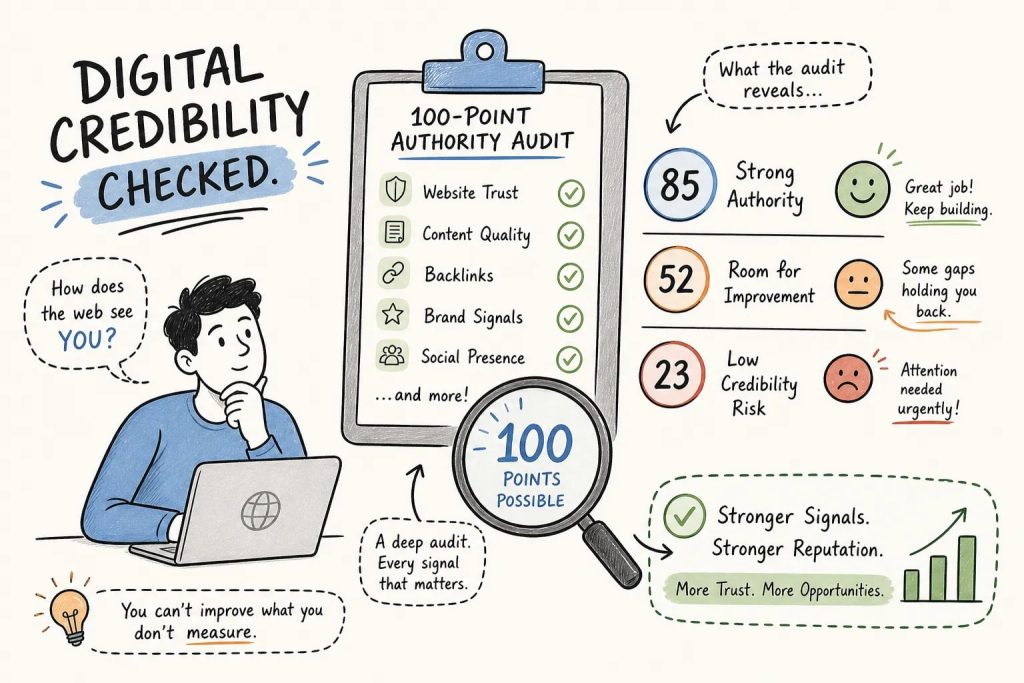
The TW3 Marketing Authority Audit™ uses a 100-point scoring framework to evaluate six specific dimensions of a firm’s authority and translate that assessment into a sequenced action plan, not a generic list of suggestions. Here’s what each scored dimension actually measures, what a low score signals in plain terms, and how the results point you toward the right fixes in the right order.
What a 100-Point Authority Audit Reveals: The Six Dimensions Behind Your Score
The TW3 Authority Framework evaluates six areas: Positioning, Proof, Expertise, Visibility, Engagement, and Experience. Each one measures something distinct, and a weak score in any single area can undermine an otherwise strong profile. Understanding what each dimension actually looks at is the only way to interpret your results honestly.
Positioning evaluates whether your specialization is clear, your ideal client is specific, and your differentiation is credible to someone who doesn’t already know you. Vague positioning bleeds points fast. If a prospective client lands on your site and can’t quickly confirm you’re the right fit for their specific situation, that’s a positioning failure. Design can amplify or obscure positioning signals, but the underlying problem is strategic, not aesthetic.
Proof looks at whether your claims are backed by visible, verifiable evidence: testimonials with real attribution, documented outcomes, named clients, and case studies with named outcomes. Generic language like “we deliver results” scores poorly, because buyers evaluating premium services don’t take your word for it. They look for documented evidence from others.
Expertise covers content depth, authorship transparency, E-E-A-T signals, and whether your published thought leadership demonstrates first-hand knowledge. Low expertise scores often surface when AI systems or search engines can’t attribute useful, specific content to a named, credible professional, which limits how often you appear in recommended results.
Visibility measures whether buyers and AI systems can find you when searching relevant problems and specializations, not just your brand name. A low visibility score means you’re essentially invisible to buyers who are actively searching for the type of help you provide. Engagement tracks whether people interact with your content or ignore it. Experience evaluates the client-facing journey from first impression through to the point of contact, because a credible firm with a confusing or sparse site loses trust before a conversation starts.
What a Low Score in Any Dimension Is Actually Telling You
Low scores aren’t just technical problems. They’re signals that buyers can’t verify something they need to verify before choosing you. Each dimension failure has a direct consequence in the real world, not just in the audit report.
A low Proof score means your credibility depends entirely on you saying you’re good. A low Expertise score often surfaces when AI systems or search engines can’t attribute useful, specific content to a named, credible professional, which limits your appearance in recommended results. A low Visibility score means you’re essentially invisible to buyers who are actively searching for the type of help you provide.
Score thresholds matter differently depending on your field. Scores below 40 typically indicate significant gaps in your digital presence audit, areas where buyers and search engines alike struggle to verify your authority. A score of 41, 60 represents established authority adequate for many competitive searches, while 61, 80 is considered industry-leading. Scores above 80 indicate a dominant authority position in most categories. For high-trust professional categories like finance, insurance, or legal services, the bar is higher: a middling score in these fields isn’t neutral. It’s a liability. Buyers in these categories make larger, more consequential decisions and apply far more scrutiny before reaching out.
A single low score in a critical dimension can drag an otherwise strong profile below a threshold that matters in competitive situations. A firm that scores well on Positioning and Expertise but poorly on Proof and Visibility may still lose opportunities to a competitor with a less impressive real-world track record but a stronger digital evidence trail.
How Your Audit Results Become a Prioritized Action Plan
The audit output isn’t just a diagnosis. It’s a sequenced roadmap, and the sequence matters more than the speed. Fixing positioning and proof issues before driving traffic is the right order. Sending buyers to a weak digital presence amplifies the problem, not the solution.
In the first 30 days, the highest-leverage moves are technical and on-site: correcting indexation errors, improving page speed, fixing broken internal links, and strengthening authorship signals such as bylines, author bios with credentials, and structured data markup. Refreshing content that already has impressions or rankings but underperforms on intent alignment is often the single highest-ROI move in the first month. Review response and online reputation audit clean-up fall here too. They don’t move domain authority quickly, but they directly affect whether a buyer who finds you trusts what they see.
Between 30 and 90 days, earning relevant editorial backlinks from credible third-party sources is the strongest lever for most authority scores. Building topical depth through coordinated thought-leadership content strengthens Expertise and Visibility scores together, especially for AI-generated search results. These plays compound over time. They don’t produce overnight results, but they produce durable ones, which is what a professional firm actually needs.
What Separates a Credible Audit from a Misleading One
Not every authority audit is worth your time or your money. The red flags are consistent: unsolicited outreach claiming you’re being outranked with no supporting data, vague “AI visibility” claims with no methodology behind them, guaranteed rankings or traffic outcomes, and audits where every finding conveniently leads to the vendor’s own services. A credible audit separates diagnosis from implementation. It tells you what was measured, how it was measured, and what the evidence shows, regardless of whether you hire the auditor.
A legitimate 100-point audit report should include category scores with the underlying measurements, not just a final number. It should provide a competitor comparison, reproducible evidence for each finding, and a prioritized roadmap with clear reasoning. If you can’t determine why a site received its points or what to do next, the “100-point” label is primarily a marketing device. These trust signals within the report itself are what separate a real digital presence audit from a sales pitch dressed up as analysis.
What a 100-Point Authority Audit Reveals, and What to Do Next
A 100-point authority audit is only useful if you can read what it’s telling you. Across six scoring dimensions, it maps the specific places where your expertise isn’t visible, your proof isn’t verifiable, and your positioning isn’t clear to the buyers you want. That map becomes the foundation of every smart fix you make from there.
If you want to know what a 100-point authority audit reveals about your digital credibility, and where your firm actually stands, the TW3 Marketing Authority Audit™ delivers a scored assessment across all six dimensions along with a competitor comparison and a sequenced roadmap before any implementation decisions are made. Request your audit and find out what your digital credibility score is revealing, and what it’s costing you in clients who chose someone else.
