
Many prospective insurance clients now use ChatGPT and other generative AI tools to research agents, sometimes instead of, or before, turning to a search engine. In 2026, 63% of insurance consumers reported using generative AI tools to research a purchase, up from 49% in 2025. If your agency isn’t surfacing in those answers, nearby competitors who do appear will be seen instead. This isn’t about gaming an algorithm. It comes down to whether AI can find, read, and verify what’s already publicly available about your business, and whether that information is consistent enough to support a confident recommendation.
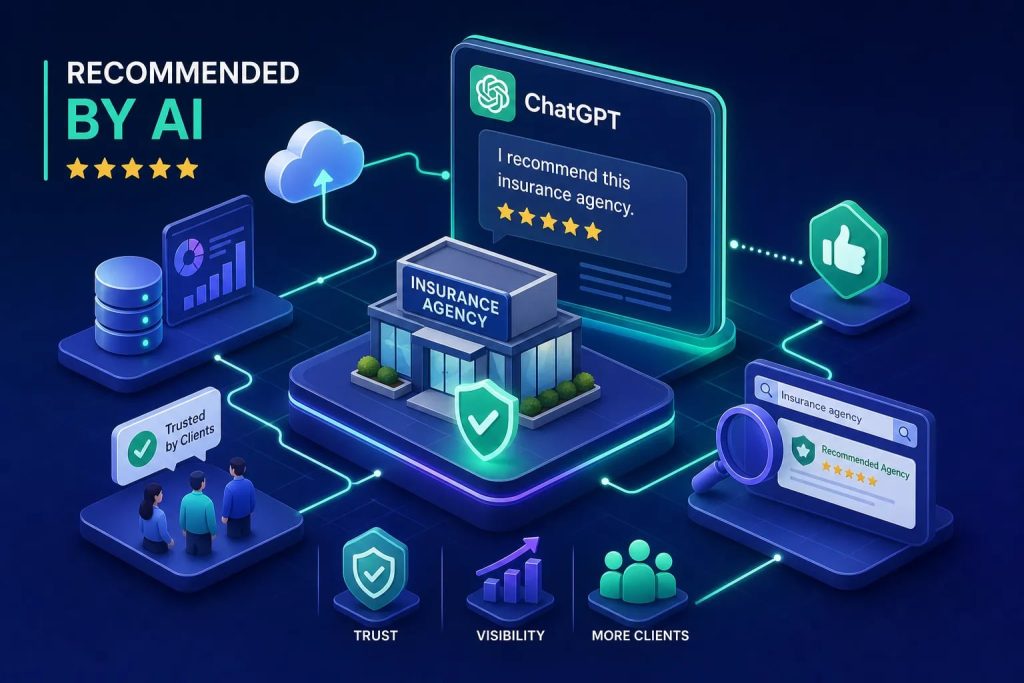
So how can an insurance agent get recommended by ChatGPT? The agents getting recommended by AI assistants have built something specific: a consistent, verifiable identity across the sources AI systems trust. Here’s what that looks like in practice, and where most agents fall short.
Why ChatGPT Recommends Some Insurance Agents and Not Others
ChatGPT doesn’t have a paid listing or a private insurance directory. It builds recommendations by cross-referencing what it finds across multiple public sources: directories, review platforms, licensing records, and your own website. Agents who appear consistently across those sources are far easier to recommend with confidence. Agents with sparse or conflicting information get skipped.
The platforms that appear most often in AI-generated insurance recommendations include Google Business Profile, Yelp, BBB, Bing Places, Trusted Choice, state licensing databases, and carrier locator pages. No single source guarantees a mention. What matters is whether several credible sources tell the same story about your agency.
The underlying question AI is trying to answer: “Is this a real, verifiable business that can help this specific person?” Conflicting phone numbers, missing credentials, or a website that doesn’t mention your service area make that question much harder to answer in your favor.
How an Insurance Agent Can Be Recommended by ChatGPT: Start with Business Identity
Before any advanced tactics, your core business information needs to match exactly across every platform where your agency appears. Name, address, phone number, service areas, hours, and license details should be identical on Google, Bing, Yelp, BBB, Apple Maps, Facebook, carrier locators, and your state association directory. Discrepancies don’t just confuse prospective clients. They signal unreliability to AI systems trying to verify your identity across multiple sources.
Complete your Google Business Profile fully first: verified, with photos, regular posts, and every service entry filled in. Then build out Bing Places, Yelp, BBB, Apple Business Connect, Trusted Choice for independent agents, and your state insurance association directory. Carrier locator pages are worth maintaining specifically because they function as authoritative third-party corroboration, the kind AI systems weigh alongside your own listings.
One step most agents skip: publish your producer license number, NPN, states served, and lines of authority as readable HTML text on your website. Not in a PDF, not embedded in an image. AI systems interpret text far more reliably than graphics, and visible licensing information builds verifiable credibility that no directory can replicate on its own.
Website Signals That AI Can Actually Read
Your website is where AI goes to verify what your directory listings claim. A generic agency site with a single “Insurance Services” page won’t hold up under that scrutiny. Each major coverage line needs its own dedicated page: auto, home, life, commercial, Medicare. Each page should describe the coverage type, the service area, the intended client, and the relevant agent’s credentials. That structure gives AI systems specific, citable content to draw from when generating a recommendation.
Schema markup translates that content into a format machines can interpret without guessing. At minimum, your site needs InsuranceAgency/LocalBusiness on your homepage, Service entities for each distinct coverage line, and Person markup for each licensed agent. Add FAQPage markup only where complete, visible question-and-answer content already exists on the page. FAQ sections that address real buyer questions, coverage limits, claims process, renewal timing, give AI assistants specific answers to pull when someone asks for a recommendation in your area.
For example, a basic JSON-LD block for your homepage might declare your agency name, address, phone, geo coordinates, and a hasOfferCatalog listing each coverage line as a Service item. A separate Person block for each licensed producer should include their name, job title, NPN, and worksFor reference back to the agency. These structured signals don’t replace readable page content, they reinforce it.
Reviews an Insurance Agent Can Use to Get Recommended by ChatGPT
Generic five-star ratings don’t carry much weight with AI systems. What carries weight is reviews that are specific, attributed, recent, and published as crawlable text on reputable platforms. A review that mentions the coverage type, the city, and a real outcome is far more useful than “Great agent, highly recommend.”
Collect reviews on Google, Yelp, and BBB. When asking clients for a review, give them a prompt: ask them to mention the type of insurance, the situation they needed help with, and what changed after working with you. That specificity is what makes a review citable by an AI assistant. On your own site, publish testimonials as visible HTML text on the relevant service page, not in image carousels or behind JavaScript. Add Review or AggregateRating schema only where the actual review text, reviewer name, date, and rating are visible on the page.
How Can an Insurance Agent Get Recommended by ChatGPT: Find Your Gaps First
Most insurance agents have some of these signals in place and are missing others. The gaps aren’t always obvious from inside your own business, and working through a checklist without knowing which items matter most for your specific situation is a slow way to make progress.
Getting recommended by AI assistants is a compounding process. Every verified listing, every schema-marked service page, and every attributed review makes the next recommendation more likely. Agents who close these gaps now build an advantage that becomes harder for competitors to close over time. According to 2026 consumer research, 45% of U.S. consumers reported using AI for a local business recommendation, a share that is only growing.
A structured diagnosis removes the guesswork. The TW3 Marketing Authority Audit™ evaluates the exact signals covered in this article, positioning, directory consistency, structured data, content credibility, reputation, and AI visibility, scored across 100 points, with a competitor comparison and a prioritized roadmap. Built for established agents who want to act on evidence rather than assumptions, the audit tells you precisely where to focus and in what order before committing to implementation. If you want to know exactly where your agency stands today, get in touch with our team to start there.
The Work Is Straightforward. The Window Is Now.
Understanding how an insurance agent can get recommended by ChatGPT comes down to one core discipline: building a consistent, verifiable presence across the sources AI systems trust. That means accurate listings on authoritative platforms, a website that makes your expertise and coverage lines machine-readable, and reviews that give AI systems something specific to cite. Agents lacking those signals risk reduced visibility in AI-sourced recommendations, which means prospective clients are more likely to find and choose someone else. The agents AI recommends consistently have these foundations in place. The time to build yours is before the gap widens further.
