
Thought leadership for consultants produces real pipeline when it combines four things: a proprietary point of view, one or two formats matched to how your buyers learn, a disciplined distribution path, and KPIs tied to pipeline rather than impressions. Before choosing any format, consultants who build the most traction start with a structured authority diagnostic that surfaces which channels will have the highest impact for their specific practice. The business case is clear: according to Edelman and LinkedIn’s B2B research, 49% of decision-makers said thought leadership generated an RFP invitation, and 60% of buyers who discovered a firm through thought leadership ultimately hired them. This article covers the formats that convert, the distribution tactics that reach decision-makers, and a concrete 90-day action plan to tie it together.
Key takeaways
- Start with a diagnostic: Choosing formats before identifying your authority gaps wastes time and budget on channels your buyers never use.
- Original research converts: Proprietary reports and case studies consistently outperform generic educational content for qualified lead generation.
- Personal profiles beat company pages: Publishing from named consultant profiles on LinkedIn drives more reach than firm-level posts.
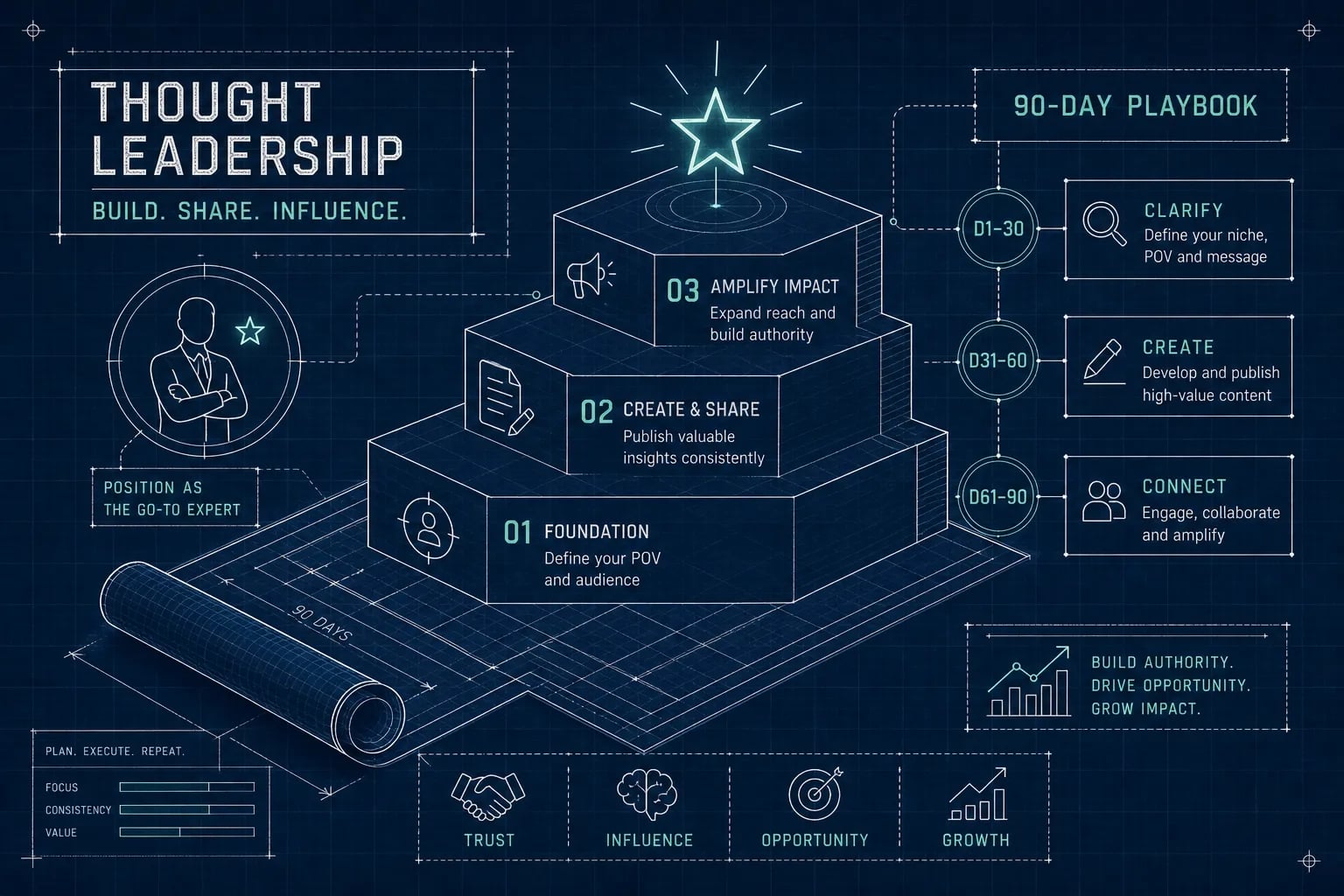
- 90 days builds momentum: A structured three-month sequence moves from stance definition to published asset to amplification, even for targeted programs with lean teams and modest budgets.
- Measure pipeline, not impressions: Content-assisted opportunities, win rate, and sales-cycle length are stronger ROI indicators than likes or downloads.
Why your thought leadership for consultants stalls in year one
A common early mistake is channel-hopping: launch a podcast, write three LinkedIn posts, attend a conference, then stall because nothing measurable happened. The root problem is choosing a channel before diagnosing where the actual authority gaps are. Picking a podcast because “I should be on podcasts”, without knowing which formats your buyers consume or where your credibility is weakest, creates effort without traction.
Large firms like McKinsey and IBM built proprietary frameworks before they chose formats. IBM’s Global Chief Marketing Officer Study became a durable platform for senior-level conversations precisely because the insight came first and the channel came second. A structured authority assessment across positioning, proof, expertise, visibility, engagement, and experience reveals which channels carry weight for your specific practice. Consultants who skip this step often invest in formats their ideal clients never use.
A distinctive point of view is the foundation before any of this matters. A contrarian observation, a proprietary benchmark, or a named framework gives buyers something to remember and cite. Without it, thought leadership becomes generic content that disappears into the feed.
Which formats actually convert clients in a thought leadership strategy for consultants?
No single format wins at every stage of the buyer journey. The most effective consulting content marketing approach organizes formats into three tiers: reach, conversion, and long-term authority.
| Format | Primary role | Best use |
|---|---|---|
| LinkedIn POV posts and carousels | Build reach and start conversations | Audience building; needs a next step tied to a higher-converting asset |
| Original research reports | Authority and qualified lead capture | Anchor asset; white papers and proprietary research reports give consultancies a durable platform for high-intent conversations |
| Case studies | Highest conversion asset | Answers the buyer’s core question: “Has this worked for someone like us?” |
| Webinars and workshops | High-intent bridge to pipeline | Lets prospects experience your thinking before booking a call |
| Podcasts and books | Trust infrastructure | Direct listeners to a diagnostic, assessment, or workshop to activate them |
Reach formats
LinkedIn POV content creates attention rather than immediate demand, so it needs a clear next step. Personal branding for consultants on LinkedIn works best when posts point toward a higher-value asset rather than standing alone as a final destination.
Conversion formats
A strong consulting case study shows the client’s starting problem, the intervention method, quantified results, and what changed in management behavior. That structure answers the buyer’s real question and consistently converts better than general thought leadership content alone. Webinars function as the strongest high-intent bridge because prospects experience your thinking before booking a call.
Long-term authority formats
Podcasts and books build credibility over time, but their audiences need a clear next step. Direct listeners toward a named assessment or executive workshop to activate that credibility and move them into a conversation.
How do you get decision-makers to actually see your content?
Distribution determines whether good content reaches the right people or disappears. The most reliable model is a coordinated trust-building sequence, not a single channel. Warm introductions outperform cold outreach because they transfer trust. That makes referral relationships with former clients, alumni, and complementary providers the highest-reliability path to decision-maker access.
For personal branding for consultants on LinkedIn, publish from your named profile rather than a company page. Named-partner profiles generate meaningfully more reach than firm-level accounts, and consistent engagement with target executives’ posts before you send a relevant message creates familiarity before the ask. For email nurture, lead with a timely insight, attach a credibility asset, and keep the list small and segmented. Senior-consultant-authored emails to targeted lists outperform generic nurture; the structure is: insight, then proof or framework, then a tailored observation, then a low-friction conversation offer.
Earned media in niche industry publications and podcasts adds third-party validation that LinkedIn alone cannot provide. Speaking at specialized conferences puts you in front of pre-qualified audiences. There is also a growing distribution channel worth building now: structuring articles so AI assistants can cite and surface them in response to executive queries extends your visible authority beyond traditional search and is becoming a measurable part of a consultant’s reach.
Building your 90-day thought leadership plan and the KPIs that tell you it’s working
Month 1 is about defining your unique stance and producing one anchor asset. A research report, a framework paper, or a detailed POV article works as the foundation. Focus here before anything else.
Month 2 is about distribution. Break that anchor asset into LinkedIn content, activate warm referral paths, and send one targeted email sequence to a segmented list.
Month 3 is about validation and amplification. Run a webinar or workshop built around the anchor asset, pitch the core idea to a relevant podcast or publication, and evaluate which assets generated qualified conversations.
Measuring thought leadership ROI for professional services means looking at the funnel across four dimensions. Track branded search volume and target-account reach to gauge awareness. Monitor executive-level interactions, webinar registrations, and repeat visits to insight pages to gauge engagement quality. Follow lead-to-opportunity rate and content-assisted pipeline to gauge progression. Then examine win rate and sales-cycle length to assess the ultimate commercial effect. Thought leadership rarely shows one clean attribution path, so use multi-touch attribution alongside qualitative evidence: a prospect citing a specific report during a sales call is as meaningful as any UTM tag.
Set a 6-month baseline before comparing performance. Define a commercial threshold, the minimum pipeline contribution required to justify program cost. Then compare thought-leadership-sourced opportunities against other channels by MQL quality, SQL rate, and win rate, not raw volume. That comparison tells you where your authority investment is actually moving the business.
Start with the right foundation for thought leadership for consultants
Thought leadership for consultants works when it starts with a clear authority diagnosis, uses formats matched to how your buyers make decisions, and distributes through channels where decision-makers already trust what they read. The 90-day structure gives you a repeatable starting point, particularly for targeted programs aimed at a narrow audience, without requiring a large research budget or a full content team.
Most consultants see the biggest early return from one strong original asset, whether a research paper, a named framework, or a detailed case study, broken into LinkedIn content and supported by a targeted email sequence. The firms and solo consultants who build durable authority are not the ones who post the most. They are the ones who make the most credible case for why their expertise is worth a conversation.
If you want to know exactly where your authority stands before you invest in any program, reach out to our team at TW3 Marketing to learn more about the TW3 Marketing Authority Audit™ and what a prioritized roadmap looks like for your specific practice.
Frequently Asked Questions
How long before we can tell if thought leadership is producing pipeline impact?
You should set a six-month baseline before comparing performance. We recommend tracking multi-touch metrics across awareness, engagement, and conversion, then compare thought-leadership-sourced opportunities by MQL quality, SQL rate, and win rate rather than raw volume.
What counts as an effective anchor asset to build momentum in 90 days?
An effective anchor asset is one strong original piece such as a research report, a named framework paper, or a detailed case study. We advise producing that single durable asset in month 1, then breaking it into LinkedIn content and a targeted email sequence for distribution in month 2.
