
Thought leadership marketing helps professional service firms solve a problem that capability alone cannot fix. Many firms have strong technical expertise and a solid track record. The problem is that capability without a visible point of view looks identical to every competitor on the shortlist. A buyer searching for a consultant, insurance advisor, or real estate expert sees a sea of websites claiming the same things: experienced, client-focused, results-driven. Generic language like that rarely creates trust, and it almost never creates preference.
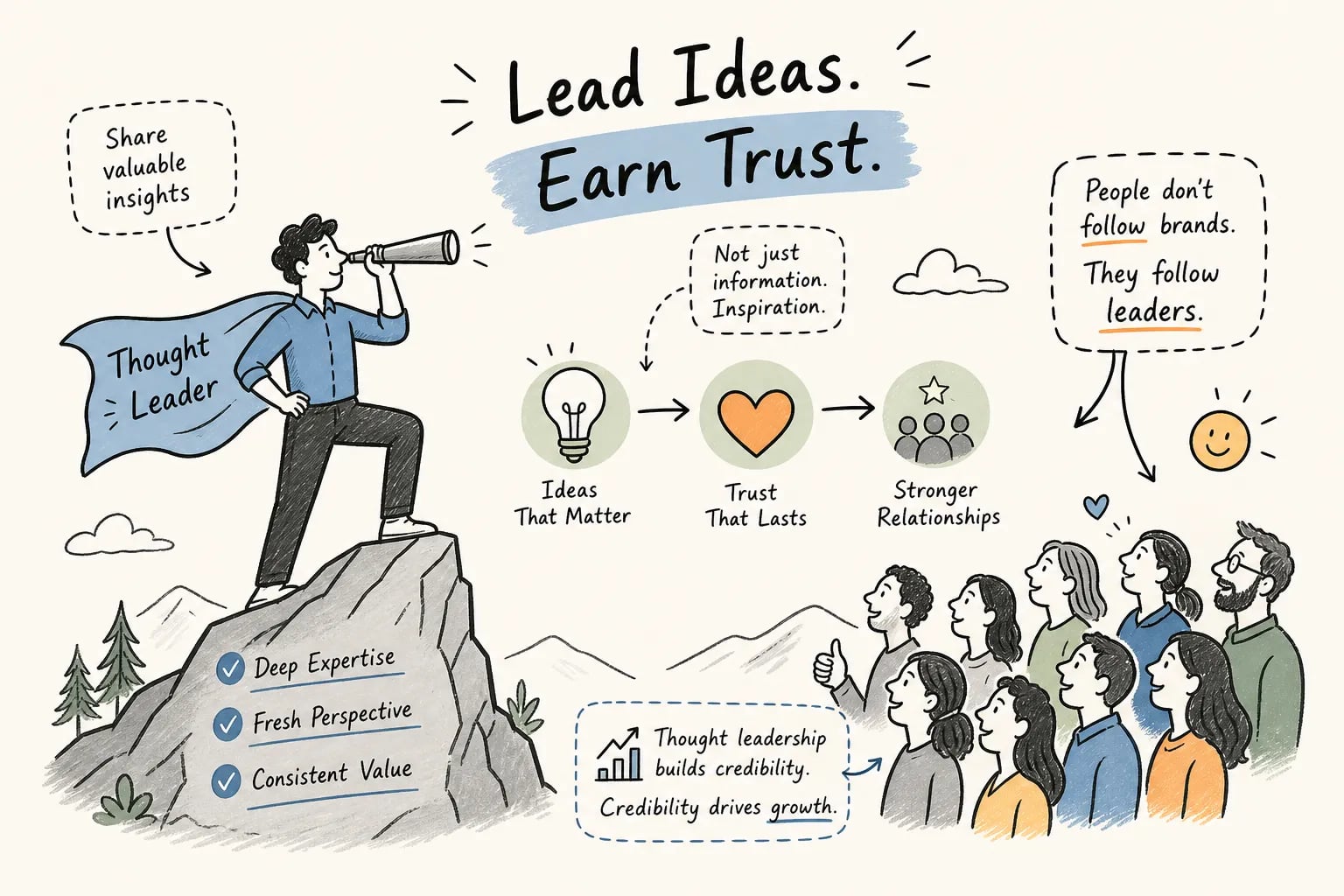
Authority marketing built around a clear, expert perspective closes that gap. It turns what a firm already knows into a recognized, trusted position in the market. For professional service firms specifically, where buyers make high-stakes decisions without the ability to test the product first, visible credibility is often an important and frequently decisive factor in many B2B buying journeys, often shaping the outcome before the first conversation even happens.
How thought leadership marketing differs from traditional content marketing
Traditional content marketing fills space, blog posts, newsletter roundups, social captions, with a primary goal of traffic or visibility. The content tends to stay neutral, educational, and safe. A thought leadership strategy built around genuine expert authority is fundamentally different. It requires a firm to take a clear, defensible position on something its ideal clients genuinely care about.
The difference sounds like this: “Here’s how to read a balance sheet” is content. “Here’s why most small businesses are reading their financials wrong and what to do instead” is a point of view. When a buyer consumes the second version, they’re not just learning something. They’re evaluating whether this firm understands their world at a deeper level than competitors do. That shift from education to evaluation is where trust begins. It’s also where the right clients start reaching out, inbound, without prompting, rather than requiring constant cold outreach to fill the pipeline.
Why professional service firms need thought leadership marketing more than most
In professional services, the product is judgment. Buyers can’t test it before they commit, so they rely on signals: who seems authoritative, who holds a clear perspective, who other credible people reference. An Edelman-LinkedIn study found that 73% of B2B decision-makers find thought leadership content more trustworthy than standard marketing materials when assessing a firm’s capability. The same research found that 42% say it led them to invite a firm they hadn’t previously considered into a competitive selection process.
The quality effect compounds over time. Firms that publish generic content tend to attract lower-fit prospects who are already focused on price. Firms that establish a clear industry authority position tend to attract clients who are already sold on the firm’s thinking before the first conversation begins. Programs with active, expert-led content generate significantly more qualified opportunities and higher close rates than firms relying on traditional content alone. That’s not a marginal difference. It changes who you’re talking to and how those conversations go.
The structure behind a successful thought leadership strategy
The most common mistake firms make is starting with a content calendar. Before any article, post, or webinar, a firm needs clarity on what position it actually owns in the market, who it serves best, and what perspective it holds that competitors don’t. Without that foundation, even well-written content fails to build a cumulative authority signal. Each piece disappears into the noise rather than reinforcing a recognizable point of view.
Positioning first
This is where firms working with a structured authority framework tend to pull ahead. At TW3 Marketing, the approach starts with positioning, proof, and expertise before a single piece of content gets created. Clarity about what the firm stands for shapes everything downstream, the topics it covers, the audiences it targets, and the way it frames every argument.
Hub-and-spoke execution
After positioning is locked in, a hub-and-spoke content system does the heavy lifting. One original insight or research position becomes the center. Articles, webinar topics, email perspectives, and social posts all extend from that center, keeping the firm’s message coherent and compounding rather than scattered.
Formats that work in thought leadership campaigns
The formats that perform best in professional services are specific. Original research reports, point-of-view articles, proprietary frameworks, case studies, and expert-led webinars consistently outperform generic educational content. What they share is a common quality: original evidence and a clear implication for the reader’s decision. If a competitor could swap in their name without changing the piece, it isn’t thought leadership. It’s just content.
What realistic results look like and when to expect them
Thought leadership marketing doesn’t work the way paid advertising does. It doesn’t produce leads on day one and stop producing them when you turn off the budget. The timeline is longer, and understanding that timeline is what separates firms that succeed from those that quit too early.
In the first 60 to 90 days, the measurable signals are qualitative: target-account engagement, branded search growth, referrals mentioning specific content, and the quality of inbound inquiries. These aren’t vanity metrics. They’re evidence the market is starting to associate your firm with a specific point of view. Pipeline influence often becomes measurable between months four and nine, with clearer revenue contribution commonly appearing by months nine to fifteen. For professional service firms with sales cycles of three to twelve months, first closed deals influenced by the program typically arrive within that nine-to-fifteen-month window.
Done consistently, a well-executed authority content program builds intellectual property that works continuously. Every article, framework, and published perspective adds to a growing authority signal. Future clients become easier to attract and easier to convert because they arrive already trusting your judgment.
The firms that win are the ones that start
Thought leadership marketing isn’t a content trend. It’s the clearest path from invisible expert to recognized industry voice, and it’s most powerful precisely where the stakes of the buying decision are highest. Consultants, insurance professionals, real estate experts, and other professional service firms are competing in markets where trust drives the decision. The firms that invest in making their expertise visible consistently attract better-fit clients, reduce price competition, and build market positions that compound over time.
The only real mistake is waiting until the market has already handed that position to someone else. If you’re ready to invest in thought leadership marketing and want to understand exactly where your firm stands today, reach out to the TW3 Marketing team to ask about the TW3 Marketing Authority Audit™. It starts with an honest diagnosis before we make a single recommendation.
