
To get recommended by ChatGPT, businesses need clear and consistent identity across the web, independent third-party evidence of credibility, a crawlable website with structured information, and recent reviews that describe specific experiences. There is no public evidence of a pay-to-rank mechanism and no single published formula governing selection. What AI recommendation systems do have is a set of evaluable signals, and understanding those signals is the starting point for getting your firm in front of buyers who ask AI before they ever visit a website or call an office. This guide covers the four areas where those signals live.
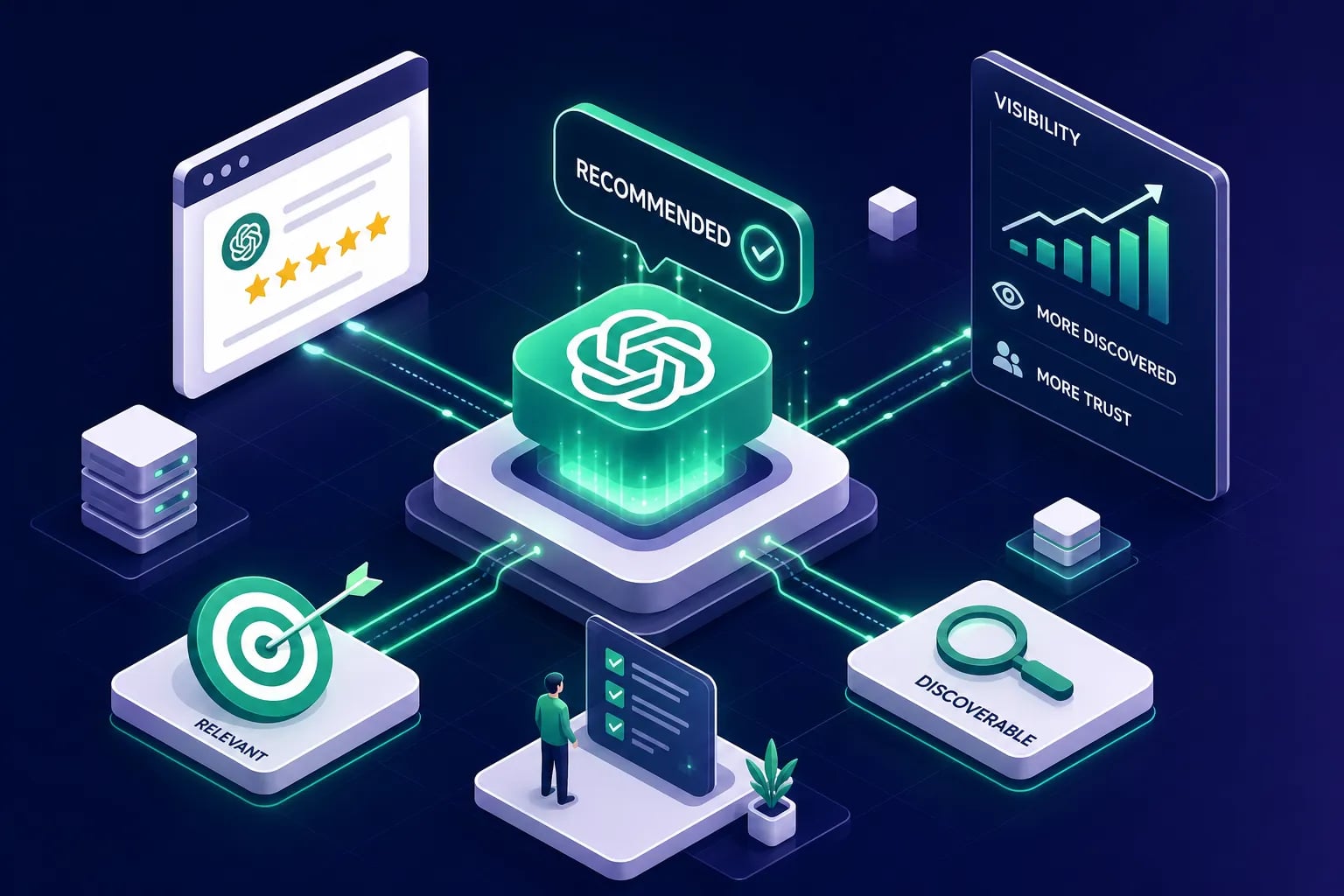
The commercial reality is straightforward: buyers using AI assistants to find consultants, insurance professionals, real estate agents, and advisory firms are making high-intent requests. They are asking for a shortlist. The firm that appears in that answer earns the conversation, while the firm that is invisible to AI loses the opportunity to be discovered at all.
Key takeaways
- Entity clarity first: Consistent name, address, phone, and service categories across all platforms are the non-negotiable foundation that everything else depends on.
- Reviews beyond star ratings: Volume, recency, platform credibility, and detailed review text help AI match your firm to specific buyer queries.
- Crawlability is required: Blocking OAI-SearchBot or Bing crawlers in your robots.txt significantly reduces the likelihood of real-time AI retrieval, even when your off-site signals are strong.
- Schema markup priorities: FAQPage, LocalBusiness, and Service schema form the strongest core combination for professional service firms, with Organization as an important supporting type.
- Third-party mentions compound: Listicles, editorial roundups, and credible directory listings create category associations that AI uses to match recommendations to buyer intent.
- Diagnose before implementing: Knowing exactly where your gaps are prevents wasted effort on signals that do not address your actual visibility problem.
How does ChatGPT actually decide who to recommend?
ChatGPT draws from multiple data layers simultaneously, not a single ranking algorithm. Pretraining data gives the model general knowledge about businesses, though that knowledge can be incomplete or outdated, especially for firms that have not built a strong web presence. For current or location-specific queries, ChatGPT Search retrieves and summarizes live web pages using Bing-based infrastructure, which means Bing indexing is a direct factor in real-time AI recommendations.
The model also pulls from business directories, review platforms, and licensed data including Yelp business information, ratings, and reviews. Third-party editorial sources, including news coverage, industry publications, comparison articles, and community content, provide independent evidence about a firm’s reputation and expertise. A business absent from these sources is not penalized; it is simply invisible. OpenAI’s OAI-SearchBot crawls websites for real-time retrieval, so blocking it in your robots.txt reduces the likelihood of appearing in real-time AI search results, regardless of how strong your off-site signals are.
Entity clarity is the non-negotiable foundation. Consistent name, address, phone number, website URL, and service categories across all sources help AI systems distinguish the correct business from similarly named alternatives. Inconsistent profiles create ambiguity, and AI resolves ambiguity by recommending the clearer option.
What signals make your business recommendation-worthy?
Reviews do more work than most firms realize. Volume, recency, platform credibility, and the specificity of review text matter more than a high star average. Reviews on Google, Yelp, BBB, and Clutch are especially useful for professional service firms because they are structured and verifiable. For B2B advisory and consulting firms, Clutch is particularly important: it is one of the platforms ChatGPT references when buyers ask which agencies or consultants to hire. AI systems use review content to match your firm to specific queries, so a review that says “reliable estate planning attorney who explained every option clearly” does more than one that says “great service.”
The role of third-party mentions and directory listings
Consistent directory listings across Bing Places, Google Business Profile, Apple Maps, BBB, and industry-specific directories reduce factual ambiguity and confirm your firm’s local and categorical relevance. More powerful still are editorial roundups and “best of” listicles from credible, independent publishers. These articles place your firm in a category, compare it with alternatives, and explain what it excels at, which is precisely the context AI uses when answering recommendation-style prompts. An LSEO industry analysis found that third-party lists accounted for 80.9% of professional-services listicle citations, compared with 19.1% for self-promotional content. The practical takeaway: earn relevant third-party mentions, maintain accurate directory data, and seek inclusion in authoritative category roundups.
What does your website need for AI to surface it?
Crawlability and indexing
Technical accessibility comes first. Submit and verify your site in Bing Webmaster Tools using domain verification, a meta tag, or Google Search Console import. Submit an XML sitemap, use URL Inspection to identify and fix crawl errors, and enable IndexNow to help Bing surface updated pages faster. Ensure your robots.txt permits both Bing crawlers and OAI-SearchBot. A technically sound site that blocks AI crawlers will still not appear in real-time AI search results.
Schema markup for AI
Schema markup is machine-readable clarification, not a ranking shortcut, but it meaningfully improves extractability. For professional firms, the strongest core combination is FAQPage, LocalBusiness, and Service schema, with Organization and its sameAs connections to authoritative directory profiles serving as an important supporting layer. FAQPage in particular exposes question-and-answer pairs that AI systems can use directly for conversational queries. AggregateRating and Review markup add trust signals when genuine reviews are visibly published on the page.
Service page content
Beyond markup, your site needs clear service pages that describe what you do, who you serve, and what differentiates your approach. Pricing ranges, case descriptions, FAQs, and direct answers to common buyer questions give AI extractable facts to work with. Content that clearly states audience fit, strengths, and limitations is far more useful to AI summarization than generalist promotional copy. One good test: if a buyer asked ChatGPT what your firm does and who it is best for, could the model find a direct, specific answer on your site?
Building the authority layer that gets you recommended consistently
Technical fixes and directory listings establish a baseline. What moves professional firms from eligible to recommended is the authority layer: independent verification of expertise that buyers and AI systems can both evaluate. Consultants, insurance professionals, real estate agents, and advisory firms compete on credibility, and AI recommendation systems reflect that by weighting expertise signals, peer mentions, and documented track records heavily. A technically perfect website attached to a firm with no industry coverage, no editorial mentions, and no detailed client reviews will still lose ground to a competitor with weaker technical hygiene but stronger documented evidence.
This is the gap most established professional firms carry: strong delivery, weak documented evidence of that delivery. Closing it requires a strategic approach that connects positioning, proof, content, reputation, and visibility into a coherent system rather than a collection of disconnected tactics. TW3 Marketing works with established professional firms using the TW3 Marketing Authority Framework.
The process begins with the TW3 Marketing Authority Audit™, a 100-point diagnostic that identifies where a firm’s AI visibility gaps are before any implementation work is recommended. Starting with a clear picture of the gaps is what separates firms that build durable recommendation visibility from those that apply generic tactics and wonder why nothing changed.
How to get recommended by ChatGPT: a quick checklist
- Verify your site in Bing Webmaster Tools and confirm OAI-SearchBot is not blocked in robots.txt
- Audit your NAP (name, address, phone) consistency across Google Business Profile, Bing Places, Apple Maps, BBB, and industry directories
- Implement FAQPage, LocalBusiness, and Service schema on your key pages, and add Organization with sameAs links
- Actively collect reviews on Google, Yelp, and relevant B2B platforms, prioritize specificity over volume alone
- Pursue inclusion in editorial roundups and “best of” lists from credible publishers in your category
- Build service pages that answer the questions buyers are already asking AI assistants
- Run a structured audit to identify which signals are weakest before committing resources
Getting recommended is a system, not a single tactic
Getting recommended by ChatGPT consistently requires consistent entity data, independent credible evidence, a crawlable and well-structured website, and demonstrated expertise that third parties confirm. None of these elements works in isolation. A firm with perfect schema markup but no third-party mentions is invisible to buyers asking AI for recommendations. A firm with great reviews but a website that blocks AI crawlers is unreachable through real-time retrieval. The system only works when all four layers are connected.
Buyers using AI assistants to find professional firms arrive ready to act. Rather than browsing options, they are asking for a specific recommendation. The firm that appears in that answer earns the conversation. Firms that want to get recommended by ChatGPT, and stay recommended as AI search evolves, need a system, not a single tactic.
If you want a clear picture of where your firm stands today, the TW3 Marketing Authority Audit™ maps exactly where the gaps are and identifies what to address first. Contact our team to learn more about the audit and what a prioritized roadmap looks like for your firm.
