
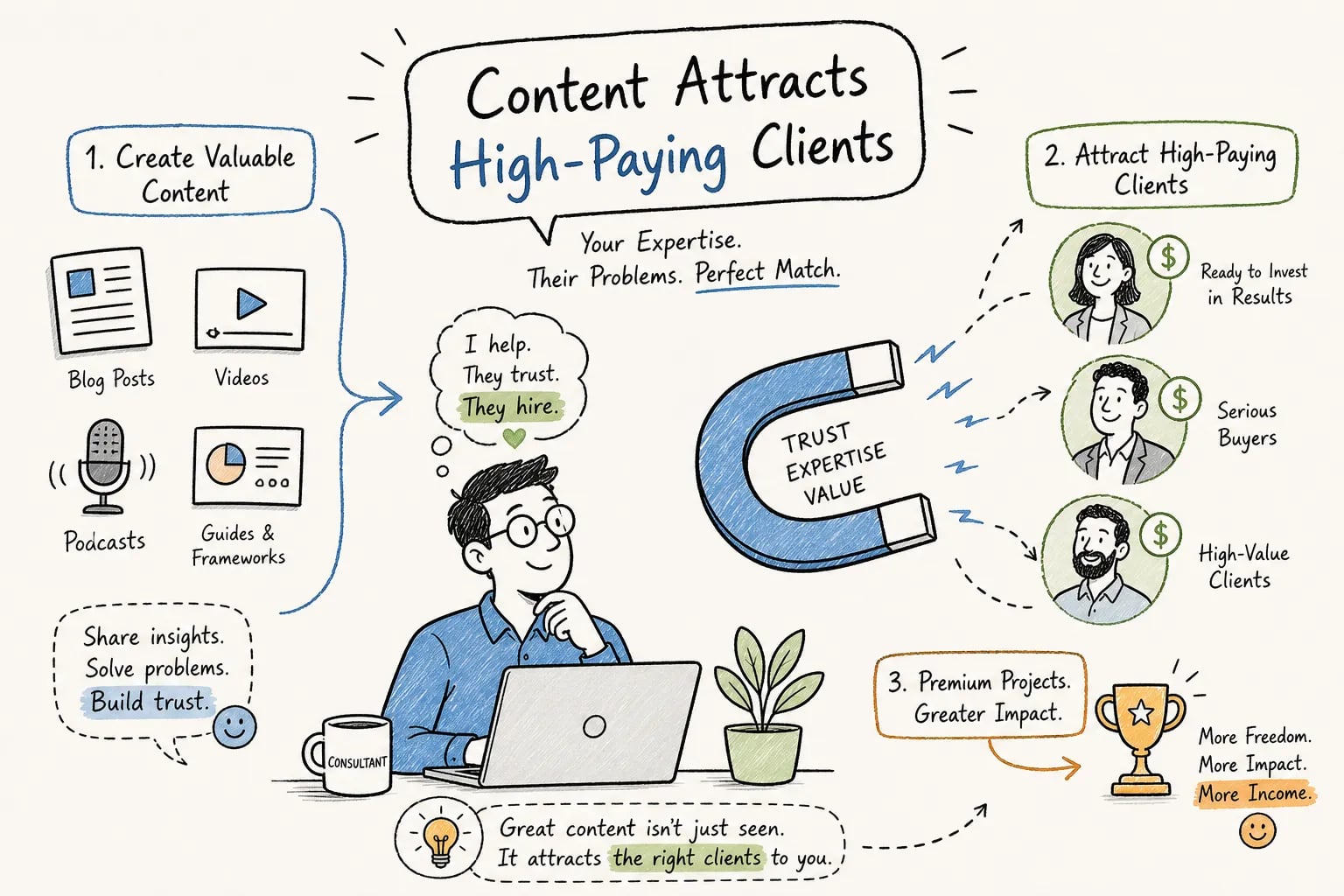
How do consultants attract high-paying clients through content? Not by publishing more, by publishing strategically. That means specific formats, aimed at expensive problems, structured so senior buyers arrive already convinced before the first conversation. The content pre-sells the engagement. Often, by the time a decision-maker reaches out, the question has shifted from “Are you credible?” toward timing and scope, something like “Can you start next quarter?”, because the content has already done that credibility work.
Understanding which formats convert, which gaps quietly eliminate you from consideration, and how to connect published insight to a signed engagement is where real strategy begins. According to a report from learningnews.com, 99% of senior executives say thought leadership is important or critical when evaluating potential advisors. The content you publish either builds that case or leaves it unbuilt.
Key takeaways
- Case studies convert best: Quantified case studies with measurable business outcomes are the strongest bottom-of-funnel asset for converting senior buyer interest into inquiry.
- Executives search problems, not services: Decision-makers search “why margins compress during growth,” not “business consultant.” Your content must match their language.
- AI visibility is now part of the shortlist: Named frameworks, consistent specialization, and structured proof help AI systems recommend you when executives ask for help.
- Content gaps cost you silently: Many consultants have content that attracts attention but fails to close the evaluation gap for premium buyers.
- Email and LinkedIn lead the channel mix: A practical starting allocation is 40% email, 30% LinkedIn, 20% industry publications, and 10% podcasts.
Which content formats help consultants attract high-paying clients?
Why case studies are your strongest bottom-of-funnel asset
Quantified case studies outperform every other format when a senior buyer is deciding whether to engage. The elements that matter to a C-suite reader are specific: the business consequence, the measurable outcome, and enough context that the reader recognizes their own situation. A generic success story won’t do that work. An executive wants to see revenue growth, margin improvement, or cost savings tied to a comparable problem at a comparable scale.
Adam Cooper of Ascent Consulting documented exactly this progression. His blog posts addressed recurring problems he heard from construction-company owners. Prospects discovered the content, recognized their situation, and engaged. According to consultingsuccess.com, the content established expertise before the sales conversation, not during it. That sequencing is the model.
Named frameworks that qualify buyers before they call
A proprietary framework or original research report does two things at once: it demonstrates expertise to human buyers and gives AI systems a named, citable structure to reference. Consultants who publish benchmarks, diagnostic tools, or clearly named methodologies signal specialization in a way that generic advice never can. Gated research captures higher-intent leads, while an ungated summary builds search and AI visibility. Both serve the same purpose, attracting buyers who are already problem-aware and solution-ready, so the first conversation is about fit, not fundamentals. This is content marketing for consultants working exactly as intended.
What do senior buyers actually search for before they contact you?
The problem-first language decision-makers use
Executives rarely search “business consultant.” They search the business problem: “why margins compress during growth,” “how to stop failed digital transformation,” “post-merger integration consultant for regional banks.” The keyword patterns that matter follow a formula: problem plus industry plus role plus outcome. A consultant whose content matches the language a CFO uses when growth stalls is far more likely to surface than one publishing generic thought leadership. According to a study from searchlab.nl, 77% of B2B buyers conduct independent online research before contacting a vendor. They’re searching before you know they exist. This is exactly why attract high-paying clients with content strategies must begin with problem-first keyword research rather than service-first promotion.
Making your expertise legible to AI recommendation systems
When a senior executive asks an AI assistant to recommend a consultant for a specific problem, the system draws on structured, authoritative, findable content. Firms surface on that shortlist when multiple sources consistently describe what they do, whom they serve, and the results they achieve. Named expertise, cited frameworks, and consistent specialization signals across multiple content touchpoints are what make a firm recommendable.
Consultants who publish AI-visible content appear in those recommendations. Those who don’t are simply absent from the conversation, and never know the opportunity existed.
What content gaps are quietly costing you high-value clients?
The signals premium buyers look for (and often don’t find)
Many consultants have content, but it’s missing the specific signals that close the evaluation gap for premium buyers: no case studies with measurable outcomes, no named framework, no content that addresses the expensive problem a CFO or CEO is actually searching. Long-form posts attract attention but bridge to nothing. High-value prospects arrive, sense the absence of proof, and move on without making contact. The content exists, but it’s working against the consultant’s positioning rather than for it. This is the silent cost that content that wins premium consulting clients is specifically designed to prevent.
How a structured authority audit identifies which gaps matter most
Diagnosis should come before any content investment. A structured authority audit evaluates where a consultant’s content, positioning, and credibility signals are strong versus where gaps exist relative to what premium buyers need to see. The TW3 Marketing Authority Audit™ is a 100-point diagnostic that maps exactly this: which content is missing, how expertise is being perceived by both search engines and AI systems, and which gaps represent the highest-cost missed opportunities. Starting with that diagnosis means effort goes toward the gaps that are actually affecting qualified inquiry volume, not toward publishing more of what isn’t working.
Building the conversion path from content to signed engagement
The channel sequence that reaches decision-makers
LinkedIn is the strongest channel for reaching new decision-makers. Document and carousel posts generate roughly 39% more reach and 30% more engagement than the average post, according to contentin.io. The practical starting point is building an audience on LinkedIn, then converting interested readers into an owned email list. Segmented B2B newsletters achieve roughly 35–50% open rates, according to arcalea.com, making email the highest-performing channel for nurturing and conversion. Industry publications add credibility with evaluation committees, while podcasts function as a trust channel rather than a direct-response engine. A practical allocation is 40% email, 30% LinkedIn, 20% industry publications, and 10% podcasts. Whitepapers distributed through this mix also serve as a durable lead magnet for consulting services, capturing contacts who are deep in the evaluation process.
The four-step conversion sequence, and what the benchmarks tell you
The conversion model has four steps: attract with insightful long-form content addressing a specific strategic problem, capture with a research report or diagnostic, prove with a quantified case study, and convert with a tightly scoped paid diagnostic or executive briefing. The funnel benchmarks are realistic: 2–5% visitor-to-lead, 25–35% lead-to-qualified lead, 40–60% discovery call-to-proposal, and 25–40% proposal-to-close, according to prospeo.io and related B2B benchmarks.
Those numbers look small at first. Consider the context: a finance-focused consultancy documented by mintcopywritingstudios.com generated more than 100 content-influenced inbound leads with a 53% MQL conversion rate, producing a pipeline exceeding $2 million. High-ticket consulting produces small numbers at every stage. One well-qualified opportunity can justify the full content investment.
How consultants attract high-paying clients through content: start with the right diagnosis
Consultants who consistently attract high-paying clients through content aren’t doing more work than their peers. They’re doing the right things in the right sequence, quantified case studies, named frameworks, and a clear distribution path to senior buyers that does more pre-selling than any cold outreach effort.
Publishing without knowing which gaps are costing you the most is an expensive gamble. The right starting point is a clear diagnosis of where your authority signals are strong and where they’re missing. The TW3 Marketing Authority Audit™ exists for exactly that purpose: giving established consultants a 100-point picture of where they stand before recommending where to invest. If you’re ready to build content that converts senior decision-makers, the diagnostic is the logical next step. Request it from our team and start from a position of clarity rather than assumption.
Frequently Asked Questions
How quickly can content make a senior buyer ready to hire us?
Content can make a senior buyer ready before the first conversation; often the question shifts to timing and scope rather than credibility by the time a decision-maker reaches out. This happens when content pre-sells the engagement through quantified case studies, named frameworks, and clear problem-first messaging so the buyer arrives already problem-aware and solution-ready.
What performance metrics should we track to know our content is converting high-value clients?
Track the funnel benchmarks: visitor-to-lead (2–5%), lead-to-qualified-lead (25–35%), discovery-call-to-proposal (40–60%), and proposal-to-close (25–40%). Also monitor channel performance against the recommended allocation (40% email, 30% LinkedIn, 20% industry publications, 10% podcasts) and the rate at which case studies generate qualified inquiries.
How do we make our firm visible to AI recommendation systems?
Make your expertise legible by publishing named frameworks, consistent specialization, and structured proof across multiple content touchpoints so AI systems can cite and recommend you. Both gated research and ungated summaries help: gated research captures higher-intent leads while ungated summaries build search and AI visibility.
Should we invest in podcasts as part of our content mix?
Yes, but podcasts function primarily as a trust channel rather than a direct-response engine and are recommended as roughly 10% of the channel mix. Use podcasts to build credibility with decision-makers while relying on email, LinkedIn, and industry publications for direct conversion.
