
Local SEO still works. A well-optimized Google Business Profile, consistent business information, and a strong review record continue to drive map pack visibility for location-based queries in 2026. But firms that treat local search as their complete visibility strategy risk missing gaps that a rank tracker alone won’t reveal. AI-powered discovery tools are changing how professional service buyers find and shortlist providers, and they pull from a different mix of signals, with greater emphasis on third-party validation and topical authority, than the ones that move a GBP up the local pack.
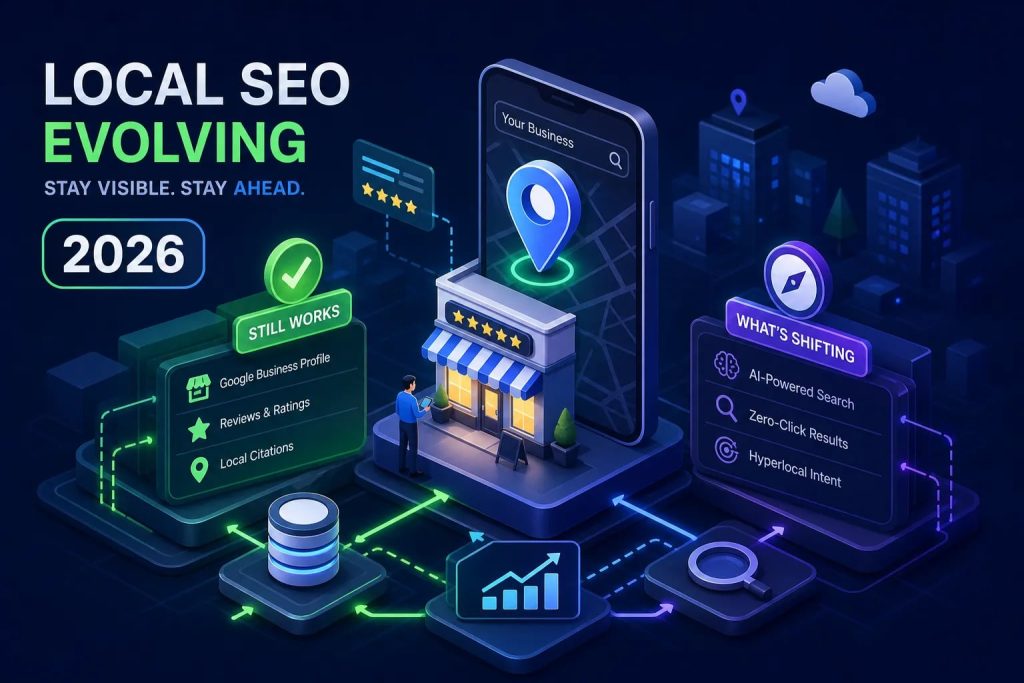
Many firms still treat local search as their primary visibility strategy. What the data shows is a widening gap between that approach and where buyers are actually starting their search.
Key takeaways
- GBP signals remain foundational: Google Business Profile signals account for approximately 32% of local pack ranking weight, according to expert estimates from sorank.com and emulent.com, making profile completeness and accuracy non-negotiable.
- Reviews influence both channels: Review velocity, recency, and response rate affect local rankings and what AI tools surface when buyers ask for recommendations.
- AI search pulls different signals: ChatGPT, Perplexity, and many AI assistants weight published expertise, third-party mentions, and structured content, not proximity or GBP categories.
- Buyers are pre-vetting via AI: Professional service buyers increasingly use AI assistants to build shortlists before they open Google Maps or visit a firm’s website.
- One diagnostic covers both layers: Understanding where a firm stands requires evaluating local visibility and AI authority signals together, not in separate audits.
What local SEO still gets right in 2026
Google Business Profile signals carry approximately 32% of local pack ranking weight, based on expert estimates from sorank.com and emulent.com. For proximity-based searches and location-dependent decisions, a profile with the correct primary category, complete services, fresh photos, and accurate hours still drives real visibility. One 2026 analysis found Local Packs appearing on 93% of simple local-intent queries, while AI Overviews appeared on only 15% of those same searches, according to a 2026 analysis cited by Yahoo Finance. The map pack is not broken. It still converts buyers who already know what they want and where they want it.
Review signals account for an estimated 16 to 20% of local ranking weight, according to sorank.com and emulent.com, and behavioral signals like calls, direction requests, and website clicks from the profile add another 8 to 10%. These signals tell Google the listing is actively serving real customers. For professional service firms, a strong and recent review record is still foundational credibility. It’s also one of the few signals that influences both local pack visibility and AI-generated recommendations, which makes it worth treating as an ongoing system rather than an occasional campaign.
Local SEO checklist for professional service firms
Before moving on to AI authority signals, confirm these local SEO basics are in place:
- Google Business Profile is claimed, verified, and fully completed with the correct primary category
- NAP (name, address, phone) is consistent across all major local listings and citations
- Services, hours, and photos are current and accurate
- Review responses are posted consistently, especially to negative reviews
- Local keyword research informs the GBP description and service pages (including “near me” search variants)
- Schema markup is implemented on key service pages
Where AI search is changing local SEO for professional service firms
Tools like ChatGPT, Perplexity, and other AI assistants generate service provider recommendations by synthesizing authority signals from across the web: published expertise, structured content that answers specific buyer questions, mentions in credible sources, and E-E-A-T indicators on the firm’s website. A business can rank in the local 3-pack and still be absent from every AI-generated recommendation when a buyer asks who the best insurance advisors in their city are for business owners. Citations and GBP categories don’t communicate to an AI assistant why a firm is the right choice for a specific type of client.
The buyer behavior shift is already in motion. According to G2’s 2026 AI Search Insight Report, AI chatbots are now the leading influence on buyers’ shortlists. Buyers describe their situation, ask for vetted recommendations, and then validate by checking local reviews and the firm’s website. A firm invisible at the AI discovery stage may never reach the validation stage, especially in professional services, where the relationship and expertise evaluation happens before the first conversation, not during it.
Why relying solely on local SEO leaves a gap in your visibility
Consider a buyer researching financial planning firms in their city. They open an AI assistant, describe their situation, and ask for recommendations. The results they get back aren’t sorted by proximity or GBP category, they’re shaped by demonstrated expertise, authoritative content, structured answers to buyer questions, and third-party credibility spread across the broader web. A firm can be fully optimized for local search and largely invisible at that stage. The signals don’t transfer automatically.
This gap hits hardest at the professional services level. According to a 2026 analysis cited by Yahoo Finance, AI Overviews appeared on 92% of informational queries and 97% of hybrid local queries in 2026. That means the advisory and comparison phase of a professional services search now frequently involves AI before it involves Maps. Buyers researching a consultant, insurance advisor, or financial planning firm are evaluating expertise and trustworthiness, not just checking hours and directions. If a firm’s digital presence doesn’t demonstrate that clearly, AI tools have nothing credible to recommend.
How do you find out where your firm stands on both fronts?
A local rank tracker tells you where the firm sits in Maps and organic results. It does not tell you whether your positioning is clear, whether your expertise is visible and credible to AI systems, or whether your website gives buyers enough proof to shortlist you. Those gaps require a broader diagnostic: one that evaluates positioning, proof, expertise, visibility, engagement, and experience as a connected system rather than separate checkboxes.
The TW3 Marketing Authority Audit™ is built for exactly this purpose. It delivers a 100-point Authority Score covering the signals that matter for both Google local visibility and AI-driven discovery, identifies gaps a local SEO audit would miss, and produces a prioritized roadmap before any implementation is recommended. For firms that have local SEO covered but suspect they’re invisible to buyers using AI search, this is where the full picture becomes clear. Get in touch with our team to start with the diagnostic.
The practical takeaway for professional service firms
Local SEO in 2026 is not obsolete. For map pack visibility and location-based queries, it still delivers results worth having. But the buyer discovery journey for professional service firms doesn’t start and end at Google Maps anymore. AI-powered search rewards authority signals, demonstrated expertise, and third-party credibility. Those are different inputs than a complete GBP and consistent NAP, though both matter.
Firms that understand their position on both fronts now are the ones that stay visible as search behavior continues to shift. The starting point is knowing where the gaps actually are, and that audit is built to surface exactly that.
Frequently Asked Questions
Will having a top-ranked Google Business Profile guarantee we appear in AI-generated recommendations?
No, a top-ranked Google Business Profile does not guarantee appearance in AI-generated recommendations. AI assistants weight published expertise, structured content, and third-party credibility differently than GBP signals, so a firm can be prominent in the local 3-pack yet absent from AI shortlists.
How much do reviews matter for both local packs and AI recommendations?
Reviews matter significantly for both channels, accounting for an estimated 16 to 20% of local ranking weight and also influencing AI tools. Review velocity, recency, and response rate affect local rankings and what AI tools surface, so maintaining an ongoing review system is important.
If our local SEO looks solid, how can we check whether we’re visible to buyers using AI search?
You should run a diagnostic that evaluates both local visibility and AI authority signals together rather than relying solely on a rank tracker. The TW3 Marketing Authority Audit™ provides a 100-point Authority Score covering signals for Google local visibility and AI-driven discovery and identifies gaps a local SEO audit would miss.
Why are AI Overviews relevant to professional service searches and how often do they appear?
AI Overviews are relevant because buyers increasingly use AI to pre-vet providers, and these Overviews frequently appear for informational and hybrid local queries. A 2026 analysis found AI Overviews on 92% of informational queries and 97% of hybrid local queries, meaning the advisory and comparison phase often involves AI before Maps for professional services.
