
Building buyer trust for professional service firms follows a predictable pattern. Skeptical prospects become confident clients when they encounter specific proof, visible expertise, a credible reputation, and positioning that speaks directly to their situation. Each signal matters at a different stage, and missing any one of them can stall the journey.
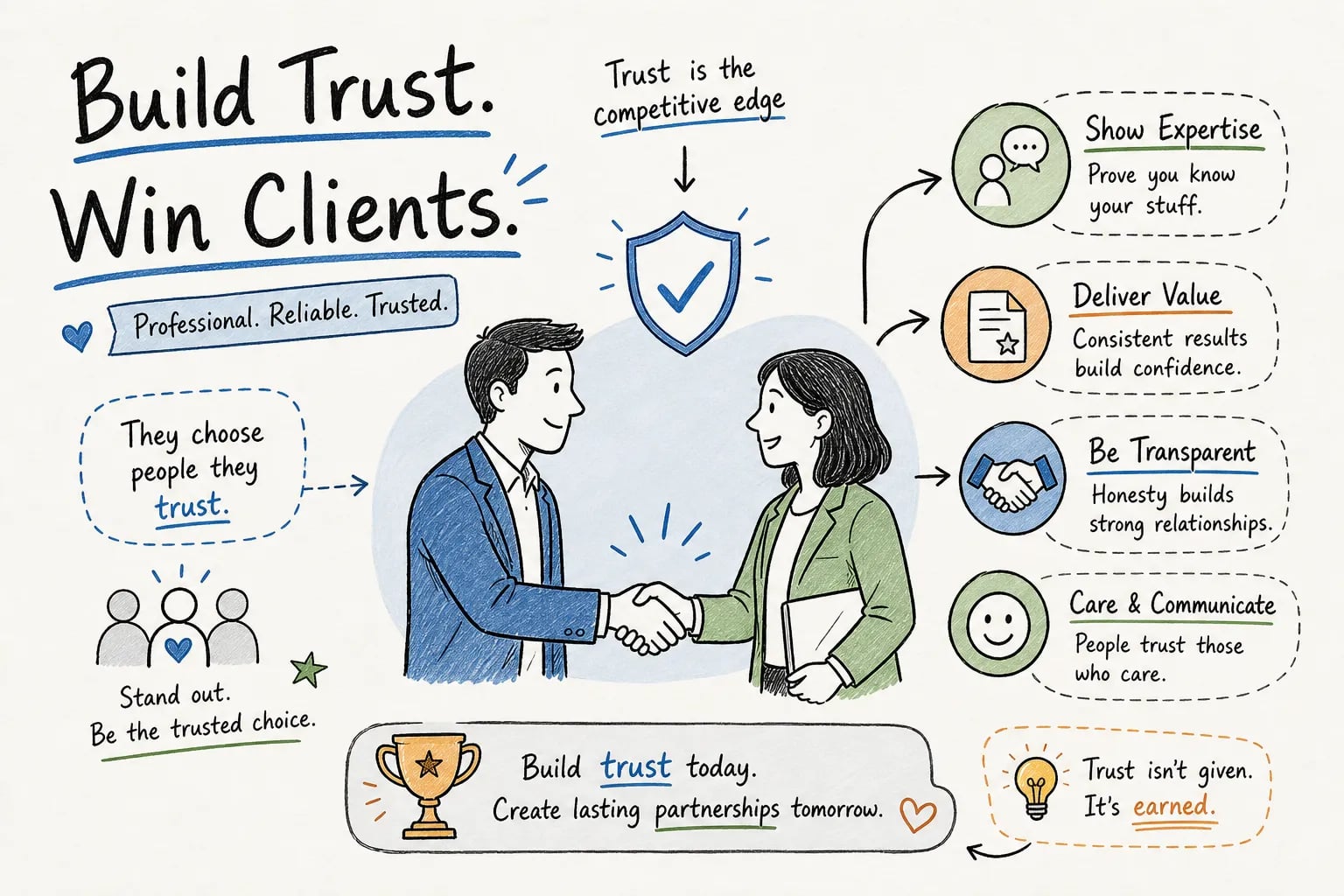
Many professional firms fail to convert despite strong expertise because that expertise isn’t visible at the right moment in the buyer’s journey. This guide walks through the trust stages your buyers move through, the signals that advance them from skeptical to confident, and a practical way to pinpoint exactly where your firm’s buyer trust building breaks down.
Key Takeaways for Buyer Trust Building
- Skepticism is the default: High-stakes professional services put the burden of risk reduction on the firm, not the buyer.
- Proof leads everything else: Quantified case studies and named testimonials consistently rank as the strongest trust-building assets for B2B buyers.
- Positioning removes ambiguity: Clear specialization shortens sales cycles and eliminates the “is this firm right for me?” question before it derails evaluation.
- Reputation amplifies, not replaces: Awards and media mentions confirm trust already established by proof; they rarely create trust on their own.
- Diagnose before you invest: Guessing which trust signal to fix is expensive. A structured audit identifies the specific gaps first.
What the Trust Journey Actually Looks Like
Prospective clients arrive with legitimate skepticism. Professional services involve high stakes, long commitments, and limited ability to evaluate quality before signing. The burden is on the firm to reduce perceived risk, not on the buyer to extend good faith.
Buyers typically move through stages that begin with initial discovery (is this firm credible at all?), move into active evaluation (does their approach and evidence fit my situation?), and end with final confidence (can I make this decision and defend it internally?). This is a simplified model of a buyer journey that in practice can involve additional steps around requirements building and internal consensus. Each stage demands a different type of signal to move buyers forward, and gaps at any point create stall points that look like disinterest but are really unresolved doubt.
That final confidence stage is where many firms lose qualified opportunities. For professional service buyers, confidence isn’t purely personal. It’s the ability to defend the choice to partners, boards, or internal stakeholders. Trust-building that only addresses individual comfort but ignores the internal-justification layer consistently loses qualified opportunities to firms that answer both questions.
The Proof Signals That Dissolve Early Skepticism
Client evidence outperforms every other trust signal at the evaluation stage. According to data compiled by empact.partners, 74% of B2B technology buyers used reviews to inform their purchase decision, and 49% ranked customer evidence as among the most trustworthy forms of proof. The key distinction is specificity. A testimonial that describes the client’s situation, what changed, and a measurable result is fundamentally different from a generic quote praising a firm’s “responsiveness.”
Third-party validation, including certifications, association memberships, and media mentions, signals legitimacy, but only when presented with enough context to be meaningful. A badge without an explanation of the issuing body, scope, and what it means for the buyer contributes little. Pair each validation signal with a brief statement of what it demonstrates and why it matters to a prospective client in that specific category.
Review Volume, Recency, and Specificity
Review volume, recency, and specificity each drive buyer confidence in different ways. A single glowing review carries far less weight than a pattern of consistent, specific reviews across multiple platforms. The goal is an ongoing, visible proof record that makes it easy for a skeptical buyer to find peer evidence without having to dig for it. These are core customer trust building signals that compound over time, a firm with 30 recent, detailed reviews across two platforms is far easier to trust than one with a single polished case study.
How Expertise and Positioning Accelerate Buyer Confidence
Useful, specific content that addresses the exact questions buyers ask during evaluation is more persuasive than any claim about being an expert. Practical guides, transparent comparisons, and direct answers to common objections build competence and credibility before the first conversation. The standard for expertise content is simple: does it help the buyer make a better decision, or does it just describe the firm?
Clear positioning eliminates the “is this right for us?” question before it stalls a deal. Firms that specify the type of client they serve, the problems they solve, and the situations where they aren’t the right fit communicate confidence and self-awareness. Research on niche-positioned professional service firms points to sales cycles of roughly 3 to 8 weeks, compared to 8 to 16 weeks for generalists, according to benchmarks from cro.expert, a conversion-rate benchmarking resource. That difference comes directly from reducing the evaluation work buyers have to do on fit.
Reputation signals, including awards, speaking engagements, and media mentions, amplify trust that proof and expertise have already established. When a buyer already has evidence of outcomes and credible expertise, visible reputation signals confirm the picture they’ve built. When foundational proof is absent, those same badges read as marketing noise.
How Do You Find Exactly Where Your Buyer Trust Building Breaks Down?
Most professional firms don’t have a uniform trust problem. They have a gap at one specific stage. Some firms generate strong initial interest but lose buyers during evaluation because their proof is too generic. Others have solid case studies but weak positioning that leaves buyers uncertain about fit. Still others have strong content but no visible reputation signals to validate their expertise claims. The failure point varies, and the solution differs accordingly.
Guessing at which trust signal to fix first is expensive and slow. A structured authority diagnostic identifies specific gaps in positioning, proof, expertise demonstration, reputation, and visibility before any implementation begins. A quality diagnostic should cover each layer of the buyer journey, produce a competitor comparison, and deliver a sequenced roadmap rather than a generic checklist. The TW3 Marketing Authority Audit™ is built for exactly this purpose: a 100-point assessment that produces evidence-based gap analysis, a competitor comparison, and a prioritized roadmap, answering the question “where is our trust-building actually breaking down?” before any plan is recommended.
The sequence of fixes matters, too. Firms with weak positioning need to address that before investing in proof assets, because even strong case studies won’t land if buyers are unsure the firm is built for them. Firms with solid positioning but thin proof should focus on building a specific, quantified evidence record. Firms with both but low visibility need to focus on reputation and search and AI presence. The diagnosis determines the order.
Start with a Clear Picture of Where You Stand
Building buyer trust is not a single tactic or a one-time campaign. It’s a staged sequence of signals, each designed to answer the specific question a prospective client is asking at that moment in the journey. Proof reduces risk. Expertise demonstration builds competence. Reputation validates the picture buyers have already formed. Clear positioning removes the friction of “I’m not sure this firm is built for us.”
The practical challenge for most professional service firms isn’t understanding these signals in the abstract, it’s knowing which one is failing them and at which stage. That’s exactly what the TW3 Marketing Authority Audit™ is designed to uncover: the specific gaps in your trust sequence, ranked by impact, so resources go toward the fix that moves the needle first. If your buyer trust building sequence has a weak point, the goal is to find it and address it before another qualified prospect goes to a firm that simply looks more credible at the right moment. Get in touch with our team to learn more about the audit and whether your firm is a fit.
Frequently Asked Questions
How quickly can clearer positioning shorten our sales cycle?
Clear positioning can shorten sales cycles substantially; niche-positioned firms see roughly 3 to 8 week cycles versus 8 to 16 weeks for generalists. That difference comes from reducing the buyer’s work to evaluate fit, so specifying the clients you serve and the problems you solve removes friction early in the journey.
What trust signal consistently persuades buyers most effectively?
Client evidence is the most persuasive trust signal, with reviews and customer evidence ranking highest among buyers. Data compiled by empact.partners shows 74% of B2B technology buyers used reviews to inform their purchase decision and 49% ranked customer evidence among the most trustworthy forms of proof.
When should we run a diagnostic to find where our trust-building is failing?
You should run a diagnostic when you don’t know which specific trust signal or stage is causing stalled deals, because guessing is expensive and slow. A structured authority diagnostic identifies gaps across positioning, proof, expertise demonstration, reputation, and visibility and tells you the right sequence of fixes.
What does the TW3 Marketing Authority Audit™ actually deliver for our firm?
The TW3 Marketing Authority Audit™ delivers a 100-point assessment that produces an evidence-based gap analysis, a competitor comparison, and a prioritized roadmap. It answers where your trust-building is breaking down before any implementation begins so resources go to the highest-impact fixes first.
