
How AI search visibility differs from traditional Google SEO for professional firms is not a minor technical distinction, it determines whether buyers encounter your firm during the moments that actually shape their decision. Google ranks pages. AI selects passages. A firm can hold the number-one organic ranking and still be invisible to ChatGPT, Gemini, or Google AI Overviews because those systems don’t pull the highest-ranked page; they pull the most useful, extractable answer. That single distinction reshapes how professional firms need to think about their online presence.
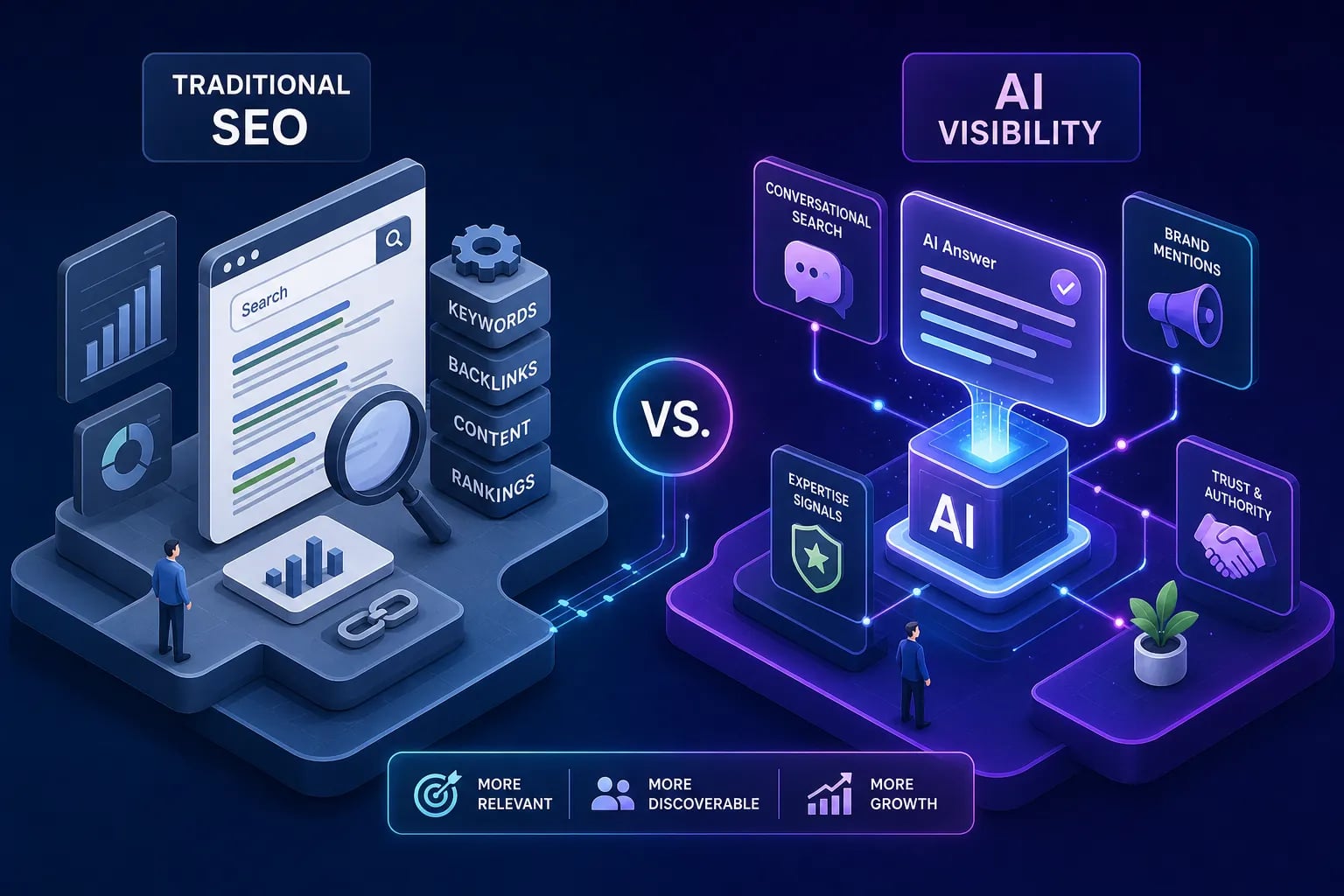
For consultants, insurance advisors, real estate professionals, and attorneys, being found at the moment a buyer evaluates options is everything. That evaluation is now increasingly happening inside an AI conversation before anyone clicks a single search result. The firms that understand this shift are building a different kind of presence. The ones that don’t are losing consideration before anyone visits their website. This positioning gap is exactly what we at TW3 Marketing evaluate when working with established professional firms.
Key takeaways
- Pages versus passages: Traditional SEO rewards well-ranked pages; AI systems select specific passages that directly answer buyer questions, regardless of overall page rank.
- Backlinks as eligibility: Quality backlinks place your firm in the candidate pool for AI retrieval but don’t guarantee citation. Topical relevance and content clarity matter more once you’re in the pool. Semrush correlation data supports backlinks as an indirect, not determinative, signal.
- Entity identity is critical:
Person,Organization, andServiceschema withsameAslinks helps AI systems disambiguate and strengthen entity signals for retrieval, though schema alone does not guarantee an AI citation. - Clicks are fewer but more qualified: Studies estimate AI answers reduce top organic CTR by roughly one-third to more than half when present, but visitors who click after an AI conversation tend to arrive with a defined need and a shortlist.
- Two scorecards, not one: Traditional SEO metrics measure demand capture; AI visibility metrics measure decision influence. Run both, and report them separately.
How AI search visibility differs from traditional Google SEO for professional firms
AI doesn’t rank pages, it selects passages
AI systems use a retrieve-select-generate-cite pipeline. They pull candidate pages from an index, evaluate passages for direct relevance, clarity, and answerability, then generate a response with selected citations. A page can be retrieved internally without ever appearing as a visible citation. Being indexed and crawlable is necessary, but passage-level usefulness often outweighs overall domain ranking.
Most firms assume ranking equals visibility. That assumption is wrong in AI search. The question isn’t whether your page ranks; it’s whether a specific passage on that page directly answers the question a buyer just asked an AI assistant. That shift, from page authority to passage extractability, is the core of how AI search visibility differs from traditional Google SEO for professional firms.
Where Google AI Overviews, ChatGPT, and Bing differ
The systems aren’t identical. Google AI Overviews draw primarily from Google’s own index, so traditional ranking carries real influence there. According to Ahrefs, as of early 2026, only about 37 to 38 percent of pages cited in Google AI Overviews also ranked in Google’s organic top 10, down from roughly 76 percent in mid-2025. That gap is growing fast. ChatGPT with web search rewrites the query, retrieves from its own infrastructure, then makes an additional model-driven selection pass. Bing Chat grounds answers in Microsoft’s ecosystem.
A firm optimized only for Google organic may still be invisible across other platforms. Each system has a different entry point and a different evaluation process. Betting on one is not a strategy.
Which ranking signals carry over and which ones change?
| Dimension | Traditional SERP ranking | AI citation selection |
|---|---|---|
| Role of backlinks | A primary ranking signal through link authority and PageRank | An indirect authority and discovery signal that determines candidate eligibility |
| Content format | Keyword-relevant pages structured for search intent | Concise, independently useful passages that directly answer specific buyer questions |
| Ranking position dependence | Strong preference for top-10 results | Can cite pages outside the top 10; relevance and extractability can override position |
| Entity identity | Domain authority and page-level signals dominate | Clear entity markup (Organization, Person, sameAs) helps AI disambiguate who you are |
| Link attribute treatment | Follow links carry ranking equity; nofollow treatment is distinct | Follow and nofollow links show similar predictive associations for AI visibility |
Backlinks: still useful, but for a different reason
In traditional SEO, backlinks flow PageRank. In AI search, they function more as authority and discovery signals that place a firm in the candidate pool. A Semrush study of 1,000 domains found roughly a 0.65 Pearson correlation between backlink-derived Authority Score and frequency of AI mentions, with the relationship strongest at higher authority levels. Quality, topically relevant backlinks outperform raw quantity. Backlinks are necessary for eligibility, not sufficient for citation.
One additional finding worth noting: nofollow links appear to carry similar predictive value for AI visibility as follow links. AI systems seem to evaluate the mention and context, not only the link equity. That shifts the emphasis toward earning credible references rather than chasing follow links at scale.
Structured data and entity clarity
Schema markup clarifies identity and reduces ambiguity; it doesn’t substitute for authoritative content. For professional firms, the most useful schema types are:
ServiceorProfessionalServicewith specific subtypes likeLegalServiceorFinancialServiceOrganizationwithsameAslinks to directories and professional associationsPersonwith credentials and role tied to individual pagesFAQPagefor genuine, visible question-and-answer content
Only mark up what’s genuinely visible on the page. Generic schema copied across every page provides little evidentiary value and can undermine trust. Schema strengthens entity signals for AI retrieval; it does not by itself guarantee a citation.
Content format: from keyword density to extractable answers
Traditional SEO rewards well-structured, keyword-relevant pages. AI-first SEO rewards pages with concise, independently useful sections that directly answer specific buyer questions. A service page written to rank for “business consulting Chicago” is formatted very differently from one designed to be cited in a conversational search answer to “what should I look for when hiring a business consultant?” Authorship signals matter here. Person schema with credentials, job title, and affiliation links helps AI systems evaluate expertise, not just domain authority.
How the buyer journey shifts when AI answers first
Zero-click behavior: what it costs and what it gains
Studies estimate that AI Overviews reduce the number-one organic CTR by roughly one-third to more than half when present, with industry analyses from sources including Ahrefs and Advanced Web Ranking tracking this trend through 2026. Informational queries like “do I need a business attorney?” or “how does a benefits advisor get paid?” are most affected because the AI answer satisfies the question without a click.
The click loss is real, but buyers who arrive after an AI conversation tend to arrive with a defined need and a shortlist. The visit is more evaluative, less exploratory. The challenge is that traditional click-based metrics won’t show you those moments of AI influence; you have to measure for them deliberately.
AI as the new gatekeeper in the consideration phase
In traditional search, the buyer opens multiple listings and self-filters. In AI search, the system narrows the consideration set before the buyer reaches any firm’s website. For professional services, this means a firm must be recommended in the AI conversation and verifiable when the buyer arrives. A firm that earns an AI mention but provides no clear credibility signals on its website loses the sale at the follow-up visit.
Where most firm websites fall short on AI search visibility
The authority signals most firm sites are missing
Three common gaps appear repeatedly: unclear authorship with no Person markup and no visible credentials tied to individual pages; service descriptions optimized for keywords but not for buyer questions; and weak entity identity with no sameAs links to directories, LinkedIn, or professional associations. These aren’t technical SEO problems; they’re authority positioning problems. A firm can have a fast, well-indexed website and still give AI systems nothing credible to cite.
What changes when AI search visibility replaces traditional Google SEO as the primary measure
Traditional technical SEO audits check crawlability, Core Web Vitals, and backlink profiles. They don’t assess whether a firm’s content is structured to answer the specific questions buyers ask AI assistants, or whether the firm’s expertise is demonstrated clearly enough for an AI to surface it as a source. Firms transitioning from SEO-only thinking need a structured authority assessment that evaluates positioning, proof, expertise, and discoverability for chatbots and AI search tools together.
That kind of structured assessment is what separates a roadmap from guesswork, which is what TW3 Marketing Authority Audit™ is built to deliver. It’s a paid 100-point diagnostic that identifies where a firm’s current approach falls short across positioning, content, reputation, and AI readiness before any implementation begins. That sequence matters: gaps first, program second.
The two visibility systems your firm needs to run now
Run two scorecards, not one
Your traditional SEO scorecard covers keyword rankings, organic traffic, CTR, backlinks, and conversions. Keep running it; it still measures demand capture. Your AI visibility scorecard covers a different set of signals:
- Mention rate: brand mentioned in AI responses divided by total tested prompts
- Citation rate: firm domain cited divided by total tested prompts
- Branded search lift
- AI referral sessions
- Recommendation rate on decision-stage prompts
These measure decision influence, not demand capture. Report the two scorecards separately. A mention measures awareness; a citation measures source attribution. They require different tactics to improve, and combining them into a single blended score obscures which one you’re actually moving.
Where to start before making any changes
Before rewriting content or adding schema, understand your current authority gap. Identify which service pages answer real buyer questions, which demonstrate clear authorship and credentials, and which are built only for keyword rankings. Starting with an authority assessment creates a prioritized roadmap instead of scattered fixes.
Understanding how AI search visibility differs from traditional Google SEO for professional firms is the first step, the second is knowing exactly where your firm stands today. The firms that pair authoritative links with clear, verifiable expertise and extractable answer content are best positioned to earn AI visibility in the period ahead. TW3 Marketing Authority Audit™ provides that 100-point foundation, with a clear gap analysis and implementation sequence, before any program recommendation is made. If you’re not ready for the full audit, our free Authority Level assessment is a preliminary starting point. That work starts with knowing where you stand.
Frequently Asked Questions
If our firm ranks number one in Google organic results, can we still be invisible to AI assistants?
Yes, a number-one organic ranking does not guarantee AI visibility. AI systems select concise, extractable passages rather than pages, so a top-ranked page can be retrieved internally without ever being cited; the decisive factor is whether a passage on your page directly answers the buyer’s question. That means ranking and AI visibility are distinct outcomes you must address separately.
How do backlinks influence our chances of being cited by AI systems?
Backlinks help by placing your firm in the candidate pool, but they don’t guarantee AI citation. Studies show backlink-derived authority correlates with AI mentions, and quality, topically relevant backlinks matter more than raw quantity; nofollow links can also carry predictive value for AI visibility. In short, backlinks are necessary for eligibility but not sufficient for selection.
What specific structured data should we add to improve AI disambiguation of our firm?
Use schema that clarifies Service or ProfessionalService (with subtypes like LegalService or FinancialService), Organization with sameAs links, Person with credentials and role, and FAQPage only for genuine visible Q&A. Only mark up content that is genuinely visible on the page, since generic schema copied across pages provides little evidentiary value and can undermine trust. Schema strengthens entity signals but does not by itself guarantee an AI citation.
How should we measure AI visibility differently from traditional SEO performance?
Measure AI visibility with a separate scorecard that tracks mention rate, citation rate, branded search lift, AI referral sessions, and recommendation rate on decision-stage prompts. Traditional SEO metrics like rankings, organic traffic, CTR, and backlinks still measure demand capture, so report the two scorecards separately to avoid obscuring which system you’re improving. Running both scorecards lets you see demand capture and decision influence independently.
