
Why contractors need AI optimization beyond traditional SEO in 2026 becomes obvious the moment you run this test. A roofing contractor ranks third on Google for “roof replacement [city].” Traffic looks reasonable. The phone rings. Marketing appears to be working. Then a homeowner opens ChatGPT and types: “Who should I call for a roof replacement in [city]?” Two different companies get named, with specific reasons. The contractor ranking third isn’t mentioned at all. This is an anecdotal scenario, but it mirrors what TW3 Marketing Authority Audit™ surfaces repeatedly across contractor markets.
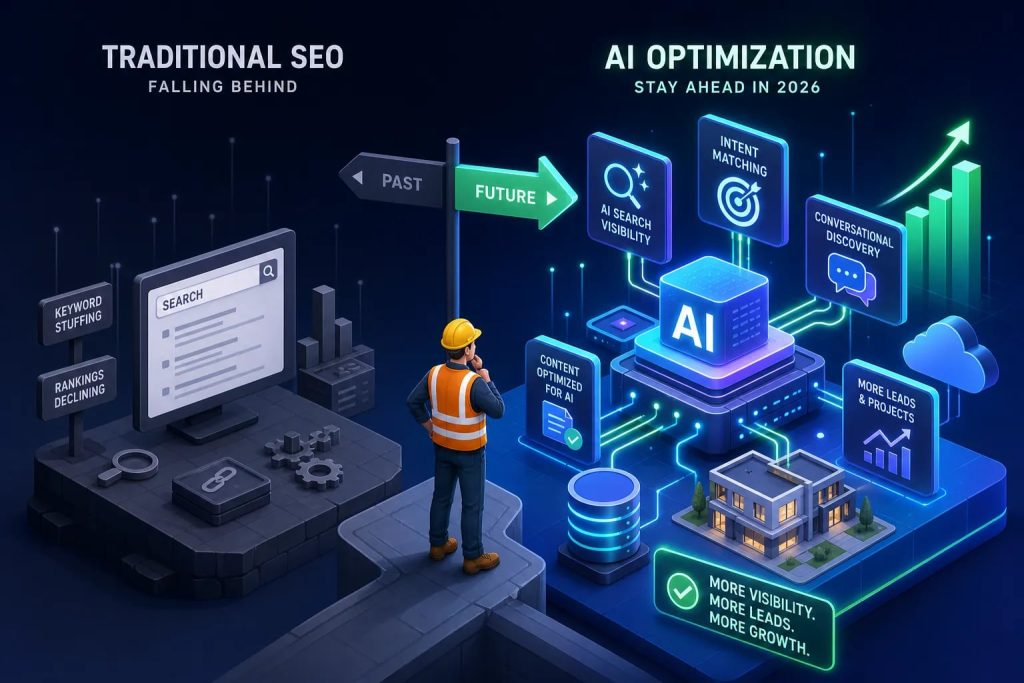
Contractors who believe their digital marketing is working because Google rankings look solid are often invisible to the AI systems their prospects are already using to make decisions. The problem isn’t that their SEO is broken. The problem is that SEO and AI recommendations run on different logic, and most contractors don’t know the difference yet.
Why Contractors Need AI Optimization Beyond Traditional SEO in 2026
Zero-click behavior reached 68% of U.S. Google searches in early 2026, up from roughly 60% in 2024, according to SparkToro/Similarweb analysis. Google AI Overviews now appear above the Map Pack on research-driven queries like “best roofing contractor” or “how much does HVAC replacement cost.” An Ahrefs analysis of AI Overview impact found that the top organic result received roughly 58% fewer clicks when an AI Overview was present. Ranking well still has value, but ranking alone no longer controls whether a contractor gets seen.
The local result page for a service query now serves three separate surfaces: the Map Pack, localized organic results, and AI-generated recommendations. A contractor can dominate one surface and be completely absent from the other two. Traditional SEO, with its focus on Map Pack placement and organic listings, optimizes for one or two of those three surfaces. That’s no longer a complete strategy for AI-driven SEO for contractors competing in 2026.
How AI Platforms Actually Decide Which Contractor to Surface
ChatGPT, Google AI Overviews, Gemini, and Perplexity don’t rely primarily on title tags to decide who to recommend. They pull from citation sources, review platforms, structured data, consistent business entity information, and content that directly answers the questions buyers actually ask. A contractor with clear, expert-level content explaining services, process, and qualifications is far more likely to get cited than one who simply has more backlinks.
Consider what this looks like in practice. A roofing company with strong organic rankings but thin service pages, mismatched business information across directories, and generic content watched a competitor with fewer backlinks get cited repeatedly in AI responses. That competitor had detailed FAQ content built from real customer questions, strong review depth, and consistent entity data across every platform where it appeared. Authority signals, not keyword density alone, can outweigh traditional ranking factors when AI systems decide who to recommend.
The contractors that AI systems recommend most often share a common profile: a clear local identity, consistent business information across every directory and profile, service-specific reviews with enough substance to identify what the company actually does well, and pages that plainly explain services and coverage areas. That’s a different checklist than the one traditional SEO produces, and it’s the foundation of effective conversational search optimization.
The Three Surfaces Most Contractor Marketing Misses
Local SEO with AI in mind means accounting for all three result surfaces simultaneously. Many contractor marketing automation tools and dashboards were built around Map Pack and organic click metrics. They weren’t designed to track AI citations, brand mentions in generative responses, or engagement signals that AI platforms use to assess credibility. That measurement blind spot is where market share quietly shifts.
Where Most Contractors Have Unmeasured Gaps
Many contractors have never opened ChatGPT and asked who it would recommend for HVAC replacement in their city. The answer can be surprising. Common gaps include inconsistent NAP data scattered across directories, service pages that describe what a contractor does without demonstrating why they’re qualified to do it, and no structured FAQ content built from the actual language customers use when they call.
TW3 Marketing Authority Audit™ is a paid diagnostic built to expose exactly these gaps. It produces a 100-point Authority Score across six dimensions: positioning, proof, expertise, visibility, engagement, and experience. The audit includes a direct competitor comparison and a prioritized roadmap. Rather than reporting the traffic metrics contractors already track, it maps where AI visibility, positioning, and credibility signals fall short compared to the competitors AI platforms are already recommending. That’s a materially different kind of diagnostic than a standard SEO report.
AI Optimization Beyond Traditional SEO in 2026: What to Fix First
The priority order matters. Lead routing and response speed come first. A contractor generating AI-referred traffic without a functional follow-up system wastes every gain made elsewhere. After that, entity consistency across the website, Google Business Profile, and directories gives AI systems the foundation they need to confidently recommend a business. Then comes building service pages and FAQ content from real customer questions, structured with schema markup, so AI can accurately summarize what the contractor does and for whom.
Metrics That Connect AI Visibility to Revenue
The metrics traditional SEO dashboards miss are the ones that actually connect marketing to revenue. Contractors optimizing for AI local listing management and AI-driven visibility need to track AI citations and brand mentions across platforms, qualified lead rate from organic traffic, estimate-to-job close rate by source, and average job value for AI-referred versus organic traffic. In GA4, these can be captured through custom dimensions tagged to traffic source and referral type, with a dedicated dashboard comparing AI-referred sessions against standard organic sessions.
TW3 Marketing Authority Audit™ case study data includes a representative comparison showing AI-optimized funnels producing a 75% qualified lead rate versus 55% from traditional SEO alone, with average job values running nearly $900 higher per engagement. These are case-study results, not universal benchmarks, but they illustrate the revenue gap that AI lead scoring for service businesses is designed to close. Those numbers tell a different story than impressions and rankings.
The Decision That Actually Matters in 2026
AI platforms are already making recommendations about contractors. With or without a contractor’s input, ChatGPT and Google’s AI systems are deciding who to name when a homeowner asks. For most contractors, those decisions are happening in a blind spot. Traditional SEO built the visibility strategy for a search environment that no longer matches how buyers find and choose service providers.
The contractors who adapt fastest are the ones who understand what authority signals AI systems actually need, where their gaps are relative to competitors, and which fixes move the needle first. That starts with an honest diagnostic, not more content production or ad spend.
Understanding why contractors need AI optimization beyond traditional SEO in 2026 is step one. Acting on it is step two. TW3 Marketing Authority Audit™ delivers the diagnostic you need to take that step: a 100-point assessment that maps your authority gaps, benchmarks you against the competitors AI is already recommending, and hands you a prioritized roadmap so you know exactly where to invest next. Contact TW3 Marketing to run the TW3 Marketing Authority Audit™ on your market, and find out who AI is recommending instead of you.
