
Customers are no longer just Googling “best HVAC company near me.” They’re opening ChatGPT and typing “who should I call to replace my AC unit in Phoenix?”, and chatgpt business recommendations are shaping purchase decisions faster than most companies have noticed. Many businesses are unaware of their visibility in AI assistants, and the gap between showing up and staying invisible often comes down to one thing: how readable your digital presence is to the systems doing the recommending. If you’re losing ground in AI-generated answers, the most likely cause isn’t a competitor with a bigger ad budget, it’s a competitor whose structured digital presence gives AI systems more to work with.
Getting recommended by ChatGPT is not about paying for placement or submitting to some official registry, though it’s worth noting that OpenAI does support merchant integrations and official connectors that can give businesses a first-party data advantage (more on that below). The businesses that consistently appear in AI-generated recommendations have built a specific kind of digital authority: structured, verifiable information across multiple independent sources. This guide breaks down exactly how those recommendations are generated, what keeps most businesses invisible, and the prioritized steps to close the gap.
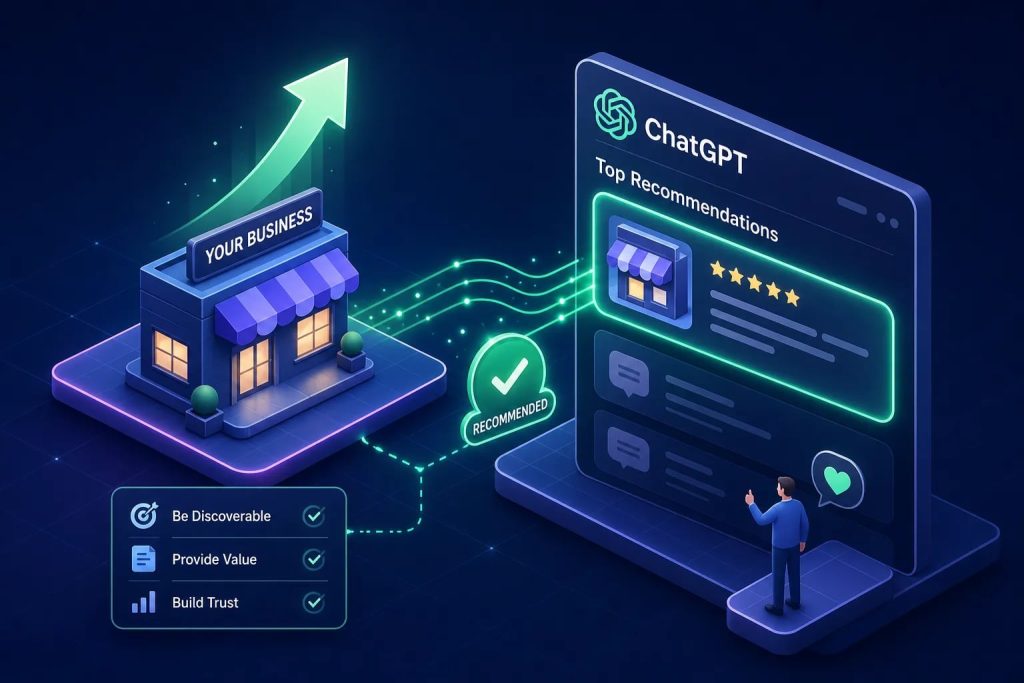
How ChatGPT Business Recommendations Are Generated
ChatGPT doesn’t pull from one master list or rank businesses the way a directory does. The recommendation process combines three inputs: the user’s prompt, retrieved context from connected sources or the web, and the model’s synthesis based on what it can verify. Understanding this three-layer model is the foundation for everything else.
The three-layer recommendation model
The prompt itself defines the intent: the service category, location, and any constraints, budget, urgency, specific requirements, the user mentions. That intent shapes what the model looks for.
Depending on whether ChatGPT has web access enabled, it then retrieves context from sources it can reach: review platforms, directories, schema-marked pages, editorial mentions, and structured data feeds. The model synthesizes all of that into a recommendation, but it’s making a judgment call based on available evidence, not reading from one authoritative source. The practical implication is that ChatGPT is not “finding” your business the way a map app does. It’s reading the evidence that exists about your business across the web and deciding whether it can confidently recommend you. If that evidence is thin, inconsistent, or hard to parse, the model defaults to businesses it can verify more easily.
Where ChatGPT sources business data
Businesses with structured, first-party data feeds have a real advantage. When a structured product or service feed exists, ChatGPT can reference current names, descriptions, availability, and contact information directly. When it doesn’t exist, the model falls back on third-party signals: Google reviews, Yelp listings, Clutch profiles, editorial roundups, and whatever it can extract from crawled web content. A business with only its own website as a source starts at a structural disadvantage. According to multiple sources reporting on ChatGPT’s local discovery behavior, the model also leans on Bing’s indexed data more than most people expect, which makes Bing Places optimization a practical priority alongside Google.
The Authority Gaps That Keep Businesses Out of ChatGPT Business Recommendations
Most business owners assume they’re missing from AI recommendations because of one obvious flaw: not enough reviews, a weak website, or no Google Business Profile. The reality is more layered. AI recommendation systems evaluate a combination of signals, and a business that scores poorly across several dimensions simply doesn’t get surfaced, even if it’s excellent at the actual service it provides.
Why strong businesses still don’t appear
There’s a real gap between operational excellence and digital authority. A contractor with 15 years of experience, spotless work, and a full schedule can still be invisible to ChatGPT because their expertise, proof, and positioning aren’t legible to the systems doing the recommending. The model can’t see the quality of the work; it can only see the structured signals that represent it online. If those signals don’t exist or don’t align, the business doesn’t make the cut.
What systematic authority diagnosis reveals
The smarter approach isn’t guessing which gap to fix first. Agencies focused on AI visibility, like TW3 Marketing, treat this as a diagnostic before a tactic. TW3 Marketing’s Authority Audit™ maps a business’s existing signals across positioning, proof, expertise, visibility, and consistency to pinpoint specifically where the gaps live. Fixing the right gaps beats adding random content or chasing reviews on the wrong platform. If your citations are strong but your schema is missing, that’s a different fix than if your schema is solid but your review recency has dropped off.
Content That Earns ChatGPT Business Recommendations
AI systems don’t favor long narrative prose. They favor content that is scannable, modular, and explicit, content they can extract, parse, and lift directly into an answer. Format matters as much as the information itself, which means even high-quality content can be overlooked if it’s structured in a way that’s hard to parse.
FAQ sections and Q&A content: the highest-impact format
FAQ schema for AI answer systems works because it maps directly to how retrieval layers surface responses. Real customer questions paired with clear, direct answers are more likely to be used by ChatGPT than generic service page copy. FAQ schema is a parsing aid, it helps intermediaries extract Q&A blocks cleanly, which improves your odds of appearing in AI-generated answers, though it doesn’t guarantee citation or ranking on its own.
To identify the right questions, look at your most common inbound calls, patterns in your reviews, and the FAQ gaps on competitor pages. Write answers in a format the model can use: one direct answer per question, no preamble, no filler. A question like “Do you offer same-day HVAC service in Dallas?” deserves a clean, factual answer, not a paragraph about your company values.
Schema markup priorities: what to implement first
Schema helps retrieval intermediaries extract entity relationships reliably. The practical implementation order: FAQPage schema for your Q&A sections, LocalBusiness schema for service area and contact data, and Review/AggregateRating schema when paired with real, displayed review content. You can find implementation guidance and code examples at schema.org. Schema doesn’t teach ChatGPT about your business directly; it helps the search and AI layers that feed into ChatGPT understand your content more cleanly, which improves your odds of being surfaced accurately.
Here’s a minimal example of FAQPage schema in JSON-LD format:
A LocalBusiness schema block should include your business name, address, phone, service area, and hours. Adding Review/AggregateRating markup only makes sense when your page actually displays the reviews it references, otherwise, the schema is flagged as misleading by search intermediaries.
Page architecture that AI systems can parse
Lead key pages with a summary block that states exactly what you do, who you serve, and where you operate. Use comparison tables for service tiers or pricing options. Use numbered steps for any process-heavy content. The goal is an explicit structure where any important fact about your business is easy to find and extract without reading the whole page. Long paragraphs that bury the answer in the middle are the format most likely to be skipped over entirely.
Reviews, Citations, and Consistency: Trust Signals That Influence AI Recommendations
The signals that live outside your website carry serious weight. Observational research and vendor testing consistently show that reviews, third-party citations, and cross-platform consistency affect how AI systems evaluate and surface local businesses, though it’s worth noting that this evidence is primarily inferential rather than from a published, causal study by OpenAI. The bar is higher than most people expect.
How reviews influence AI recommendations, and what kind matter most
Review volume matters most at low-to-mid counts. Based on observational data from local AI visibility audits, a working baseline for consistent AI visibility appears to be around 150 Google reviews, with top local businesses often showing closer to 240. These are rules of thumb from practitioner testing, there is no officially documented minimum, and thresholds vary by industry and competitive density.
After a certain volume threshold, recency and specificity start to matter more than raw count. Detailed, experience-rich reviews that describe the actual service, the outcome, and the technician by name carry more signal than generic “great company!” ratings. Collect reviews continuously on Google, Yelp, and Trustpilot, plus category-specific platforms like Clutch or Angi depending on your industry.
The role of third-party citations and earned mentions
ChatGPT leans heavily on editorial roundups, industry directory listings, association pages, and independently authored mentions to validate that a business is legitimate. A business with only its own website as a source is structurally disadvantaged compared to one that appears across credible independent sources. Earning those mentions through local media coverage, industry associations, and relevant directories is a core part of any serious AI visibility strategy, not an optional add-on.
Why cross-platform consistency is non-negotiable
Your business name, address, phone number, service descriptions, and service categories need to match exactly across your website, Google Business Profile, Bing Places, and major directories. Inconsistency signals unreliability to AI systems doing cross-reference checks. If your website says you serve “the greater Austin area” but your directory listings only list one zip code, that discrepancy creates friction that works against you. The same applies to credentials, certifications, and specializations: if they’re on your website but absent from your directory profiles, the confirmation signal is incomplete.
Connecting Your Business Data Directly to ChatGPT
Businesses that can surface structured, first-party data directly into the ChatGPT ecosystem have a meaningful edge over those relying solely on what the model can crawl from the open web. This is increasingly relevant for any service business building a resource library, FAQ hub, or structured knowledge base.
Product and service feeds: the direct data path for product recommendation AI
OpenAI’s merchant-style integrations allow businesses with structured service or product feeds to supply ChatGPT with current names, prices, availability, and URLs. When this feed exists, the model references first-party data directly rather than approximating from external sources. That reduces errors in how your business is described and improves the accuracy of any recommendation that includes specific service details or pricing ranges. If you operate a multi-location service business or have clearly defined service tiers, building out this feed is worth the investment.
Knowledge connectors and MCP: plugging in internal business knowledge
The Model Context Protocol (MCP) is the current official standard for custom business integrations with ChatGPT. In practical terms, MCP and similar knowledge connectors let you expose specific internal data to ChatGPT in a controlled way: your FAQ repository, service documentation, scheduling availability, or knowledge base. The model can then pull from that data when answering prompts relevant to your business.
For a local service business, a simple MCP setup might connect your scheduling system so ChatGPT can answer availability questions accurately, or link your FAQ library so service-specific answers come directly from your documented responses. The technical lift is real, but the payoff is first-party accuracy rather than relying on what the model can infer from external sources.
How to Monitor Whether ChatGPT Is Recommending Your Business
Most business owners make changes and have no reliable way to know if they worked. Without measurement, AI optimization is guesswork. The good news is that you don’t need enterprise tools to build a practical monitoring system.
Manual prompt testing: what to ask and how to interpret results
Start with a structured set of 10 to 20 prompts that mirror real buyer language: category plus location, problem-based queries, and comparison prompts like “who are the best [service type] companies in [city]?” Run them in a fresh chat with no prior history, so previous conversations don’t influence the output. Document whether your business appears, where it appears in the response, which competitors are named, and whether the tone is positive, neutral, or hesitant. Re-run the same core set on a monthly schedule to track directional changes.
Tracking indirect signals of AI visibility improvement
There’s no official “ChatGPT impressions” metric yet, so tracking a cluster of correlated signals is the practical alternative. Watch for growth in branded search volume, increases in direct traffic, new referral sources from AI-adjacent platforms, and an uptick in review velocity. Customers who mention finding you through an AI assistant are also worth capturing and logging. When multiple signals move in the same direction over the same period, that’s meaningful confirmation that your authority signals are improving.
Start Here: Your Next Step Toward ChatGPT Business Recommendations
Getting into chatgpt business recommendations is earned, not purchased. The businesses that consistently show up have built structured, verifiable digital presences, on their own websites, across review platforms, and through third-party citations. The approach isn’t complicated: audit your content architecture, implement the right schema, build your review and citation base, and connect your data where the technical setup makes sense.
Run the 10-prompt test described above first. That gives you a concrete baseline, you’ll know whether you’re appearing at all, how you’re described, and who’s showing up instead of you. That’s the information you need before committing to a specific tactic mix.
If you want a faster, more systematic read on where your business stands, TW3 Marketing offers an Authority Audit™ that maps your signals across the dimensions AI systems use to evaluate businesses and delivers a prioritized fix list rather than a random stack of tactics. Their Authority Score™ Check gives you an initial read on how your business currently appears in Google and ChatGPT, a useful starting point if you want to understand your gaps before deciding where to invest.
