
The most pressing question of 2026 is “Does traditional SEO still work in 2026?” Because, here’s the number that stops most business owners cold: 93% of Google AI Mode searches end without a single click to a website. That figure has plenty of people asking whether the SEO budget they’ve spent years building just became a sinkhole, and whether traditional SEO still works when customers use AI to find businesses. The honest answer is more useful than the alarming one.
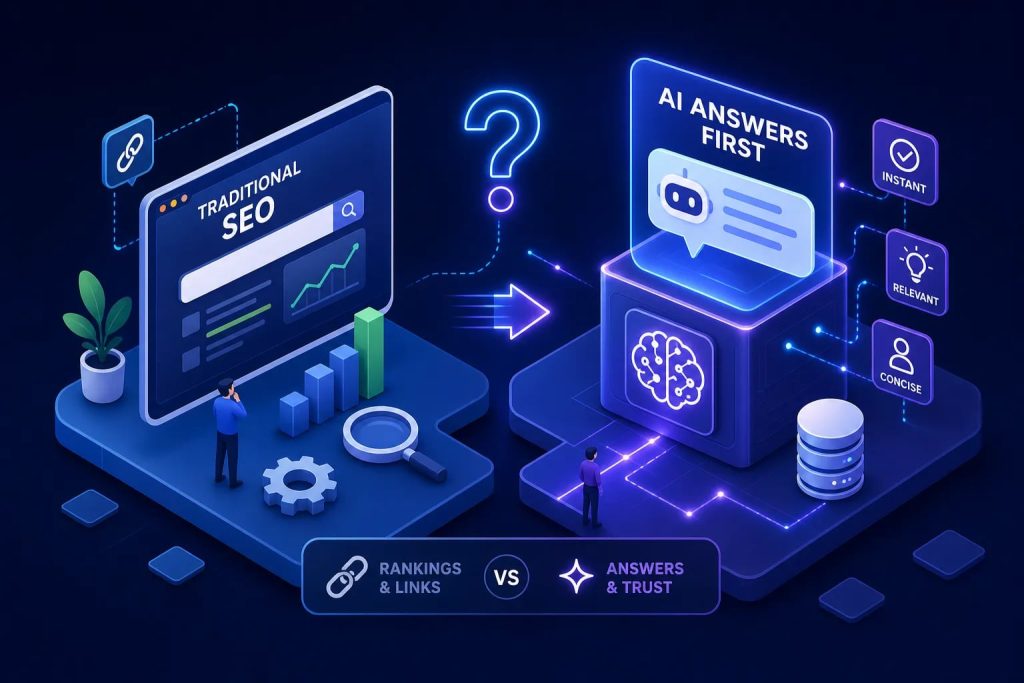
AI assistants currently handle about 17% of U.S. search interactions and roughly 28% globally. Traditional search engines still process the majority of queries. The shift is real and accelerating, but it isn’t a full replacement yet, and that distinction matters for how you allocate your next 90 days of marketing effort. At TW3 Marketing, this is the question clients bring to us more than any other right now. So here’s the practitioner’s breakdown: what the data actually shows, which SEO investments still pay off, what you need to add, and where to start.
What the search landscape actually looks like in 2026
The 56% figures circulating in some marketing reports overstate the shift because they measure all AI activity, not just search-like behavior. When you filter for queries where someone is actually trying to find information or a business, the number drops to around 28% globally and 17% in the U.S. That’s still significant. It’s just not the full-replacement story some are selling.
Zero-click rates tell a clearer story about behavior change. Google traditional SEO searches overall are already sitting at about 60, 65% zero-click. When AI Overviews appear, that rate jumps to 83%. In Google AI Mode, it hits 93%. Pew panel data from 2025 shows that when an AI summary appears on a results page, clicks to external sites fall from 15% to 8%, and only 1% of users click a link inside the AI summary itself. Ahrefs’ 2025 analysis shows AI Overviews cut the top organic result’s click-through rate by 58%.
The right frame for all of this isn’t “traditional SEO is dead.” It’s a measurement problem. Visibility is still happening; clicks are just no longer the right metric for measuring it. Here’s the practical implication that most guides miss: AI systems first retrieve candidate sources using traditional search signals, then rerank for trust, semantic fit, and extractability. If you’re not ranking traditionally, you’re not in the candidate pool for AI citation at all. Traditional SEO is now the floor, not the ceiling.
Does traditional SEO still work when customers use AI to find businesses? The 2026 verdict
Yes, but the role it plays has changed. Traditional SEO no longer wins visibility on its own; it earns you a seat at the table where AI systems then apply a second round of filtering. Businesses that understand this two-stage process are the ones holding ground as AI-powered search becomes the default. The ones treating SEO as a complete strategy on its own are quietly losing ground without knowing why.
This question, does traditional SEO still work when customers use AI to find businesses?, doesn’t have a clean yes or no answer. It has a conditional one: yes, if you pair it with the authority and structural signals that AI retrieval systems actually evaluate. The sections below break down exactly what those signals are and which ones to fix first.
The SEO signals that still carry full weight
Domain authority and backlink quality
Domain authority and backlink quality still matter. Sources cited by LLM search assistants consistently skew toward high-authority domains, because AI systems use the same trust proxies Google has always used: backlink quality, domain reputation, and topical consistency. A weak backlink profile makes AI citation unlikely regardless of how well-structured your content is.
E-E-A-T signals
E-E-A-T has become more critical, not less. Experience, expertise, authoritativeness, and trustworthiness aren’t just Google Quality Rater criteria anymore. They’re the filters AI systems apply when deciding which sources to quote. Author credentials, consistent publishing history, and clear expertise signals now directly influence whether AI assistants, including SEO for AI assistants like ChatGPT and Perplexity, surface your business in their answers. If this used to feel like a nice-to-have, it’s now operational.
Technical health and content freshness
Technical health and content freshness remain baseline requirements. Site speed, crawlability, and mobile performance still function as qualification signals. Updated content is specifically favored by conversational search systems, especially for decision-stage queries. A sweep of stale, thin pages should be on your near-term list regardless of your AI strategy.
What AI systems actually look for when choosing sources
Semantic relevance beats keyword matching in AI retrieval. A page that directly answers a specific question in natural, conversational language outperforms a keyword-optimized page with traditional on-page structure. Consider the difference between a page stuffed with the phrase “best HVAC contractor near me” and one that opens with a clear, direct answer to “How do I choose an HVAC contractor?”, structured with subheadings, specific criteria, and a plain-language explanation. The second page is what the search generative experience (SGE) and AI retrieval systems consistently favor. This is the single biggest practical shift in how content needs to be written for AI-powered search environments.
Structure and extractability function as a hidden ranking factor. AI systems favor pages where answers are easy to locate and pull: clear headings, self-contained answer paragraphs, numbered steps, and definitional blocks. The format that works for zero-click search is the same format that increases AI citation probability. FAQPage, HowTo, Article, and LocalBusiness schema in JSON-LD format are the most cited structured data types for AI answer generation. Schema helps primarily because it improves machine readability, not because it signals anything special to the algorithm independently of good content.
Topical depth consistently outperforms thin coverage in both traditional SERPs and AI citation pools. LLM search assistants favor sources that establish authority across a subject area, not just sources that answer one question in isolation. If your content covers the edges of a topic while leaving the core thin, AI systems will default to a competitor who covered it more completely.
The authority gap that keeps businesses out of AI answers
Many businesses rank on page one for competitive terms and still get passed over by AI systems when generating answers. The reason is usually an authority gap: specific trust signals that AI platforms use to evaluate credibility are missing, inconsistent, or invisible to machine systems. Ranking and citation are related outcomes, but they’re not the same outcome.
The signals that consistently influence AI recommendation map closely to what we’ve built TW3 Marketing’s diagnostic framework around: positioning clarity, proof signals (reviews, case studies, testimonials), demonstrated expertise, digital visibility, engagement indicators, and on-site user experience. When any of these signals are weak, AI systems default to citing a competitor instead. A structured authority audit built around these signals, rather than traditional SEO metrics alone, shows exactly which gaps to close first.
Local service businesses feel this most acutely. A local HVAC company or general contractor with a strong operational reputation and weak digital authority signals is effectively invisible to AI discovery. ChatGPT and Google AI Overviews pull from what they can verify. They can’t cite what they can’t see and confirm. Fixing authority signals before spending more on ads or content is the sequence that produces durable results, not the reverse.
Tracking AI-driven visibility when referrers disappear
Standard analytics misread AI traffic in a specific way. AI assistants strip referrer data or route users through what analytics platforms classify as direct traffic. Most GA4 setups currently misclassify AI-originated visits, which causes businesses to underreport AI influence and overcredit other channels. That measurement gap leads directly to bad budget decisions.
The attribution approach that works uses three layers:
- Direct capture: Set up GA4 AI Assistant channel groupings and custom channel rules for known AI referral domains (ChatGPT, Perplexity, Gemini, Copilot).
- Hardened tracking: Implement server-side tracking and CRM source preservation before later visits overwrite the original attribution.
- Proxy modeling: Track branded search lift and direct-traffic decomposition as indicators of zero-click AI influence.
No single model covers the full picture; the combination does.
Branded search lift is worth watching closely as a leading indicator. When AI assistants mention a business by name, branded search volume rises even when no click is recorded. Tracking branded search trends in Google Search Console alongside direct traffic patterns gives you a measurable proxy for AI-driven awareness that is otherwise completely invisible in standard reporting.
Your prioritized action plan: what to do first
This week, audit your highest-traffic pages for conversational structure and add FAQ sections that answer common decision-stage questions. Add or update LocalBusiness and Organization schema in JSON-LD. Set up a custom AI channel grouping in GA4. Verify that author credentials and E-E-A-T signals are visible on your key pages. None of these require a developer or a large budget, and they move the needle quickly.
Over the next 30 to 60 days, build topical depth around your core subject areas rather than chasing individual keywords. Update stale content, especially pages that cover frequently asked or time-sensitive questions. Set up CRM source capture so AI-influenced leads are tracked through the pipeline, not just to the first session. These are structural improvements that compound over time.
The foundational layer that makes everything else work is authority. Content optimization and schema implementation produce diminishing returns when the underlying authority signals are weak. A structured authority diagnostic covering positioning, proof, expertise, visibility, engagement, and experience identifies the specific gaps AI systems see, so your effort goes to the right place rather than adding more content on top of a leaky foundation.
So, does traditional SEO still work when customers use AI to find businesses?
Yes, but it’s now the entry fee rather than the full strategy. The businesses that stay visible as AI-powered search becomes the default are the ones treating authority as infrastructure, not as a byproduct of publishing content. Keyword rankings and AI citations aren’t competing goals; they share the same foundation.
Keep investing in traditional SEO, especially domain authority and technical health. Add the structural and schema elements AI systems need to extract and cite your content. Fix your measurement setup so you can see the full picture, not just the clicks that show up in GA4. Each of those investments builds on the others, and none of them works in isolation.
If you’re not sure where your authority gaps are, that’s exactly what TW3 Marketing‘s Authority Score™ Check surfaces. Within 48 hours, you get a clear picture of how your business currently appears to both Google and ChatGPT, and which signals are holding you back from AI citation. Request yours at TW3 Marketing before your next content or ad spend decision, it’s the right diagnostic before investing further in tactics built on a weak foundation.
