
Your business ranks #1 on Google. Someone asks ChatGPT the exact same question your page answers. ChatGPT names three competitors and never mentions you. That gap is real. It’s growing, and it has a name: answer engine optimization. So what is answer engine optimization, and how does it work? It’s the practice of structuring your content and authority signals so AI-powered systems select your business as a trusted source, not just rank your page in a list.
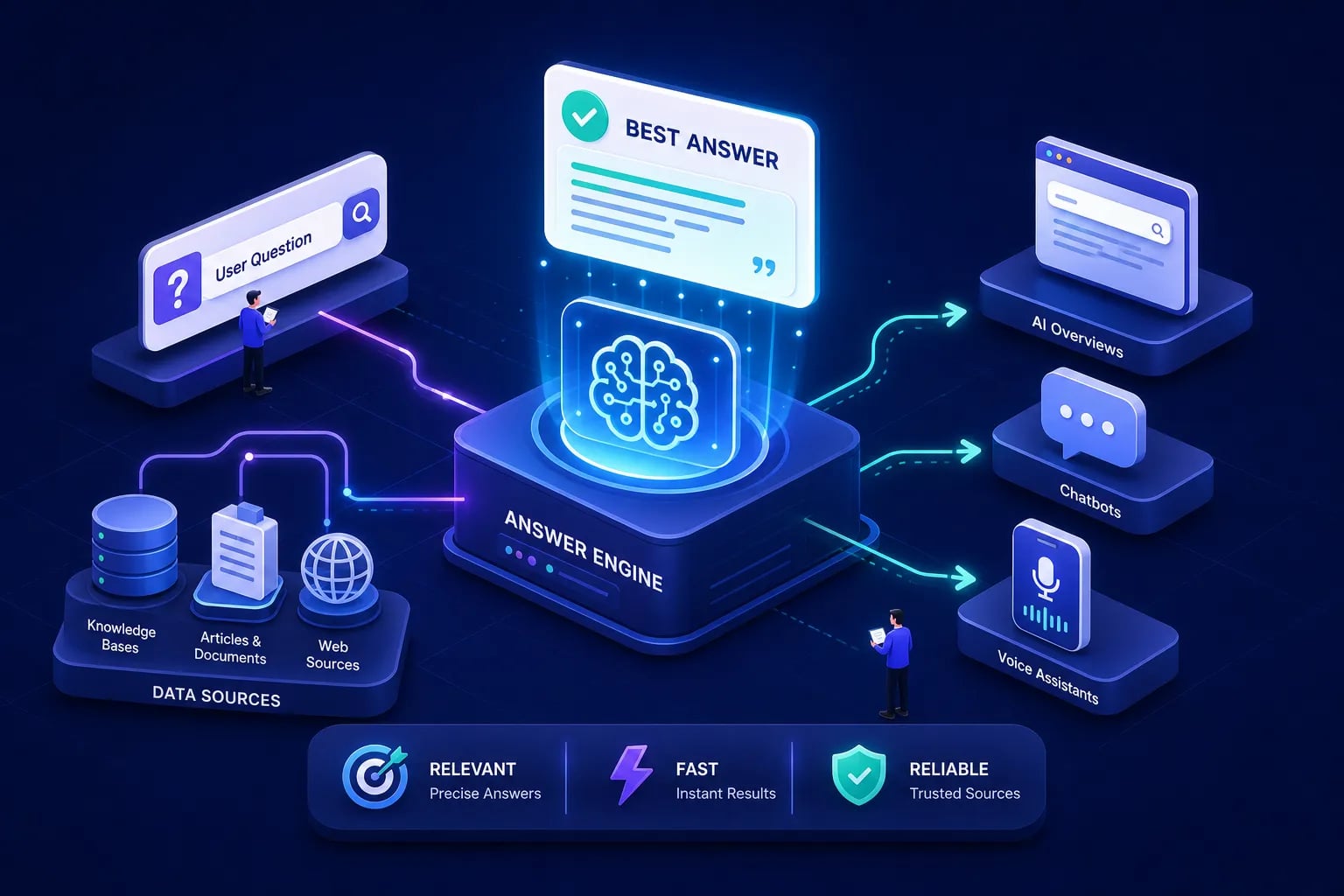
AI assistants no longer send users to a list of links and let them decide. They pick a source, extract the answer, and either cite it or don’t. The businesses that get cited win the customer interaction before a single click happens. The businesses that don’t get cited are functionally invisible, regardless of how well their traditional SEO performs.
This article gives you a clear definition of AEO, explains how AI systems actually select their sources, covers the content and brand signals that drive citation, and closes with a practical 30/90-day action plan you can hand to your team today.
How Answer Engine Optimization Works, and Why It Differs from Traditional SEO
Understanding what answer engine optimization is and how it works starts with recognizing what it is not. Answer engine optimization is the practice of structuring and optimizing content so AI-powered answer engines can understand, extract, and cite it as a direct response to a user query. That sounds close to SEO, but the goal is completely different. In traditional SEO, you optimize to rank on a page of results. In AEO, you optimize to be quoted as the answer. One gets you a position in a list. The other gets you named as the source.
Traditional SEO optimizes for ranking signals: backlinks, keyword usage, page authority, and technical crawlability. Those signals tell Google which pages deserve to appear in search results. AEO, or AI search optimization, optimizes for extraction signals: clear structure, answer-first paragraphs, verified authorship, and entity consistency across the web. Those signals tell an AI system which source to trust when generating a response.
Here’s where it gets uncomfortable for businesses that have invested heavily in SEO: ranking #1 does not guarantee AI visibility. Ahrefs reported in March 2026 that 37.9% of URLs cited in Google AI Overviews also appeared within the first 10 search-result blocks for the same query. That shows a top organic ranking can help, but it does not guarantee inclusion in an AI Overview. The optimization challenge has fundamentally changed.
How AI Answer Engines Find and Pick Their Sources
Retrieval-enabled answer systems often use retrieval-augmented generation, or RAG. Instead of relying only on a model’s stored training data, these systems retrieve relevant passages from an index or connected source and use them to ground the generated answer. Your content may never reach the generation step if the retrieval process skips it. That is why structure and clarity matter more than keyword density when you optimize for AI answers.
Think of it like a researcher pulling quotes for a report. They’re not scanning for keyword frequency. They’re looking for a passage that directly answers the question, can be extracted cleanly, and comes from a source they can attribute and verify. If your page makes that job easy, you get cited. If it doesn’t, the researcher moves on.
The three major systems each approach this slightly differently. Google AI Overviews pull from the organic search index and prefer pages with direct-answer passages near the top, corroborated across multiple sources. Bing/Copilot uses live web retrieval with visible footnote citations, showing a similar preference for clean, structured, attributable content. ChatGPT without a retrieval tool generates from training data with no live citations. With web browsing or API retrieval enabled, it surfaces whatever the connected application retrieves and passes to the model, citations in that case depend entirely on how the application is built, not on the base model.
All three systems favor content that is easy to extract, simple to verify, and clearly attributable to a real, identifiable source. That consistency is what makes conversational search optimization a discipline worth taking seriously on its own terms.
Content Structures That Signal “Cite Me” to AI Systems
Answer-First Paragraphs and Schema for AI Answers
The most important structural change you can make is also the simplest: put the direct answer first. Every section of your page should open with the answer to that section’s question, not with context-setting or background. AI systems extract passages, not page summaries. If your answer is buried in paragraph four, the retrieval system may never reach it.
Beyond answer-first paragraphs, these structural patterns consistently improve extraction likelihood:
- Question-based H2 and H3 headings that mirror real user queries
- Short, self-contained sections with one clear claim per block
- Ordered lists for how-to content; tables for comparisons
- A real FAQ section built from questions your audience actually asks
- One H1 that aligns precisely with the page’s primary topic
Schema markup reinforces what your visible content already says. FAQPage schema is the highest priority for schema for AI answers because it makes question-and-answer pairs explicitly machine-readable, reducing the ambiguity a retrieval system has to resolve on its own. HowTo schema works for procedural content. Article and BlogPosting schema signal authorship, publication date, and topic clearly for editorial pages. The critical rule: schema must mirror what’s actually on the page. Adding FAQPage markup to a page with no visible FAQ section is a signal mismatch, not a shortcut.
The Brand and Authority Signals AI Uses to Evaluate Sources
AI systems don’t just evaluate pages. They evaluate the entity behind the page. This is the layer most businesses miss entirely when they start optimizing for AI answers. You can have a perfectly structured page with every schema type implemented correctly and still not get cited, because the AI system can’t confidently identify who you are.
Entity clarity is what separates brands that get cited from brands that don’t. That means consistent business name, address, and phone number across all directories; clear author attribution on every piece of content; and third-party mentions in relevant publications and industry sites.
Cross-web consistency tells an AI system: this brand is real, identifiable, and trustworthy. A business with strong domain authority but inconsistent entity signals and no third-party corroboration is far less likely to be cited than a smaller brand with a clear, coherent, verifiable identity across the web. These are the AI answer ranking signals that determine whether your authority translates into citations.
TW3 Marketing built their Authority Framework™ to address exactly this problem. The framework targets six signals AI platforms use to identify trustworthy, recommendation-worthy businesses: positioning, proof, expertise, visibility, engagement, and experience. Most businesses that go through an Authority Audit™ find they’re weak in two or three of these areas, not because their SEO is broken, but because their authority signals were never structured with AI discoverability in mind. The 100-point Authority Audit™ diagnoses which signals are creating gaps before any content or technical work begins. That diagnostic-first approach is what separates a real AEO strategy from a generic checklist.
A Practical AEO Action Plan: 30 Days and 90 Days
The first 30 days are about fixing what’s already on your site. These lower-lift changes can shift your extractability quickly without requiring new content.
- Audit your top 5, 10 informational pages for answer-first paragraph structure. If the answer to the page’s main question appears below the fold or past the second paragraph, rewrite the intro.
- Add FAQPage schema to those same pages and create or update a visible FAQ section using real customer questions.
- Check NAP consistency across every directory and profile where your business is listed.
- Verify your Google Business Profile is complete, active, and correctly categorized.
- Confirm that every author bio on your site is current, consistent, and connects to a credible external profile.
The 90-day work is where sustained AI visibility gets built. This is the authority layer that compounds over time.
- Identify 8, 10 conversational queries your audience is actively asking AI tools, then create or restructure content specifically around direct answers to each
- Earn third-party mentions in relevant publications, directories, and industry sites to build corroborating entity signals
- Implement Article and HowTo schema across your content library where applicable
- Run a structured authority audit to identify remaining trust gaps before spending more on content production
- Build a repeatable review process tied to AI citation monitoring so you can track what’s working
Metrics That Tell You Whether Your AEO Strategy Is Working
What to Track, and When to Expect Results
AI visibility shifts before traffic does. The first measurable signs of AEO progress show up at the citation level, not the click level. If you’re watching only traffic and conversions in the first 60 days, you’ll underestimate how much is already changing.
Track AI citation frequency first. Tools like BrightEdge, the Semrush AI toolkit, and manual query testing let you monitor how often your brand appears in AI-generated answers. Watch Google AI Overview appearances through Search Console impression data. Track zero-click visibility trends separately: rising impressions without rising clicks is not a failure, it means AI systems are seeing your content. Referral traffic from AI-adjacent sources is another leading indicator worth isolating.
For realistic expectations: internal case studies show AI visibility moving from 31% to 55% in 60 days after focused AEO work, 0% to 21% across 1,500+ tracked prompts over six months, and referral traffic increases of 5x after specific technical changes. The timeline depends on your current authority baseline, content volume, and how aggressively you build out entity signals. TW3 Marketing’s Authority Score™ Check delivers a 48-hour snapshot of where your business currently stands in both Google and ChatGPT, creating an honest starting baseline for every metric you track from that point forward.
What to Do Next
Answer engine optimization is not a future concern to plan for. It’s a current competitive gap that grows wider every month businesses delay. Understanding what answer engine optimization is and how it works is only step one, acting on that knowledge is what separates the businesses AI systems surface from the ones that keep ranking on pages fewer people click every quarter.
The companies that structure their content, resolve their entity signals, and build genuine authority across the web are the ones AI systems surface when prospects ask for recommendations. Those that don’t will continue to lose ground, regardless of their organic rankings.
For businesses that want to know exactly where they stand, TW3 Marketing’s Authority Audit™ is built specifically to diagnose the signals AI platforms use for recommendation decisions. It delivers a clear roadmap rather than a generic checklist, because the gaps vary by business and by industry, and generic checklists miss them.
If you’re not sure whether your content is AI-readable yet, the first step is understanding what AI systems already know, or don’t know, about your business. Get in touch with the TW3 Marketing team to start with that baseline.
