
When a homeowner asks ChatGPT “who’s the best roofer near me,” they’re not opening a browser and scrolling through results. They’re reading the first answer the AI gives them, and many will call that contractor directly. The same pattern plays out on Google AI Overviews, Siri, and Alexa every day. The contractor who shows up in that answer has a significant advantage. These answer engine optimization tips for local contractors show you exactly how to become that contractor, across your GBP, on-page structure, schema, reviews, and local reach.
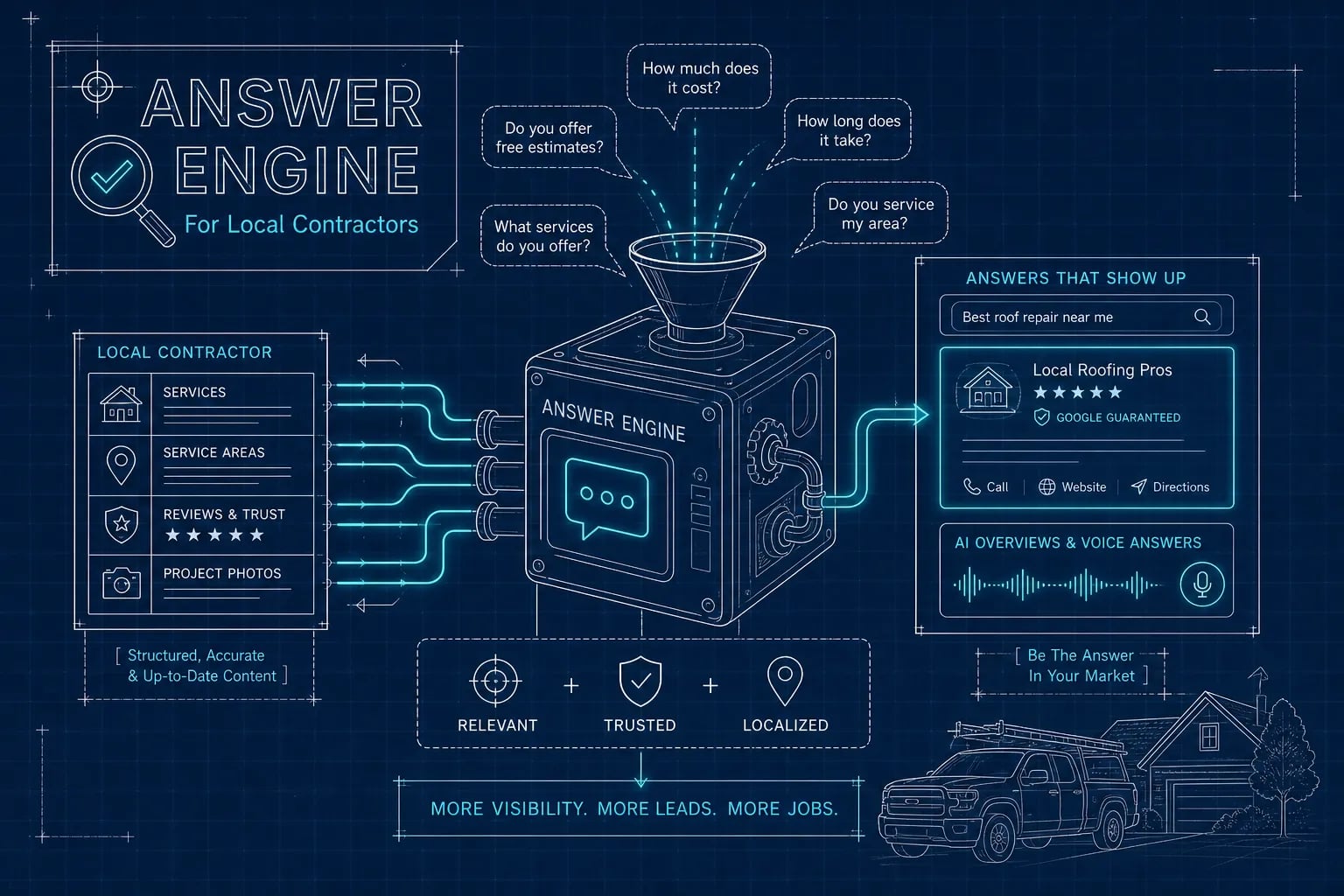
The problem is that most contractor websites were built to rank on traditional search: clean navigation, keyword-rich meta titles, a few blog posts. That formula doesn’t translate to AI answer extraction, which requires a completely different set of signals. Structured content, specific schema markup, verified reviews, and a consistent entity footprint across the web are what drive results now.
Before you work through these 12 tips, run TW3 Marketing‘s Authority Score™ Check, our proprietary audit that shows how your business currently appears in ChatGPT and Google AI, identifies the trust gaps holding you back, and gives you a clear starting point. It takes approximately 48 hours. Once you know your baseline, these tips give you a concrete action path.
1. Lock down your Google Business Profile for AI queries
Your Google Business Profile is a primary, highly influential source that AI systems draw from when a homeowner asks for a local contractor. These three optimizations make the biggest difference.
Tip 1. Choose the most specific primary category available
Not all GBP categories carry equal weight for AI matching. “General Contractor” and “Plumber” are not interchangeable to an AI system; each maps to a different set of intent-based queries, and choosing the wrong one costs you relevance. Your primary category is the single most important field in your GBP for matching your business to the right homeowner queries.
Use the most specific subtype available. If you’re a roofer, select “Roofing Contractor,” not “General Contractor.” HVAC companies should select “HVACBusiness.” Add secondary categories only for services you actually offer, not to cast a wider net.
Tip 2. Seed your Q&A section with real homeowner questions
AI systems can pull answers from your GBP Q&A section verbatim. When a homeowner asks Google AI “does this company serve my neighborhood?” or “do they offer same-day service?”, the answer may come directly from your Q&A. An empty or unanswered Q&A is a missed signal, and a badly answered one is a trust gap.
Seed several common questions your customers actually ask, for example, 5 to 8 entries covering topics like “Do you offer free estimates?”, “What areas do you serve?”, and “Do you have emergency availability?” Write concise, accurate answers in plain language. Don’t leave these to chance or wait for spam to accumulate.
Tip 3. Write service descriptions in plain customer language
AI systems match natural-language queries to your GBP service entries. If your descriptions are full of trade jargon, they’re harder for AI to match to the way real homeowners phrase questions. Each service description should state what the service is, who it’s for, and where you offer it.
A strong description looks like: “Roof leak repair for homeowners in Austin, TX. We identify the source, seal the damage, and back the work with a written warranty.” Keep your business name, address, and phone number identical across your GBP, website, and directories. That NAP consistency strengthens entity matching, which is how AI confirms your business is real and credible.
2. Answer engine optimization tips for local contractors: on-page structure
Generative AI engines don’t read your page the way a human does. They scan for clear semantic hierarchy and extract answers from structured blocks. This approach to voice search optimization for contractors and AI-driven local SEO starts with how you build each page.
Tip 4. Use a single answer-first hierarchy on every service page
The strongest page structure for AI extraction follows a consistent pattern: H1 equals the service plus the city, followed by H2s that map to homeowner questions, with H3s reserved only for breakdowns within a larger section. If your current pages lead with your brand name as the H1 and use generic H2s like “Our Services” or “Why Choose Us,” they’re structured for humans scanning a brochure, not for AI extracting an answer.
Rebuild your service page headers around question-shaped subheads. For a roof repair page, your H2 sequence might be: “How roof repair works,” “What a typical repair costs in Austin,” “Which areas we serve,” “What past customers say,” and “Frequently asked questions.” That structure tells AI exactly what each section contains and makes extraction straightforward.
Tip 5. Write FAQ answers in the 40, 60 word sweet spot
AI snippets most reliably pull answers that are 40 to 60 words, answer-first, and self-contained. The first sentence should deliver the direct answer. The second adds a single qualifier or supporting detail, and that completes the formula.
A question like “How long does roof repair take?” should open with: “Most roof repairs take one to two days, depending on the extent of the damage and weather conditions.” Starting with “The timeline depends on a number of factors…” buries the answer and reduces extraction probability. Lead with the answer every time, in every FAQ. This format works equally well for featured snippets and generative AI extraction.
Tip 6. Place your FAQ block before the final contact CTA
Where your FAQ sits on the page matters. Placing FAQs near the related service information and before the final conversion block creates a clearer experience for readers. A FAQ stuffed into the footer or stacked above your reviews gets less extraction value.
A practical order for a contractor service page is: intro, service scope, process, pricing or estimates, local proof, FAQ, then contact CTA. Keep the FAQ section tightly focused on the specific service on that page. Spreading FAQ content across random locations dilutes the relevance signals AI systems use to match your page to a query.
3. Add schema markup that AI systems can extract
Schema tells AI systems exactly what your business does, where you do it, and how to verify it. Without it, AI engines are forced to guess, which introduces uncertainty and reduces your recommendation likelihood.
Tip 7. Add LocalBusiness and Service schema to your core pages
Use the most specific LocalBusiness subtype available in JSON-LD: “RoofingContractor,” “Plumber,” “HVACBusiness,” or “Electrician.” Add this to your homepage and contact page. For each individual service page, add a separate Service schema block that includes the service name, service type, and the provider linked back to your LocalBusiness entity via the @id field, along with the areas you serve.
Here is a simplified example of how that JSON-LD connection looks:
<code>{
  "@context": "https://schema.org",
  "@type": "Service",
  "name": "Roof Repair",
  "serviceType": "Roofing",
  "provider": {
    "@type": "RoofingContractor",
    "@id": "https://yoursite.com/#business"
  },
  "areaServed": "Austin, TX"
}</code>
Linking your Service schema back to the LocalBusiness entity via @id is what creates a clean association that generative engines can follow. Without that link, your schema is a collection of isolated signals instead of a connected entity profile. Implement everything in JSON-LD, which Google recommends as the preferred format.
Tip 8. Implement FAQPage schema on pages with real Q&A content
FAQPage schema is for pages with multiple question-and-answer pairs. QAPage schema is a different type, used only for pages built around a single question and its responses. Most contractor service pages need FAQPage, not QAPage.
Each Question in your FAQPage schema should match the exact heading text on the page, and each Answer should be the direct-answer paragraph immediately below it. That alignment between visible content and structured data reinforces extraction accuracy. Don’t add FAQPage schema to pages without a visible FAQ section; the schema and the page content must match.
4. Answer engine optimization tips for local contractors: review signals
AI platforms use review text, recency, and volume as trust signals. Research on local SEO for home service businesses consistently shows that specific, recent reviews outperform generic ones in AI recommendation frequency, the quality of the signal matters as much as the volume.
Tip 9. Collect reviews that name specific services and locations
Recommendation algorithms scan review text for service and location signals. A review that says “fixed our AC in Round Rock, TX on short notice” carries more extraction value than “great company, highly recommend.” The difference is specificity: one gives the AI something to match to a query, the other gives it almost nothing.
After every completed job, ask your customer to mention the specific work done and the city in their review. A simple text template sent post-job makes this repeatable. Contractors who collect specific, location-tagged reviews consistently outperform those with generic feedback in AI recommendation frequency, a pattern TW3 Marketing sees repeatedly across client accounts in competitive home service markets.
Tip 10. Respond to every review with natural service and location language
Owner responses are indexable content on your GBP. A response that says “Thanks for trusting us with your roof repair in Cedar Park” signals service type and location to AI systems without stuffing in keywords. Every response you write is another data point reinforcing your authority signals.
Acknowledge the specific job, thank the customer by first name when possible, and mention the city. Keep responses concise, a short paragraph is enough for clarity and indexability. Avoid copying and pasting the same boilerplate response to every review; that pattern signals low engagement and reduces the informational value of your entire response set.
5. Build local reach and AI visibility at scale
AI recommendations favor businesses that appear credible and consistent across multiple platforms. These last two tips extend your authority footprint beyond your website, and they’re essential for any serious AEO for contractors strategy.
Tip 11. Create city-specific landing pages for every service area
A single “Service Areas” page with a list of city names is usually far less effective for city-specific AI extraction than dedicated city-service pages. It’s too broad, too thin, and gives recommendation algorithms no concrete answer to pull for a city-specific query. A dedicated page for “roof repair in Cedar Park, TX” gives AI exactly what it needs: one localized, extractable answer for that query.
Build a separate page for each city-service combination you realistically serve, using the same H1-H2-H3 structure from Tip 4. Each page needs unique content, not a template with only the city name swapped in. Start with your top three revenue-generating service areas before expanding. Thin pages built solely for volume hurt more than they help.
Tip 12. Keep your NAP signals identical across every directory
Recommendation algorithms use entity matching to confirm your business is legitimate. Inconsistent business name, address, or phone number across Google, Yelp, Angi, HomeAdvisor, BBB, and industry directories creates ambiguity that reduces AI confidence in surfacing your business. Even a small difference like “St.” versus “Street” registers as a mismatch signal.
Audit your top 10 directory listings and make your name, address, phone, website URL, and business category identical across all of them. Tools like BrightLocal or Whitespark can find and correct inconsistencies at scale without manually checking each listing. This is the kind of foundational work that directly affects how AI systems verify and trust your business entity.
Put the system to work
These 12 tips function as a connected system, not a one-time checklist. Your GBP feeds schema data, schema supports page extraction, reviews confirm authority, and city pages extend your geographic footprint. Each layer reinforces the others, which is why contractors who optimize only one or two areas rarely see the full impact.
The progression runs like this: GBP and schema form the foundation. Reviews and page structure build the signal. City pages and NAP consistency extend the reach. Working in that order improves your chances of closing the gaps keeping you out of AI answers.
Before you decide which of these to tackle first, run TW3 Marketing’s Authority Score™ Check, our proprietary audit that shows how your business currently appears in ChatGPT and Google AI, identifies the specific gaps holding your score back, and gives you a prioritized starting point. Contact our team to get yours started.
Recent surveys indicate that AI tools are increasingly used for local business discovery, with some 2026 studies reporting up to 45% of consumers using AI for local business research, and homeowner-specific adoption continuing to grow. The businesses showing up in those answers aren’t getting lucky. They applied answer engine optimization tips for local contractors like these, and built their authority signals on purpose. Start yours today.
