
How is AEO different from traditional SEO? The short answer: traditional SEO gets your page into a ranked list of blue links, while answer engine optimization (AEO) gets your content extracted and used as the direct answer, often before a user ever clicks anything. Many businesses are still optimizing for a search results page that fewer and fewer customers actually use to make decisions. According to SparkToro’s 2026 data, roughly 68% of Google searches in the U.S. end without a click. AI assistants like ChatGPT and Google AI now deliver direct answers, and the businesses feeding those answers aren’t necessarily the ones ranking #1 in Google. That gap is exactly what AEO was built to close.
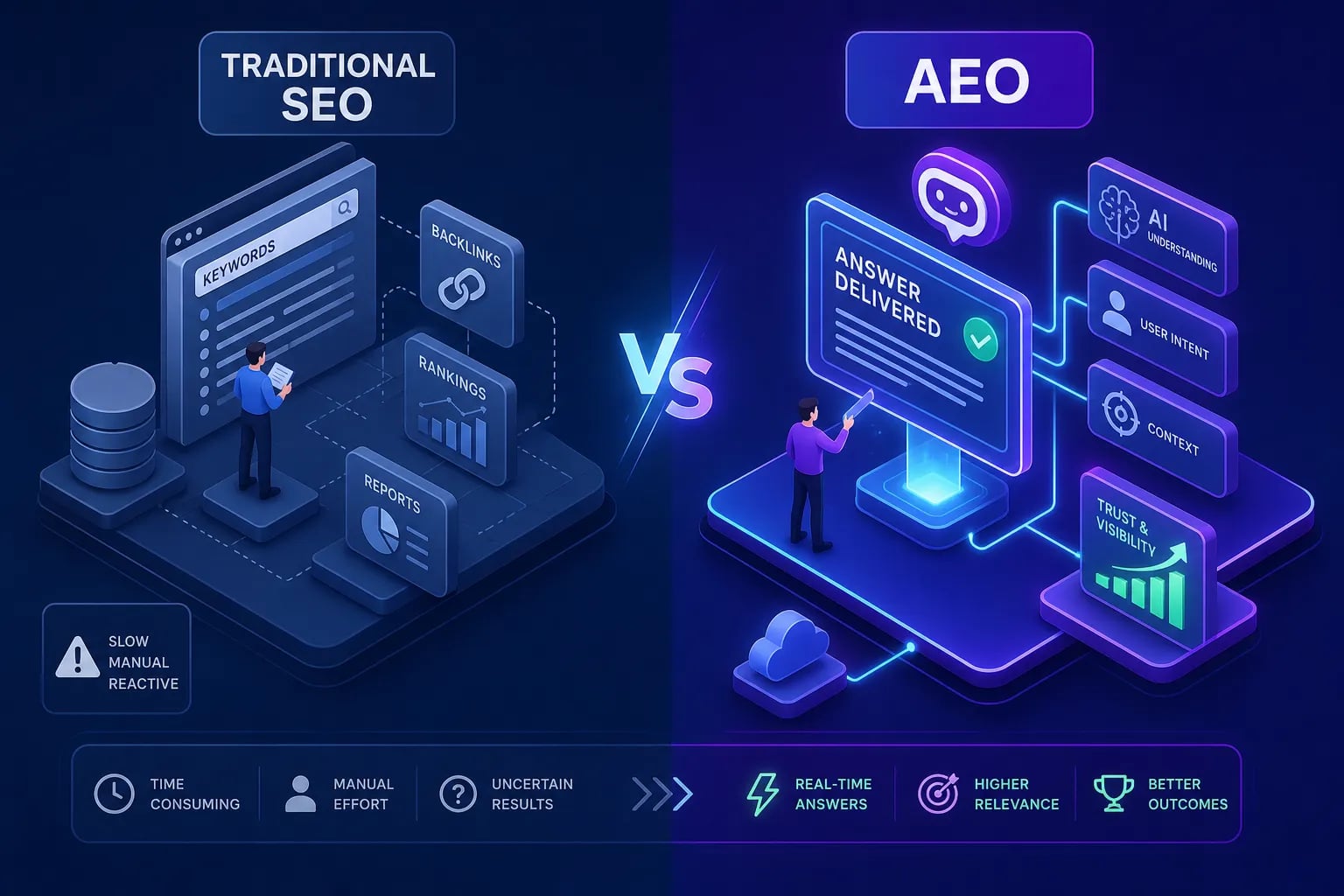
AEO and traditional SEO aren’t the same discipline with a new coat of paint. They pursue fundamentally different outcomes, use different ranking signals, and require different content strategies. At TW3 Marketing, we started seeing this visibility shift in client data before most agencies had a working name for it. This article explains what separates AEO from traditional SEO, which signals drive AI recommendations, and seven concrete tactics you can apply to start showing up where your customers are already asking questions.
AEO vs. SEO: what they’re actually trying to accomplish
Traditional SEO and AEO share a surface-level goal: visibility. But visibility means something completely different in each context. Traditional SEO gets your page into a ranked list of blue links. AEO gets your content extracted and used as the answer itself, often without a click ever happening. That’s not a technical tweak, it’s a mission-level difference in what success looks like.
The shift from ranking to being cited
Traditional SEO defines success as a high position in a SERP and the traffic that flows from it. AEO redefines success as being the source an AI assistant pulls from when a user asks a question. Your content doesn’t need to rank first; it needs to be trusted, structured, and clear enough to be quoted directly. That changes your entire content objective from “write for rankings” to “write to be cited”, the core of AI answer optimization.
The downstream consequence is significant. When an AI assistant cites your business as the answer to a local service question, the user often stops searching entirely. There’s no page 2. There’s no comparison shopping through a results list. You either get named or you don’t. That’s a winner-take-most dynamic that traditional SEO never created at this scale.
How is AEO different from traditional SEO in the queries it targets?
Traditional SEO was built around keyword-based searches: short phrases with implied intent, like “HVAC company near me.” AEO targets conversational, question-based queries, the kind users type or speak directly to AI systems: “Who should I call for HVAC repair in Dallas?” Those are different questions with different structures, and content written to answer one doesn’t automatically serve the other. AEO-optimized content, including voice assistant optimization for spoken queries, needs to match the full question intent, not just hit a keyword cluster.
What AI answer engines look at when picking a source
AI systems don’t simply list results. They scan multiple sources, interpret intent, and synthesize a response, often citing only a handful of sources. Getting selected as one of those sources requires a different profile than ranking on page one of Google.
Traditional SEO ranking factors vs. AEO selection signals
Traditional SEO leans heavily on backlink profiles, natural topic coverage and clear language support relevance, while keyword density is not a primary success metric. AI answer engines weigh content clarity, semantic relevance, entity signals, verified evidence (reviews, credentials, citations), and whether an answer is self-contained and extractable. Backlinks remain important as a proxy for authority, but AI systems place stronger relative weight on extractability and other evidence signals, particularly in direct-answer scenarios. They’re evaluating whether your content reads as authoritative across multiple correlated signals, not just whether other sites link to you.
The practical difference shows up in content audits. A page can rank well for a keyword-based query while being nearly invisible in AI-generated answers, because the page was written to accumulate ranking signals rather than to deliver a clean, extractable answer. Those are structurally different content strategies. Featured snippet optimization is a useful bridge concept here: pages built to win featured snippets share many of the same structural qualities that AI systems favor.
Why structured authority outweighs technical optimization in AEO
AI systems don’t just parse HTML the way traditional crawlers do. They evaluate whether content reads as authoritative and trustworthy across multiple signals: author credentials, consistent brand presence across platforms, verified reviews, FAQ-style directness, and schema markup that clarifies who is answering and why they’d know. Businesses with strong authority foundations have a compounding advantage here. The more consistently their expertise signals appear across their website, Google Business Profile, industry directories, and review platforms, the more confidently AI systems can cite them.
7 tactical changes to make your content answer-ready
These aren’t philosophical shifts. They’re changes you can make this week, and they directly affect whether AI systems extract your content when users ask relevant questions.
Tactics 1 through 4: content structure and format
- Rewrite headings as questions that match conversational query phrasing. Instead of “Our HVAC Services,” use “What HVAC services do we offer in [city]?” That heading structure aligns with how users phrase AI queries and makes passages easier to extract.
- Lead with a direct answer in the first sentence under each heading, then support it with context. AI systems look for answer completeness. Burying your answer in paragraph three after a long preamble is an AEO failure mode.
- Use structured formats that match query type: step lists for “how to” queries, comparison tables for “X vs. Y” queries, and concise definition paragraphs for “what is” queries. Each format signals to AI systems that your content is organized around answering a specific type of question.
- Build FAQ blocks into high-traffic pages with concise Q&A pairs that AI can extract cleanly. FAQ-style content is among the most reliably extractable formats available, and pairing it with FAQPage schema makes it machine-readable in a way AI systems can cite verbatim.
Tactics 5 through 7: schema, markup, and cross-platform authority
- Add FAQPage and HowTo schema to relevant pages. Schema markup tells AI systems and search engines what type of content the page contains, making it easier to parse and use as a structured source. Note that schema is a supporting signal rather than a guarantee, Google has confirmed that AI Overviews don’t require structured data, but well-implemented schema consistently improves extractability.
- Implement Article and Organization schema to clarify who is producing the content and what their expertise is. The schema fields for author, datePublished, and dateModified establish credibility signals that AI systems use to assess freshness and source authority.
- Build consistent authority signals across platforms. Ensure your Google Business Profile, industry directories, reviews, and website all reflect the same positioning, credentials, and service area. Cross-platform consistency is how AI systems validate trustworthiness. If your website describes you as a commercial HVAC specialist but your directory listings are vague, AI systems register that inconsistency as a confidence gap.
Why service businesses face the biggest AEO gap
Home services, contracting, and other high-intent local and professional service categories are among the areas where customers most frequently turn to AI assistants. “Who’s the best roofer near me?” and “What plumber should I call for an emergency?” are AI-first questions now. But most service businesses have weak structured authority signals, which means they’re invisible in the answers their customers are already getting. This isn’t a traffic problem. It’s an authority diagnosis problem.
The six authority signals AI platforms use to recommend local businesses
TW3 Marketing’s Authority Framework™ maps directly onto what AI platforms actually evaluate when deciding which business to recommend. The six factors are:
- Positioning, whether AI systems can clearly identify what your business does and for whom
- Proof, reviews, credentials, and verifiable evidence
- Expertise, reflected in your content depth and consistency
- Visibility, your presence across platforms and directories
- Engagement, signals that users interact meaningfully with your content
- Experience, quality signals on your website itself
These aren’t abstract marketing categories. They correspond precisely to the AEO selection signals covered earlier in this article.
TW3 Marketing’s Authority Audit™ is a proprietary 100-point diagnostic that scores a business across all six areas, surfacing the specific gaps affecting AI visibility. It’s the bridge between understanding AEO theory and knowing what to actually fix, rather than guessing which tactics to prioritize.
What an authority gap looks like in practice
Consider a plumbing company with a solid Google review profile and decent website traffic that still doesn’t show up when someone asks ChatGPT for a local plumber recommendation. This happens because the business has traffic signals but lacks the structured expertise signals, schema markup, and cross-platform consistency that AI systems need to confidently recommend them. The reviews are there, but they’re not reinforced by FAQ content, clear service-area schema, or consistent credentials across directories. AI systems can’t confidently cite a source that sends mixed signals. TW3 Marketing’s Authority Score™ Check is a company-specific diagnostic that identifies this kind of gap, showing where a business stands in both Google and ChatGPT so teams know exactly what to address first.
How to measure AEO performance differently
Most businesses tracking AEO progress try to apply SEO metrics to a fundamentally different system and come away confused. Rankings and click-through rates are trailing indicators for AEO. The leading indicators are visibility in AI-generated answers and citation frequency, and they require a different measurement approach.
The AEO KPI stack: from impressions to AI-influenced revenue
Think in three tiers. At the top of the funnel, track answer inclusion (whether your content or brand appears in AI answers), share of voice across a defined set of target prompts, and citation frequency. At mid-funnel, track AI referral traffic and the engagement quality of those visits. At the bottom of the funnel, track assisted conversions and AI-influenced leads. The conversion math here matters: Semrush’s 2026 AI Traffic Report found that AI-referred traffic converts at roughly 4.4 times the rate of standard organic search. That changes the ROI calculation significantly, even when raw traffic volumes are modest.
What a practical AEO measurement cadence looks like
Track visibility and citation metrics monthly, because AI answer surfaces fluctuate and need smoothing before you draw strategic conclusions. Reviewing pipeline and revenue attribution works better on a quarterly basis. Platforms like Semrush and BrightEdge, along with dedicated AI visibility trackers, can monitor brand mentions and citation rates across Google AI Overviews and Perplexity; ChatGPT monitoring typically requires running repeated manual prompts or using specialized third-party tools rather than direct programmatic access. Even without dedicated tooling, manually querying AI assistants with your target questions on a weekly schedule and logging whether your business appears gives you early directional data that most competitors aren’t collecting at all.
What documented AEO results actually show
The available case study data is mostly observational rather than controlled experimental evidence, but the patterns are consistent enough to draw useful conclusions. Businesses that restructured content for AEO have seen AI citation rates nearly double in published reports. One documented example tracked LLM prompt visibility climbing from 31% to 55% and citation share rising from 15% to 35% after focused AEO work in a B2B technology context. A separate report covering a content restructuring effort found 35% brand visibility across Google AI Overviews, Gemini, ChatGPT, and Perplexity after shifting to direct answer formats. AEO doesn’t displace traditional SEO overnight. What it does is shift the type of visibility a business earns, and it tends to improve traffic quality before it improves raw volume.
The higher conversion rates from AI referral traffic have a plausible explanation rooted in where those users are in the decision process. Users arriving from AI citations have typically already had the AI validate a business as a trustworthy answer, which is a different starting point than someone browsing a results page. Selection bias in how users phrase AI queries may also play a role. Either way, when a homeowner asks an AI assistant who to call for emergency HVAC service, that recommendation often ends the search entirely. Businesses that have built structured authority signals into their content and digital presence are the ones getting named. Many competitors, by contrast, are still relying on paid ads to reach customers they could be reaching through organic AI visibility.
The bottom line on AEO vs. traditional SEO
Traditional SEO wins rankings. AEO wins recommendations. The two aren’t mutually exclusive, but businesses still treating them as the same discipline are building authority in the wrong direction for where search is heading. Understanding how AEO is different from traditional SEO is the first step, the second is diagnosing which authority signals are missing and fixing those before layering on more content or more campaigns. The seven tactics in this article are a concrete starting point for both.
For service businesses in particular, getting recommended by AI isn’t a future consideration. It’s a competitive advantage that’s already separating businesses in 2026. The gap between businesses that have structured authority signals and those that don’t is widening every quarter, and it shows up directly in who gets named when a customer asks an AI assistant for a recommendation.
If you want to see exactly where your business stands right now, run TW3 Marketing’s Authority Score™ Check. It shows how your business currently appears in both Google and ChatGPT, giving you a clear baseline before committing additional budget to content or campaigns. Reach out to our team to get started.
