
A potential customer lands on your service business website. They scroll for a few seconds. They see a logo, some generic copy about “quality service,” and a phone number. Nothing confirms the business is legitimate, insured, or recommended by anyone they could verify. They bounce. They didn’t leave because of price. They left because nothing on that page made them feel safe enough to pick up the phone.
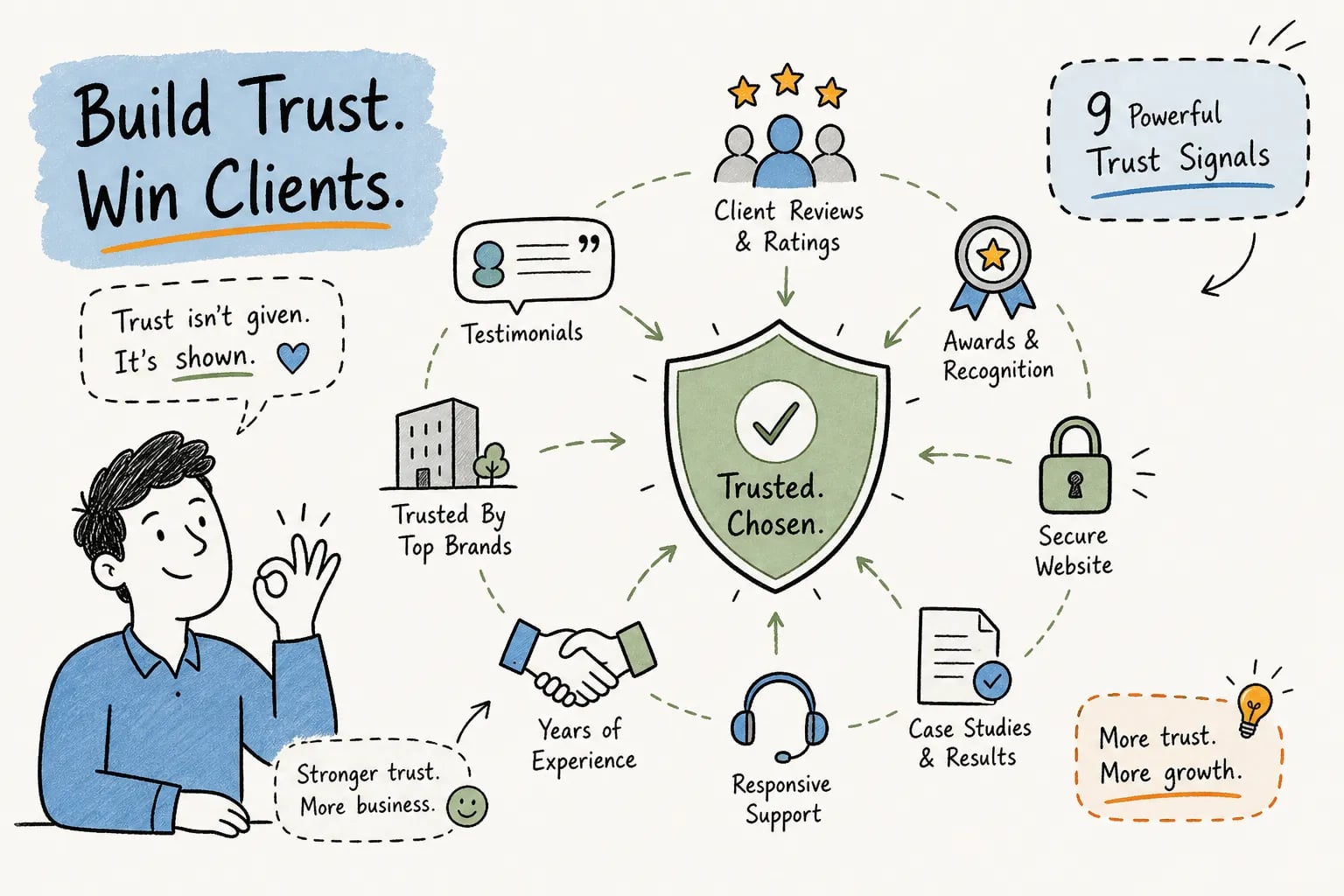
This exact scenario plays out thousands of times a day, and it’s the most common pattern TW3 Marketing’s team identifies across service website audits: businesses that have the credentials but fail to display them in a way that actually registers with a visitor. The credentials exist. The trust doesn’t transfer. That gap is the conversion problem, and it’s entirely fixable once you know which signals move the needle.
Below you’ll find the nine most powerful trust signals for service business websites in 2026, organized by practical priority, with a breakdown of which are verifiable versus decorative and exactly where to place them so they work at the moment a visitor is deciding whether to call you or your competitor.
Why trust signals carry more weight in 2026 than ever before
Customer behavior has shifted in a fundamental way. An increasing share of service decisions now begin with an AI assistant: Google AI Overviews, ChatGPT local queries, voice search. What’s critical to understand is that those systems pull from the same credibility signals that convert human visitors: reviews, verified credentials, structured business information. A trust signal that used to just reassure a website visitor now also determines whether an AI platform surfaces your business in the first place. Getting this right is both a conversion problem and a visibility problem.
Verifiable signals vs. cosmetic signals
This distinction determines whether your trust signals actually do anything. Verifiable signals can be traced back to a third party: a licensed review platform, a government database, a certification body. Cosmetic signals are self-claimed graphics that anyone can download and drop on a page. Visitors are increasingly good at recognizing the difference, and AI systems are, too. A generic “5-star service” badge means nothing. A Google review widget tied to a live profile with 87 real reviews means everything.
What the data says about trust and conversion
Research on product reviews shows that review volume, recency, rating, and the presence of both positive and critical feedback can influence buyer confidence. Those studies do not establish a universal conversion percentage for service businesses. The practical standard is to display genuine, recent reviews with clear source attribution and avoid implying that a perfect rating is the only credible outcome.
The most powerful trust signals for service business websites in 2026: Signals 1-3
This tier consistently produces the highest conversion lift because it combines human persuasion with third-party verification. These signals don’t just tell visitors your business is good; they show documented evidence from people who paid you money and are willing to attach their names to it.
1. Google-verified star ratings and review volume
Google Business Profile is among the most impactful review platforms for local service businesses. Its ratings appear directly in search results and Maps, influencing decisions before a visitor even reaches your website. Consistent review acquisition matters here; a one-time push fades fast. Displaying a linked Google review widget on your site reinforces what a prospect already saw in search. Reported conversion lifts from placing a review widget above the fold on service pages versus burying it in the footer vary widely, commonly in the 15, 30% range, with some vendor-reported home-service cases reaching higher. The right move is to test placement on your own site and measure the result directly.
2. Video testimonials with named, recognizable customers
Video outperforms written reviews for one simple reason: a real face, real voice, and specific details create credibility that text cannot replicate. A customer describing the problem they had, the outcome they got, and the neighborhood they’re in is worth more than ten paragraphs of generic praise. Keep videos to 60, 90 seconds, optimize them for mobile viewing, and add an on-screen caption with the customer’s name and service type. Visitors who engage with video testimonials tend to show stronger purchase intent than those who only read written reviews, test this on your own pages to quantify the lift for your specific audience.
3. Case studies with measurable outcomes
Case studies are underused on service websites because most businesses don’t know how to structure them. They don’t need to be long. They need three things: the problem the customer had, the specific solution you provided, and a quantifiable result, hours saved, cost under estimate, or project delivered ahead of schedule. A one-page case study structured this way signals professionalism and competence in a way no “About Us” page ever could. It’s documented proof, not marketing copy.
Top trust signals for service business websites in 2026: Signals 4-6
This tier targets skepticism about legitimacy. Service customers making high-stakes decisions want proof that a company is licensed, insured, and run by people with genuine expertise. Most service sites either bury this information or skip it entirely, a significant missed opportunity at exactly the moment a visitor is closest to converting. Addressing that gap directly, at the right spot on the page, is often what separates a phone call from a bounce.
4. Licensing and insurance documentation
Displaying your license number with a direct link to the state verification database is far more powerful than stating “licensed and insured” in a footer line. Insurance certificates can be offered as downloadable PDFs. Evidence on the conversion impact of licensing credentials is mixed, some studies report meaningful lifts when credentials are placed near contact forms, while others find limited effect, so the most reliable approach is to display this information prominently and run an A/B test to measure the impact on your specific pages. The verification link is what separates a real credential from a claim.
5. Expert bios with verifiable background details
What makes a bio credible: years of experience with specific context, named certifications, a real headshot (not a stock photo), and a link to a LinkedIn profile or professional organization membership. A founder or lead technician bio on a service page answers the question every prospect is silently asking: “Who am I trusting my home or business to?” Generic company descriptions don’t answer that. A bio that names credentials, shows a face, and links to a verifiable profile does.
6. Industry certifications from recognized bodies
Certifications from recognized bodies carry genuine third-party weight. NATE certification for HVAC and EPA 608 credentials are well-documented examples of credentials that signal both competence and accountability to a regulating body; certifications like GAF Master Elite for roofing and IICRC credentials for restoration carry similar intent, though their conversion impact varies by market and customer familiarity. Display these as logos linked to the certifying body’s verification page. The link-back is the entire point: it’s what separates a verifiable credential from a decorative badge anyone could download.
Signals 7-9: Authority amplifiers most service sites overlook
These signals don’t always produce the loudest individual conversion spikes, but they fill the credibility gaps that make visitors hesitate even when the top-tier signals are strong. Think of them as the supporting layer that makes everything else more believable.
7. Third-party platform badges with active profile links
BBB Accreditation, Angi ratings, and Trustpilot are supplementary signals that matter most for higher-ticket or first-time service purchases. The key point: these badges must link to a live, active profile. A dead link or a profile with no reviews does more harm than no badge at all. Google Customer Reviews badges, where applicable, often carry strong trust weight in this category because they connect back to a platform visitors already use daily, though no single platform has a definitive conversion edge across all service categories.
8. Security seals and privacy verification
Security signals matter most at the moment a visitor is about to submit a contact form or enter payment information. Norton/DigiCert site seals, HTTPS indicators, and a clearly linked privacy policy address the “is this site safe?” hesitation at exactly the right moment. Placement is everything here: security badges in the footer register far lower than those placed directly adjacent to CTAs and contact forms. The goal is to eliminate friction at the decision point, not decorate the page.
9. Location and community proof
Location-specific signals are consistently underestimated. Real project photos with neighborhood callouts, local association memberships, community partnerships, and service area maps address two questions at once: “Do they serve my area?” and “Do my neighbors trust them?” For AI-driven search, location signals also improve the business’s chances of being surfaced in geographically relevant queries. This type of proof works for both human visitors and the AI systems deciding which local service business to recommend.
Where to place trust signals for maximum conversion impact
Knowing which signals to display is only half the equation. Trust signals work at the moment of hesitation, not during general browsing. The data is consistent: the footer is the lowest-performing placement for most trust signals. By the time a visitor reaches the footer, they’ve already decided to leave or convert.
The highest-converting placement zones are:
- Directly above or below the primary CTA button
- Adjacent to contact or quote forms
- On pricing and service detail pages
- In the hero section of the homepage
These are the spots where hesitation peaks. That’s where your strongest signals need to be.
On mobile, the challenge is screen real estate. Trust signals compete directly with CTAs for visibility, so stacking order matters: place the trust signal above the CTA, not below it. Review widgets and video embeds need to load fast; anything that triggers Core Web Vitals penalties undermines the trust you’re trying to build. Service site visitors on mobile are often in active decision moments, driving, comparing, or dealing with a home emergency. Reducing friction and surfacing proof quickly matters more on mobile than on any other device.
How to find out which trust signals your site is actually missing
Most service businesses don’t have a trust signal problem because they’re careless. They have one because they’ve never had a structured way to audit what’s present, what’s missing, and what’s being displayed incorrectly. The pattern that emerges across hundreds of service website audits is consistent: businesses have Google reviews but don’t display them on the site; they hold licenses but don’t link to verification; they have satisfied customers but have never captured a video testimonial. A generic badge with no live link makes this worse, it creates the appearance of a self-promotional page rather than a credible one, and that impression is hard to recover from once a visitor forms it. The gap isn’t awareness. It’s implementation.
TW3 Marketing’s Authority Audit™ is built specifically to address this. The 100-point scoring system evaluates six core authority signals, positioning, proof, expertise, visibility, engagement, and experience, and maps your current trust signals against what’s missing. It’s designed to show how your business presents itself to both human visitors and AI platforms like ChatGPT and Google AI, then delivers a prioritized fix roadmap rather than a list of vague recommendations. Reach out to TW3 Marketing to get your Authority Score and see where you stand.
The bottom line on trust signals for service business websites in 2026
Trust signals are not decorative. They are conversion infrastructure. The nine signals ranked here span high-urgency items, Google reviews, verified credentials, and licensing documentation, and supporting layers like security seals, location proof, and platform badges. Presence matters, but placement matters just as much. Service businesses that put strong signals near CTAs and optimize them for mobile consistently outperform competitors who rely on generic copy and logo-stuffed footers.
The practical next step is straightforward: audit what’s currently in place, identify what’s missing, and fix what’s being displayed in a way that doesn’t build confidence. Do it before your competitors do. In a market where AI systems increasingly decide which service business gets recommended first, the businesses that implement the most powerful trust signals for service business websites in 2026 convert more visitors and get found more often, two outcomes that compound over time.
