
A homeowner pulls out their phone and types into ChatGPT: “Who’s the best HVAC company near me?” Two businesses in the same zip code both have websites, Google reviews, and have been running ads for years. One gets recommended by name. The other doesn’t appear in the answer at all.
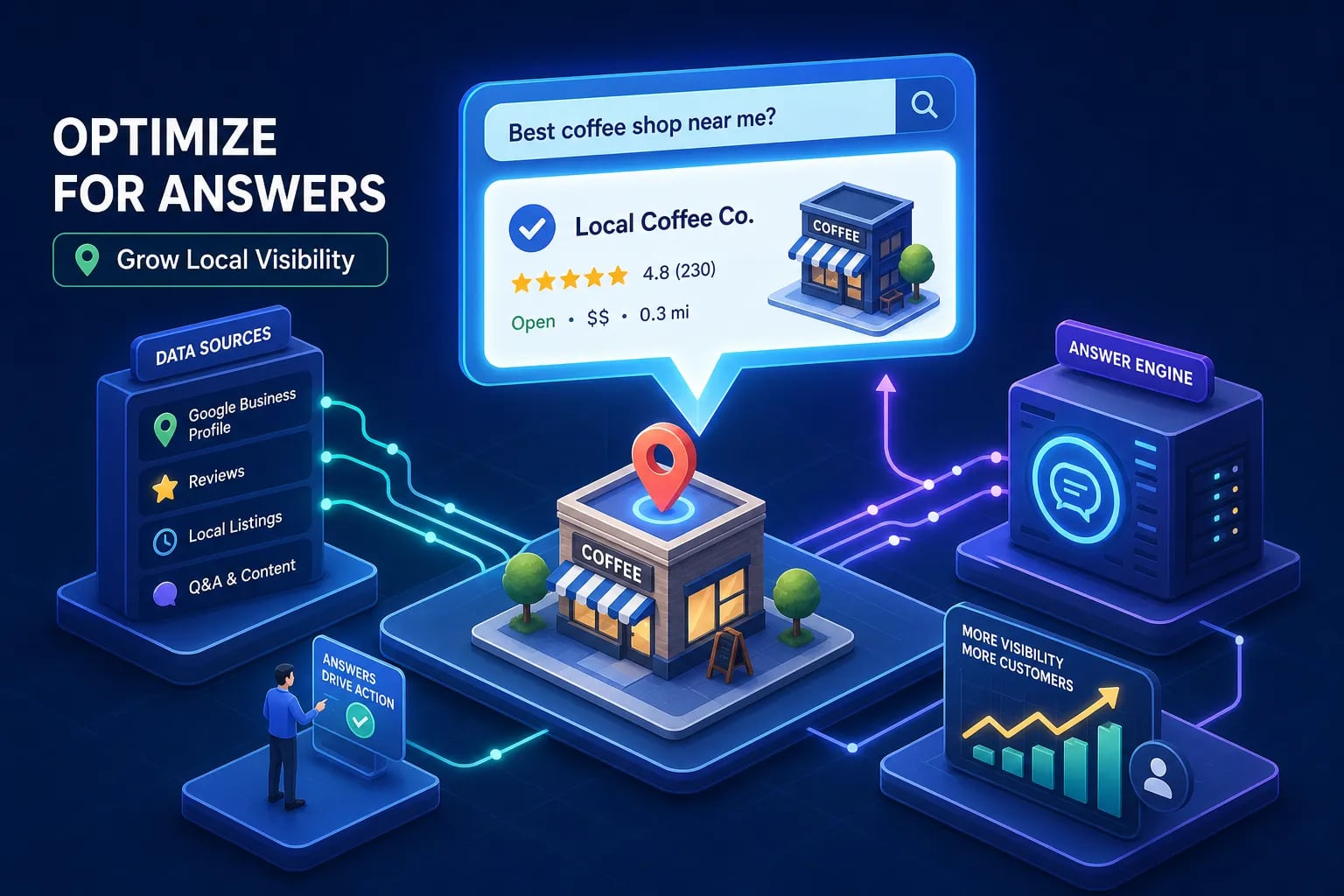
That gap isn’t luck, and it isn’t the result of one company spending more on ads. It’s the direct result of a discipline called answer engine optimization, and many local businesses have limited awareness of it. Businesses already working with authority-focused agencies are watching this play out in real time across industries like roofing, insurance, home services, and HVAC. Practitioners in the field consistently observe the gap between visible and invisible businesses widening as AI-generated answers become a larger share of how customers find local services.
This article breaks down what AEO actually is, how AI systems choose which local businesses to surface, what winning and losing looks like in practice, and the specific steps you can take to close the gap.
What is answer engine optimization, and how is it different from SEO?
Traditional SEO is built around one goal: help users find your page in a list of results. Answer engine optimization operates on a different premise entirely. AI-powered systems like Google AI Overviews, ChatGPT, and Perplexity often synthesize a direct response from sources they trust rather than presenting a clickable list, and even when they do include source links, many users never need to click through. The goal of AEO is to become one of those trusted sources.
The simplest way to frame the difference: SEO helps users find your page; AEO helps users get your answer without necessarily clicking, by making your content extractable for AI summaries. In traditional search, you optimize for a position. In AI-generated search, you optimize to become the answer itself. That requires a fundamentally different approach to content structure, credibility signals, and how clearly your business entity is defined online.
Both disciplines overlap on the fundamentals: authority, relevance, and technical quality all matter in both. But AEO adds requirements that traditional SEO doesn’t demand. Your content needs to be answer-ready, meaning it delivers concise, extractable facts directly, not marketing copy that dances around the question. AI systems need to pull a clean, accurate response from your page and attribute it to your business with confidence.
How do AI systems decide which local business to recommend?
The selection process isn’t a simple ranking. AI answer engines retrieve a candidate pool from web search, business listings, maps data, and review platforms, then rerank that pool based on relevance, freshness, and trust signals. For local queries specifically, the businesses that earn citations tend to be the ones whose digital presence is current, structured, and easy for AI to extract usable facts from.
Entity clarity is the foundation of this. AI systems need to confirm that your business is who you say it is, and these platforms do that by looking for corroboration across multiple sources: your website, your Google Business Profile, your directory listings, and third-party mentions. When those sources tell a consistent story, the AI gains confidence. When they contradict each other or leave gaps, the AI moves on to a competitor whose signals are cleaner.
For local service queries, the signals that carry the most weight are your website’s service clarity, the completeness of your Google Business Profile, and your review content. A GBP filled with generic descriptions and sparse reviews is not the same trust signal as one where every service is described in full sentences and where recent reviews mention specific services and neighborhoods. That contrast is what answer engines evaluate when they decide whose name to include in a response.
What does it actually cost local businesses to be invisible in AI answers?
AI visibility can influence discovery and consideration, but individual case-study outcomes should not be treated as universal benchmarks. The durable lesson is to make business information complete, consistent, specific, and easy to verify across your website and trusted third-party profiles.
The losing side of this equation is just as concrete. Consider two HVAC contractors in the same market with similar qualifications and similar ad budgets. One has structured service pages, consistent schema markup, and 80-plus recent reviews with location-specific language. The other has a brochure-style website and a half-completed Google Business Profile. When a homeowner asks an AI assistant who to call, only one business name appears. The other isn’t penalized; it simply isn’t there.
The invisibility cost goes beyond lost traffic. Based on practitioner observation, AI recommendations carry an implied endorsement that a ranked list of links typically doesn’t. When ChatGPT names your competitor, that recommendation lands differently than appearing third in a search result. The trust transfer is immediate, and the business that isn’t cited doesn’t get a second chance at that moment.
Which AEO tactics actually move the needle for local businesses?
Start with your service pages. Rewrite them to answer real questions directly: include pricing ranges, typical response times, certifications, and process steps in plain language. AI tools need extractable facts, not headlines and value propositions. A service page that says “we provide expert plumbing solutions” gives an answer engine nothing to work with. An illustrative sentence such as “we offer same-day drain clearing for residential homes in [city], with pricing explained before work begins” provides concrete, verifiable details.
Add concise FAQs only where they answer questions customers genuinely ask, and keep the answers visible on the page. Use FAQPage schema only when it matches that visible content. LocalBusiness and Service markup can clarify business and service details, but Google does not require special AI markup and schema does not guarantee a citation.
Off-site, the priorities are:
- Google Business Profile completeness: Fill every field. Write service descriptions as full answers, not taglines. Seed the Q&A section with real questions your customers ask and answer them directly. This is worth treating as a standalone content task rather than a checkbox, a thorough GBP is one of the highest-leverage moves a local business can make for AI visibility.
- NAP consistency: Your business name, address, and phone number must be identical across every listing, directory, and profile. Any inconsistency creates entity confusion that answer engines read as low trust.
- Review recency and content: A steady stream of recent reviews that mention specific services and locations signals active credibility. Recency and relevance of review content tend to matter more than raw volume alone; recent, service-specific reviews often signal higher freshness and relevance to AI systems than an older accumulation of generic five-star ratings.
How do you measure whether your AEO efforts are actually working?
Traditional analytics won’t give you the full picture here. You need to track a different set of signals. Brand mention rate is the core metric: how often does your business name appear when you run target prompts through ChatGPT, Google AI Overviews, and Perplexity? This requires manual testing with a structured prompt library, not a dashboard you check passively.
Build a set of 10 to 15 prompts that mirror how your customers actually search. Examples: “best roofing contractor in [city],” “who fixes HVAC systems near [neighborhood],” “top-rated plumber in [zip code] with same-day service.” Run these weekly across AI tools. Log whether you appear, where you appear in the response, and exactly what the AI says about you. Accuracy matters as much as presence; if an AI is citing incorrect information about your business, that’s a separate problem to fix.
Alongside prompt testing, track AI referral traffic in Google Analytics. Sessions arriving from ChatGPT.com and Perplexity are now trackable as distinct referral sources. Also watch for branded search lift, a rise in people searching your business name directly. That lift is often the first measurable sign that AI visibility is building offline awareness before a customer ever visits your site. Connect these signals to GBP Insights data on call clicks, direction requests, and form fills to tie AI mentions to actual business outcomes.
How do you find out where your business actually stands right now?
Most local businesses have no visibility into how AI systems perceive them. They have website analytics, keyword rankings, and maybe a GBP dashboard, but no structured way to assess whether these platforms are citing them, ignoring them, or describing them inaccurately. Starting AEO without that baseline means spending time and money on fixes without knowing which problems are actually costing you citations.
The Authority Audit™ from TW3 Marketing was built specifically for this gap, a 100-point diagnostic that scores the six signals AI platforms use to evaluate and recommend local businesses: positioning, proof, expertise, visibility, engagement, and experience. For businesses asking where AEO improvements will have the fastest impact, the Audit produces a prioritized action plan rather than a generic checklist. The difference between guessing and knowing is significant when you’re competing for AI recommendations in a market where your competitors are already moving.
If you want a preliminary read on your own, start here: run your core service queries through ChatGPT and Google AI Overviews, check your GBP for empty fields and outdated service descriptions, and audit your NAP consistency across your top five directories. What you find will tell you a lot about why your business may or may not be appearing in AI-generated answers right now.
The shift is already underway
Answer engine optimization isn’t a replacement for SEO. It’s an additional layer that determines whether AI systems recommend your business or your competitor’s when a customer asks a direct question. The businesses earning AI citations in 2026 aren’t necessarily the biggest or the longest-established. They’re the ones whose digital presence is structured clearly enough for AI to trust and cite with confidence. That’s a solvable problem for any local business willing to approach it systematically.
The first step is knowing where you stand. Run a handful of target prompts in ChatGPT and Google AI, review your GBP completeness, and check whether your schema markup is in place. If what you find is thin, inconsistent, or simply not showing up, that’s the gap answer engine optimization is designed to close. Get in touch with our team at TW3 Marketing if you want a diagnostic that tells you exactly which signals are holding your business back.
The businesses that act on this now won’t just survive the shift to AI search. They’ll be the ones AI recommends by name. That’s not a prediction, it’s already happening in markets across the country, and the window to get ahead of it is open right now.
