
A homeowner’s furnace breaks down on a cold January night. She doesn’t open Google and scroll through ten blue links. She opens ChatGPT and types: “Who’s the best HVAC company near me?” An answer comes back in seconds, with two business names. Neither one is yours. That’s the problem answer engine optimization exists to solve, and if you’ve been asking yourself how to start using answer engine optimization to get found by AI assistants, you’re already thinking about the right problem.
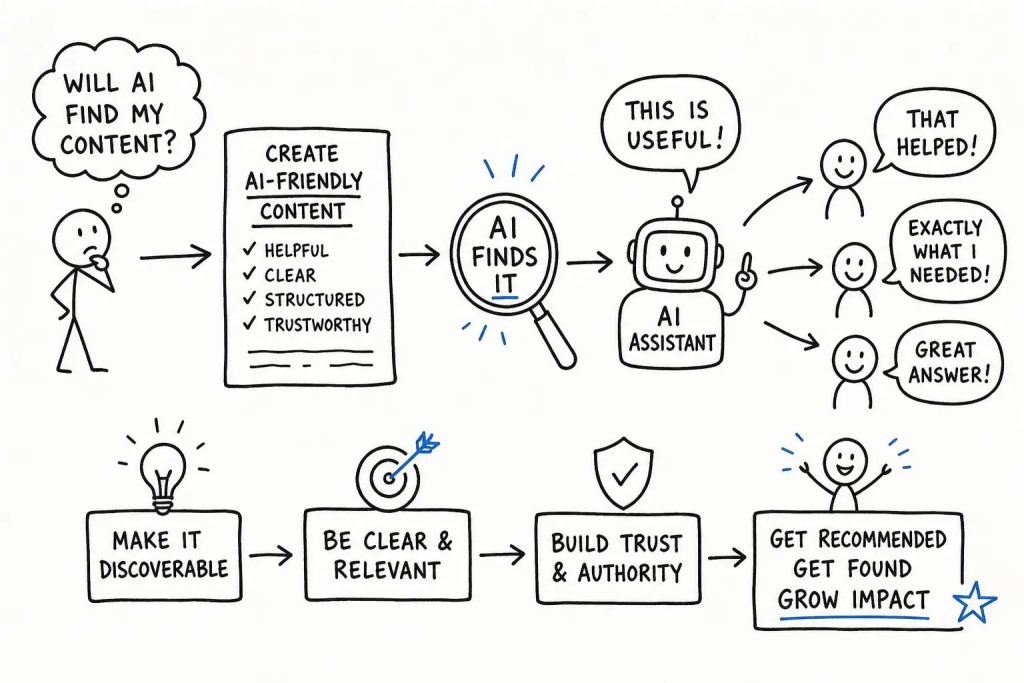
Answer engine optimization (AEO) is the practice of structuring your content so AI-powered systems like ChatGPT, Google AI Overviews, and voice assistants can extract and cite it directly in their responses. It’s different from traditional SEO in a fundamental way: SEO earns you a spot on the results page; AEO earns you a mention inside the answer itself. For service businesses, that distinction is becoming the difference between a phone that rings and one that doesn’t.
The good news is that AI assistant discovery isn’t reserved for big brands with massive budgets. Small and local businesses that follow a structured approach have built real visibility in AI-generated answers, it takes consistent effort and the right framework, but the path is learnable. Here are five steps to start improving your AI search optimization today.
What Sets AEO Apart from Traditional SEO
Why Ranking on Google Isn’t the Whole Game Anymore
Traditional SEO is built around earning clicks. You optimize for keywords, build backlinks, and chase rankings so users see your page and visit it. That model still has value, but AI assistants operate differently. When someone asks ChatGPT or a voice assistant a question, they typically receive a single synthesized answer or a short list of prioritized suggestions, not the multi-result page users get from a traditional search engine. There’s no page two. There’s no scrolling. There’s just the response the AI constructs from sources it trusts.
Service businesses that optimize only for clicks are effectively invisible in that moment. The customer got their answer, made a mental shortlist, and moved on. If your business wasn’t mentioned, you weren’t considered. That’s why AI visibility for websites has become a separate discipline worth mastering.
How AI Systems Decide Which Sources to Cite
Based on multiple AEO analyses, four signals determine whether an AI assistant pulls from your content. First is passage clarity: can the AI lift a clean, direct answer from your page without ambiguity? Second is semantic relevance: does your content actually answer the question being asked? Third is authority and trust signals: are you recognized as a credible source across the web? Fourth is freshness: is your content current enough to be reliable?
The most underappreciated of these four signals is passage clarity, specifically, whether AI can extract a clean answer from your text at all. A highly authoritative domain can still be skipped if its text is dense narrative prose with no clear answer structure. A smaller site with a well-formatted FAQ block can outperform it. That insight shapes everything in the steps below.
How Do I Start Using Answer Engine Optimization to Get Found by AI Assistants?
Step 1: Audit Your AEO Gaps Before You Change Anything
Before you rewrite a single page or add a line of schema, you need to know where you actually stand in AI-generated results. TW3 Marketing’s Authority Score™ Check is a paid audit designed to do exactly that: it surfaces how your business currently appears inside Google and ChatGPT results, identifying specific gaps in your positioning, proof, expertise, and visibility signals. Starting with a diagnostic ensures every change you make is grounded in actual data rather than assumption.
What a Baseline Audit Reveals
Run through these questions on your top five service pages:
- Are you answering real customer questions, or just describing what you do?
- Do your pages have any schema markup at all?
- Is your business mentioned on credible third-party sites outside your own domain?
- Are your content dates visible?
Each “no” is a gap that costs you citations. Documenting these gaps before you start is a practical first move, businesses that have a clear picture of their current standing before making changes tend to use their time and resources far more effectively than those making blind adjustments.
Step 2: Reformat Your Content So AI Can Extract It
Write Answers First, Context Second
Most service business websites lead with a headline like “Welcome to ABC Plumbing, serving Dallas since 1998.” That’s context. AI assistants need the answer first. A page about water heater installation should open with a direct, 40-to-60-word answer to the question “How does water heater installation work?” before it explains anything about your company history or service area. Research into AI answer retrieval supports this length range as the practical target for an extractable passage. That answer-first structure is what makes a passage extractable.
Think of it this way: AI systems decompose a user’s question into components, then look for passages that map cleanly onto each component. If your content is organized around your brand narrative, you’re writing for humans scanning a brochure. If it’s organized around questions, you’re writing for the way AI retrieves answers, and that’s exactly how you optimize for ChatGPT and AI answers more broadly.
The Formats AI Surfaces Most Reliably
The content formats that appear most consistently in AI-generated answers share one trait: they’re modular. Concise direct answers, FAQ blocks, numbered step sequences, and brief comparison tables all break content into discrete units that AI systems can lift and recombine. For service businesses, the highest-impact move is adding a genuine FAQ section to every major service page, written in the plain language your customers actually use when they talk to ChatGPT or a voice assistant.
Step 3: Add Structured Data to Your Highest-Value Pages
FAQPage and HowTo Schema: Where to Start
JSON-LD is the implementation format of choice because it stays separate from your visible HTML and is straightforward for crawlers to parse. According to Google’s structured data documentation and multiple AEO analyses, FAQPage schema is the highest-leverage starting point for most service businesses. It maps your visible Q&A content into a format AI systems already know how to read. If you have a page explaining a process, HowTo schema is the natural next step: it breaks instructional content into discrete steps that AI systems can decompose and reassemble into a response.
The critical rule: your structured data must mirror what’s visible on the page. Don’t add FAQ schema for questions that don’t actually appear in the page content. Search engines and AI systems cross-reference the two, and mismatches undermine trust rather than building it.
Organization Schema and Entity Recognition
Organization markup tells AI systems who you are as a recognizable entity, not just what a specific page is about. It establishes your name, location, URL, and connections to credible third-party profiles through the sameAs property. Linking to your LinkedIn, Google Business Profile, and relevant industry directories through this markup strengthens your canonical identity across AI systems. When an AI assistant is confident about who you are as an entity, it’s far more willing to cite you by name.
Step 4: Build Citation Authority and Content Freshness Signals
The Trust Signals AI Systems Weigh Most Heavily
Off-page signals matter here in ways that parallel traditional SEO but with a different emphasis. Mentions on authoritative third-party sites, consistent name, address, and phone data across directories, verifiable expert authorship, and corroboration across multiple credible sources all increase the likelihood of citation. A single mention in a respected industry publication can outweigh dozens of low-quality directory listings. Prioritize placements in local news outlets, trade publications, and established business directories over bulk citation building.
Consistency is equally important. If your business name appears differently across platforms, or your phone number varies between listings, AI systems lose confidence in citing you. Audit your NAP data across every directory where your business appears and clean up any discrepancies before pursuing new placements.
Why Content Freshness Is a Citation Signal, Not a Vanity Metric
AI assistants flag recency especially for topics where facts change: pricing, regulations, equipment standards, and best practices. Adding a visible “Last Updated” date to key service pages, refreshing your statistics annually, and publishing new FAQ content tied to current customer questions all send freshness signals that improve citation odds.
A quarterly content refresh calendar is a practical minimum for maintaining AI visibility over time. It doesn’t require publishing new pages constantly, updating and re-dating existing pages often accomplishes the same goal, and it’s far more sustainable for a small team.
Step 5: Track AI Visibility and Build a 90-Day Action Plan
Simple Metrics That Tell You If AEO Is Working
Start with manual prompt testing. Build a set of 20 to 30 prompts that reflect real questions your customers ask, for example, “Who installs water heaters in [your city]?” or “What should I look for in an HVAC contractor?”, then run them monthly across ChatGPT, Perplexity, and Google AI. Track whether your brand is mentioned, how prominently, and which competitors appear instead of you when you don’t. Add AI referral traffic monitoring in GA4 as a secondary signal. Tools like Semrush’s AI Search Health score and SE Ranking’s citation analysis features can automate much of this tracking once your baseline is established.
Month one’s goal is establishing a documented baseline so you can measure whether your content changes in months two and three are actually improving your citation rate, for instance, moving from zero mentions out of 20 prompts to six or more. That documented starting point is what makes the next 60 days of work measurable rather than theoretical.
A 90-Day AEO Roadmap for Service Businesses
Here’s a practical timeline that gets results without requiring a full team:
- Month 1: Complete a baseline audit using the questions above. Reformat your top five service pages with answer-first structure and add FAQ blocks written in plain customer language.
- Month 2: Implement FAQPage, HowTo, and Organization schema in JSON-LD. Refresh any outdated content with new dates, updated statistics, and current pricing or process information.
- Month 3: Pursue a handful of quality third-party citation placements on credible, authoritative sites relevant to your industry and location. Run your full prompt panel across AI platforms and compare results against your month-one baseline.
This isn’t a one-time project. Treat it as a repeatable quarterly cycle. The businesses that maintain consistent AI visibility are the ones that have built a system, not the ones who ran a sprint and moved on.
Start Now, Not After Your Competitors Do
Knowing how to start using answer engine optimization to get found by AI assistants comes down to three foundations: clear answers AI can extract, structured content search systems already understand, and the trust signals that make AI willing to cite your business by name. None of them require a massive budget or a dedicated technical team. They require a clear picture of where you currently stand and a disciplined approach to closing the gaps.
The service businesses showing up in AI-generated answers in the months ahead are likely the ones building this system now. The ones waiting to see how it plays out risk watching a competitor’s name appear when a homeowner asks ChatGPT who to call.
TW3 Marketing’s Authority Score™ Check is a structured audit built to give you that starting picture, showing how your business currently appears inside AI results and mapping out where to focus first. Reach out to our team to get yours started.
