
When a homeowner types “best HVAC company near me” into Google, they get a list of links and start clicking around. When that same homeowner asks ChatGPT the same question, they get a recommendation. One interaction produces browsing behavior; the other produces a decision. Understanding that gap is exactly why the AEO vs SEO question has become urgent for local service businesses, and why treating search optimization as a single strategy is no longer realistic in 2026.
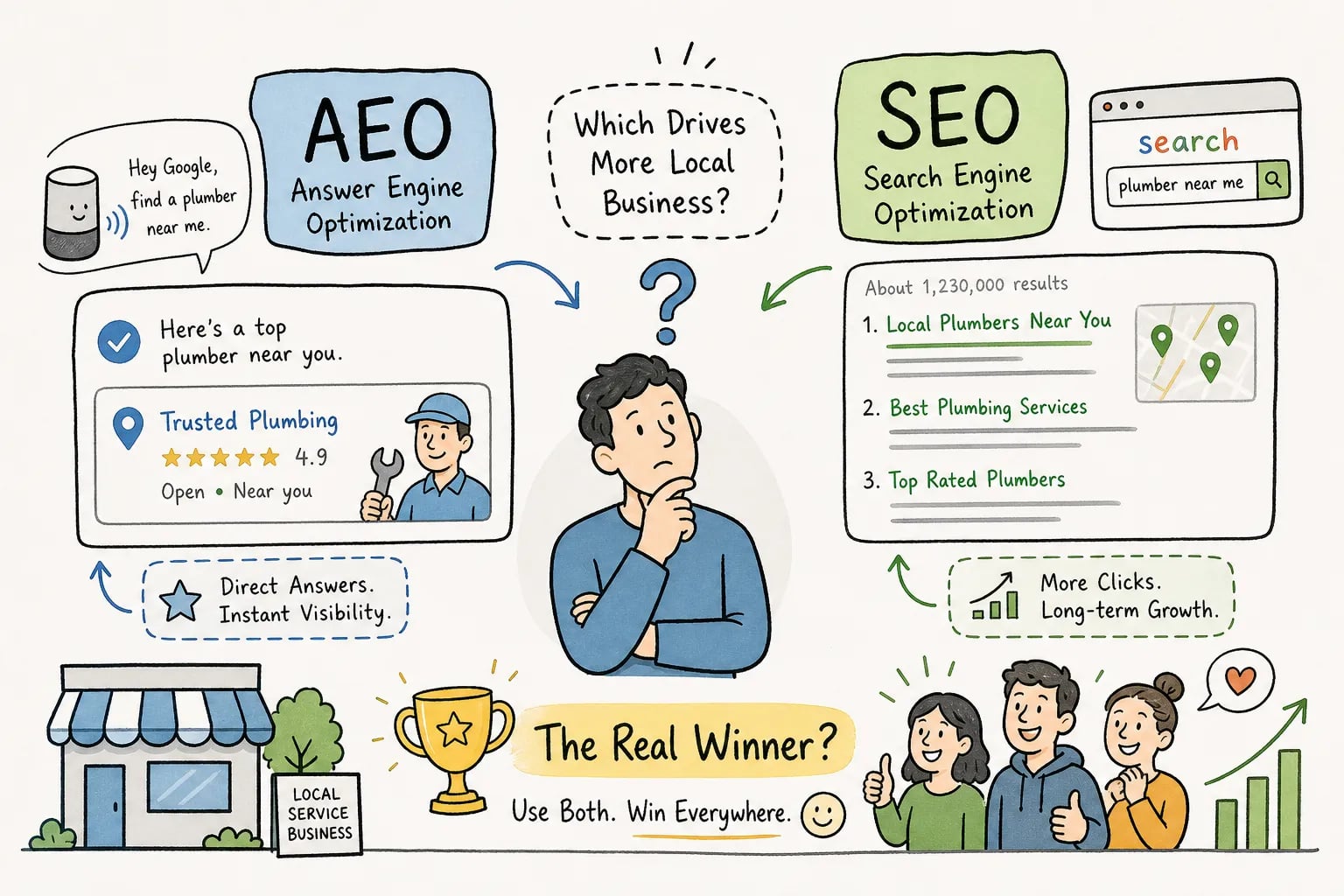
Search Engine Optimization (SEO) and Answer Engine Optimization (AEO) are not interchangeable terms for the same thing. They target different outputs, use different signals, and require different content structures. Agencies working with contractors, HVAC companies, and service businesses have had to build entirely separate playbooks for each. By the end of this article, you will know which strategy drives real results in 2026, and how to pursue both without starting from scratch.
What AEO and SEO Are Each Trying to Accomplish
Traditional SEO has always had one job: get your page to rank in a list of clickable results. The levers are keyword relevance, backlinks, domain authority, and technical crawlability. Success looks like a top-three ranking, strong click-through rate, and steady organic traffic. The output is a link on a results page that a user chooses to click.
Answer engine optimization targets something different entirely. AEO aims to get your content cited or summarized inside an AI-generated response on platforms like ChatGPT, Perplexity, and Google AI Overviews. The success metric is not a ranking position, it is whether your business is mentioned, quoted, or recommended when someone asks an AI assistant a question your company can answer. The output is the answer itself, with your brand attached to it.
The two strategies do share a foundation. Both require crawlable, well-structured content built on legitimate authority signals. Organic rank still influences which sources AI systems pull from, so strong SEO supports AEO. The difference is that AEO adds a layer of extractability requirements on top: your content must be written so AI systems can lift a clean, confident answer directly from it.
AEO vs SEO: How Ranking Signals Differ
Traditional search engines reward keywords, backlinks, page speed, domain authority, and comprehensive topic coverage. A page that earns external links and covers a subject thoroughly tends to rank well. Format matters, but authority signals carry most of the weight.
AI answer systems weight content differently. Extractability is the critical variable. Systems like ChatGPT and Perplexity look for direct answers upfront, clear heading hierarchies, FAQ-style structure, named authorship, and trust signals that match E-E-A-T standards. They also factor in consistent entity mentions across third-party sources and structured data like organization schema. A page that earns no AI citations despite strong organic rankings is usually missing one of these signals.
The content formats that perform well also diverge, and this is where AEO optimization requires a deliberate shift. For SEO, long-form comprehensive pages optimized for click intent still work. For AI answer ranking, short, structured, quote-ready passages win. Tables, bullet comparisons, and defined terms perform especially well because they are easy to extract verbatim into a generated response. According to structured-content analyses cited by BrightEdge and similar industry researchers, clearly hierarchical content with bullets and tables gets cited significantly more often than dense, unbroken prose.
That structural contrast is worth pausing on before moving to conversion data, because it changes how you approach every page on your site.
AEO vs SEO: Which Strategy Actually Wins for Local Service Businesses in 2026?
When someone asks an AI assistant which solar company to trust or who to call for an emergency plumbing repair, they are not browsing options. They are closer to accepting a referral than conducting a search. That behavioral difference matters more for local service businesses than for almost any other category, because customers in HVAC, roofing, and similar trades typically represent high average ticket values, often running into the thousands of dollars per engagement, based on industry benchmark data from trade associations like ACCA and NRCA.
The conversion data reinforces this. AI-referred visitors convert at roughly 4.4 times the rate of traditional organic visitors, according to Semrush’s 2025 AI traffic analysis. The volume is still smaller: AI referral traffic represents about 0.14% to 1% of total website visits in most benchmarks. But for a local service business where one new client can generate significant revenue, conversion quality matters more than raw traffic numbers.
At the same time, traditional organic rankings are under pressure. Data from Seer Interactive and corroborating analyses published in early 2026 show organic click-through rates dropping between 47% and 61% on queries where Google AI Overviews appear. Ignoring AEO does not protect your existing SEO results. It just means losing ground on both fronts simultaneously.
This is the shift that led TW3 Marketing to develop their Authority Framework around the six signals AI systems use to evaluate source credibility: positioning, proof, expertise, visibility, engagement, and experience. Each signal addresses a specific gap between how Google ranks pages and how AI systems decide which sources to cite. Their 100-point Authority Audit is designed to identify where a local service business falls short of being recommended by AI answer engines, not just ranked by Google. For businesses navigating the AEO vs SEO divide, that kind of AI-focused diagnostic fills a gap that traditional SEO audits were never built to address.
How to Capture Both Without Rebuilding Your Content from Scratch
Most existing service business pages can be updated to serve both SEO and AI answers with a few targeted adjustments. Start by adding a direct-answer intro paragraph to each key service page. State what you do, who you serve, and where you operate in the first two sentences. AI systems prioritize content that leads with the answer rather than burying it, research from Conductor and similar content strategy firms recommends placing the core response within the first 40 to 60 words of a passage to improve AI SERP optimization.
Next, break long sections into headed subsections where each H2 or H3 addresses one specific question. Add an FAQ module to your highest-traffic pages using questions your customers actually ask AI assistants. These changes improve your chances of appearing in AI Overviews and featured snippets. Most businesses that implement them carefully see no disruption to existing keyword rankings, though results will vary depending on competitive landscape and current site authority.
For measurement, track AI citations using platforms like ZipTie, Peec AI, or SE Ranking’s AI Overviews monitoring alongside your standard Google Search Console data. Watch for brand mentions across ChatGPT, Perplexity, and Google AI. Then compare conversion rates by traffic source in your analytics. If AI-referred sessions are outperforming organic at a meaningful rate, that is confirmation the strategy is working, and a signal to invest more in AEO optimization.
The Practical Path Forward
In short, AEO vs SEO is not an either/or question for local service businesses, it is a sequencing and prioritization problem. Both channels matter. Both require attention. And the businesses that build authority legible to both search engines and AI answer systems will hold a durable competitive advantage as AI-generated answers continue to displace traditional search results at the top of the page.
The practical starting point is an honest audit of where your business currently stands across both channels. If you do not know how your authority signals appear to AI systems today, you cannot identify the gaps that are costing you recommendations. TW3 Marketing’s Authority Score check is one tool designed specifically for this purpose, it gives service businesses a baseline picture of how they appear across Google and AI platforms. Whatever tool or provider you use, establishing that baseline before spending more on content or ads is the move that separates businesses that adapt from those that keep optimizing for a results page that fewer users ever see.
