
If you’re wondering what marketing channels deliver the best ROI for HVAC companies today, the answer depends less on which channel you pick and more on the order you deploy them. Most HVAC companies run ads before they’ve built the digital foundation that makes those ads convert. The result is a predictable pattern: rising cost per lead, shrinking margins, and a lot of finger-pointing at the algorithm. The real problem isn’t the channel; it’s the order. Marketing programs that prioritize authority work before ad spend, the audit-first approach, tend to see stronger paid performance downstream. That’s not a coincidence. It’s how the funnel is supposed to work.
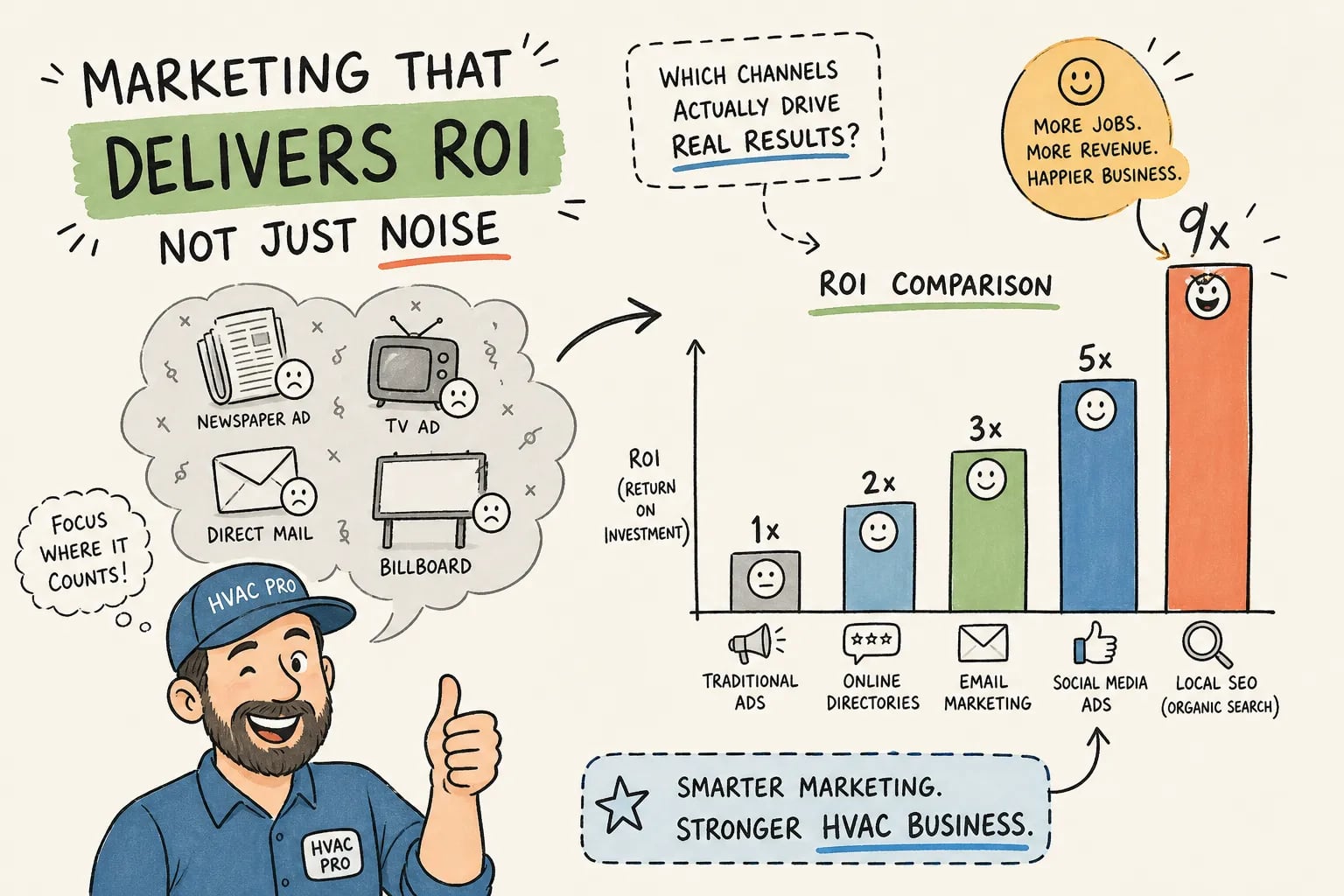
This article ranks the main HVAC marketing channels by 2026 benchmarks: CPL, ROAS, and realistic lead volume. Use it to decide where to put money first and where to wait until the foundation is solid.
What marketing channels deliver the best ROI for HVAC companies today (2026)
Every marketing channel you run feeds into the same destination: your digital presence. If that presence has weak trust signals, thin reviews, or unclear positioning, every dollar you spend on traffic is working against itself. The ad clicks land. The leads don’t convert. And you assume the channel failed. Understanding which HVAC marketing channels deliver the best ROI starts with fixing that foundation before scaling any paid spend.
The “leaky funnel” most HVAC owners ignore
The average HVAC website converts at 2, 3%. Top-performing pages hit 5, 8%. That gap is almost never about ad targeting or keyword selection. It’s about authority signals: review volume, proof of expertise, clear positioning, and a site that signals credibility before a visitor has to decide whether to trust you. An authority audit, like TW3 Marketing Authority Audit™, a 100-point diagnostic built around six trust signals, can help you identify exactly where the conversion leak is before spending another dollar on traffic.
How AI-driven search changed the HVAC lead landscape in 2026
Google AI Overviews and ChatGPT-style local recommendations don’t rank businesses the way traditional search does. They synthesize from multiple sources and favor businesses with consistent entity data, recent reviews, complete Google Business Profiles, and website content that directly answers the user’s question. HVAC companies without structured proof signals and expertise content are largely invisible in AI-generated answers. That makes authority optimization a channel in itself, and a prerequisite for every other channel’s performance.
Local SEO, reviews, and organic content: the highest-ROI baseline for HVAC companies
Industry data puts organic search at 42, 54% of HVAC lead volume in 2026. It’s not the fastest channel, but it’s the most efficient per lead over time. And it compounds in ways paid channels don’t.
What organic SEO actually returns for HVAC companies
Established local SEO programs generate leads at $10, $30 CPL, the lowest benchmark of any channel covered here. Realistic lead volumes are 20, 50 leads per month at the six-to-twelve-month mark, with companies ranking for 10, 15 local keywords reaching 30, 80 organic leads per month. Ranking movement is usually visible by months three to four, with meaningful lead flow starting around months six to twelve. In major metros, consistent lead generation can take nine to fifteen months, depending on competition and the site’s starting authority.
Reviews and Google Business Profile: the ROI multiplier
Reviews aren’t a standalone channel. They’re a conversion layer that amplifies every other channel you run. A strong GBP with consistent 4.5-star ratings directly affects Local Pack visibility and AI recommendation likelihood. Review volume and recency are scored as trust signals by both human buyers and AI search engines. Neglecting them doesn’t just hurt your reputation, it actively drags down the performance of your paid channels.
Google LSAs vs. search PPC: what the 2026 benchmarks actually show
Both channels generate leads. They don’t generate them at the same price, and the gap matters when you’re managing a real budget.
Google Local Services Ads: the strongest paid channel for HVAC in 2026
The 2026 benchmark for residential HVAC LSAs is roughly $51 CPL and a 9.55x closed ROAS. Book rates run 38, 44%, with a cost per booked job around $190 against an average ticket around $2,110. LSAs appear above traditional search ads and carry Google’s verification badge, which means the platform itself functions as an authority signal. The catch: LSAs perform best when you already have strong reviews and a verified GBP. Without those, the Google Screened badge doesn’t carry the weight it should.
Google Search PPC: fast volume, but at a cost
Blended HVAC search PPC CPL runs about $104, with branded search closer to $34 and non-branded closer to $149. ROAS ranges from 2.5x to 5.0x, significantly below LSAs. Book rates reflect the same gap: 55.3% for branded, 37.6% for non-branded, and 32.2% for Performance Max. Search PPC earns its place for seasonal surge coverage, new market entry, or service lines without organic rankings yet. It’s not a primary foundation channel, and treating it like one is one of the more expensive mistakes HVAC companies make.
Direct mail: still relevant, but only in specific scenarios
Direct mail has a niche in HVAC marketing, and the data supports using it in the right context. The numbers swing widely based on list quality and offer type.
CPL and response rate benchmarks for HVAC direct mail in 2026
Cold EDDM and prospecting campaigns produce 0.5, 2.5% response rates and a CPL of $80, $200, with ROAS in the 3:1, 6:1 range. Targeted campaigns aimed at older systems in specific ZIP codes bring CPL down to $40, $110 and ROAS up to 13:1. Past-customer reactivation is the strongest direct mail performer, hitting 5, 9% response rates. Seasonal and radius mailers after installs run 3, 5% response rates and work well as a low-cost supplement to digital channels.
Direct mail works best as a complement to a digital program, not a replacement. It’s weakest as a cold prospecting tool in competitive urban markets where your digital CPL is already lower.
How to stack your HVAC marketing budget by priority
The channel order matters as much as the channel selection. Here’s how the ROI data ranks the best HVAC marketing channels for 2026.
The ROI-ranked channel stack for 2026
- Priority 1: Authority foundation, trust signals, reviews, AI visibility, GBP optimization. This affects CPL across every downstream channel.
- Priority 2: Local SEO + organic content, lowest CPL ($10, $30), highest long-term lead volume, compounds over time.
- Priority 3: Google LSAs, strongest paid CPL (~$51), highest ROAS (9.55x), performance directly tied to review quality.
- Priority 4: Google Search PPC, situational use for seasonal gaps or new service lines; blended CPL ~$104.
- Priority 5: Direct mail, supplemental, past-customer focus, CPL $40, $200 depending on targeting precision.
A simple starting point: the authority audit before any budget move
Before reallocating your marketing budget, you need to know your current authority baseline. Where are the trust gaps? What does AI search see when it evaluates your business? Which signals are missing that explain why your paid campaigns underperform? Those answers change which channel you should prioritize and how much you should spend.
TW3 Marketing Authority Audit™ is built for exactly this: a 100-point scoring system across six trust signals that identifies what’s blocking ROI across all your channels. With an average customer LTV of $15,340 in residential HVAC, the cost of a weak authority foundation isn’t a marketing problem; it’s a revenue problem.
If you want to know what marketing channels deliver the best ROI for your HVAC company today, start by knowing your authority score. Reach out to the TW3 Marketing team to request your audit and see exactly where your business stands.
