
Understanding why local service businesses need an authority audit before spending on marketing starts with a problem most owners never diagnose: it’s rarely a traffic problem or a budget problem. More often, it’s an authority problem. And when the foundation leaks, throwing more money at marketing just moves water faster through the holes. That’s the leaky bucket problem in its most expensive form, a weak foundation that makes every campaign cost more and convert less than it should.
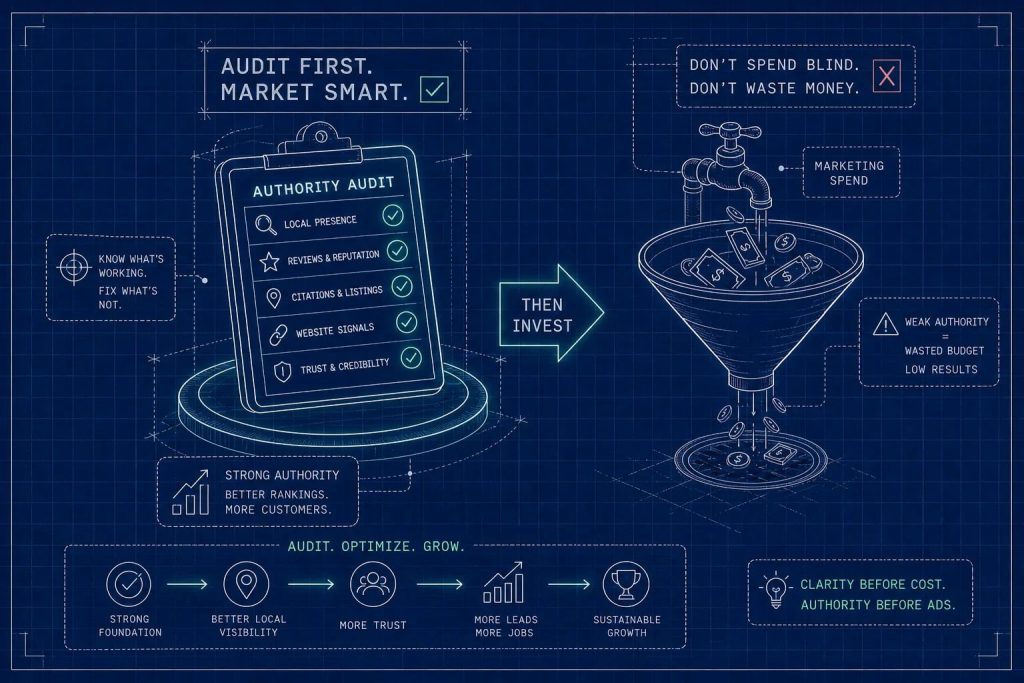
The fix isn’t a bigger ad budget or a new channel. It’s knowing exactly where your credibility breaks down before you spend another dollar. That’s the core argument for running an authority audit first, a structured marketing audit that treats diagnosis as a prerequisite to investment, not an afterthought. At TW3 Marketing, that principle shapes every client engagement. It’s not caution for caution’s sake. It’s the professional discipline of understanding the problem before recommending a solution.
What Weak Trust Signals Actually Cost You
Authority problems aren’t soft or abstract. They show up directly in conversion rates and cost per acquisition, and the numbers are not subtle. Before committing to any marketing budget prioritization decisions, you need to know what trust gaps are already taxing your campaigns.
How an Incomplete Profile Drains Your Budget
One 2026 industry benchmark puts conversion rates at roughly 4.5% for fully optimized Google Business Profiles versus roughly 1.8% for incomplete ones, figures treated as directional estimates, not universal averages. At the same traffic cost, that gap means paying approximately 2.5 times more per acquired customer from an incomplete profile. In practice, at $20 per visit, CPA drops from around $1,111 to $444 when the profile is complete. Profile completeness is an independent factor that influences conversion regardless of ad creative or targeting quality, which means profile fixes often reduce CPA even when other campaign variables stay constant. It’s a structural tax on every campaign running over a weak foundation, and a local SEO audit will surface it in the first pass.
What Citation Inconsistency Does to Your Cost Per Acquisition
Inconsistent business name, address, phone, or hours across directories doesn’t just hurt local search rankings. It creates hesitation at the exact moment a prospect is deciding whether to call. Research on NAP inconsistency shows that trust friction at this stage compounds into measurable conversion loss, model a 25% conversion penalty and you’re looking at roughly 33% higher cost per acquisition before accounting for ad spend. A wrong phone number or outdated address doesn’t just lose one lead; it erodes the conversion rate across every channel touching that directory. The math is unforgiving, and it stays invisible until a reputation and citation audit forces you to look.
Why Local Service Businesses Need an Authority Audit: The Six Diagnostic Areas
A legitimate authority audit isn’t a vague “check your marketing” exercise. It’s a structured local business audit checklist that evaluates six specific areas, each answering a concrete question about whether buyers and search engines can independently verify who you are, where you operate, and why you deserve their trust.
Breaking Down the Six Areas
A thorough marketing audit covers the following:
- Review count, recency, and response rate, answers “Can I trust them?”
- Google Business Profile completeness, answers “Is this business active and credible?”
- Citation consistency across major directories, answers “Is this business real and stable?”
- Backlink quality and local relevance, answers “Does the web vouch for this business?”
- Website trust signals (credentials, contact clarity, structured data), answers “Are they qualified?”
- Competitive benchmarking, answers “Why this business over the alternatives three blocks away?”
Each area connects directly to a decision a buyer is making. Skipping any one of them leaves a gap the audit cannot diagnose.
What the Audit Output Should Actually Look Like
A real authority audit produces a prioritized action plan, not a list of observations you’ll file and forget. Each finding should name the problem, quantify its business consequence, specify the fix, and define a success metric. Anything less than that is a report, not a roadmap. This is the difference between a structured diagnostic and the free audit most agencies offer to justify a sales call.
The Diagnostic Checklist Before You Commit Budget
Here’s a practical framework you can use immediately, either to self-assess or to vet an agency claiming they’ve already done this work for you.
Start with Financials and Tracking Before Anything Else
Pull 90 days of marketing spend by channel. Calculate cost per lead, cost per booked job, and conversion rate by channel. Then verify your tracking setup: if forms, call tracking, and CRM stages aren’t configured correctly, every performance claim in your account is unreliable. Fix measurement before increasing spend. This step alone often reveals that a “performing” channel is only performing because it’s the only one with working attribution.
Visibility, Reputation, and Conversion Path in Sequence
After tracking is confirmed, move through Google Business Profile completeness and map-pack rankings, review profile health compared to your top competitors, citation accuracy across major directories, and your website’s conversion path: mobile speed, offer clarity, trust signals, and calls to action. Then check lead-handling speed. This sequence matters because it mirrors exactly where buyers encounter your business and where they abandon the decision. Auditing in any other order produces findings disconnected from how customers actually make decisions.
The KPIs That Tell the Truth About Where Money Disappears
Most businesses optimize for clicks, rankings, and impressions because those numbers look good in a report. The numbers that actually matter are different.
Three Reports That Expose the Real Waste
Cost per qualified customer is the primary decision metric, not cost per click or cost per lead. Build three reports monthly: channel profitability connecting spend to booked revenue, landing-page efficiency tracking sessions to qualified leads, and a call-loss report capturing missed calls, after-hours calls, and recovered opportunities. These three reports surface the waste that rankings dashboards consistently hide. A channel can look efficient on CPL and terrible on cost per booked job, and without these reports, you’ll never see the gap.
What Your Data Sources Should Reveal, and Usually Don’t
GA4 shows on-site behavior but undercounts phone leads without call tracking integrated. Google Search Console reveals search demand and click performance but cannot prove lead quality. Local rank tracking across a geographic grid shows where you’re actually visible versus where you assume you’re visible. None of these tools produce a complete picture alone. A real authority audit connects them into one coherent view of where buyers are finding you, what they’re doing, and where they’re leaving without contacting you.
Why TW3’s Approach Starts with the Audit, Not the Program
Responsible firms don’t recommend implementation until they understand what’s broken. That’s the principle behind the TW3 Marketing Authority Audit™, a paid 100-point diagnostic that evaluates positioning, proof, expertise, visibility, engagement, and experience before any implementation program is recommended. It reflects the same sequence that any serious marketing audit should follow: understand the foundation before scaling spend.
The audit produces an Authority Score, an evidence-based gap analysis, a competitor comparison, and a prioritized roadmap. It answers the fundamental question: where is this business losing trust, and what will fixing it actually change? That answer shapes every decision that follows. TW3’s Momentum and Domination programs only follow a completed TW3 Marketing Authority Audit™ because recommending spend before understanding the foundation is exactly the problem this article is about. If you want to know where to start, reach out to the TW3 Marketing team about the TW3 Marketing Authority Audit™ before committing to any implementation spend.
Fix the Leaks Before You Turn Up the Pressure
Running the audit first isn’t caution, it’s how you avoid funding a broken system. The leaky bucket doesn’t care how much you pour into it. Businesses that consistently get strong returns from marketing are rarely the ones that spend the most. More often, they’re the ones that fixed their foundation first and then scaled with confidence.
That’s exactly why local service businesses need an authority audit before spending on marketing. If you haven’t run a proper local business audit, one that covers reputation, citations, profile completeness, and competitive positioning, that’s the first step. Not more ads, not a bigger budget. Start with a clear picture of where trust breaks down, fix those gaps with documented priorities, and then invest in the channels and programs that will actually convert. The sequence matters more than the spend.
