
Paid search works exactly as long as you pay for it. When the budget stops, the leads stop. For an established service firm, that’s not a marketing strategy, it’s a monthly subscription to someone else’s platform, with nothing to show once you cancel. If you’re evaluating authority-based marketing alternatives to PPC for service businesses, the economics make the case quickly.
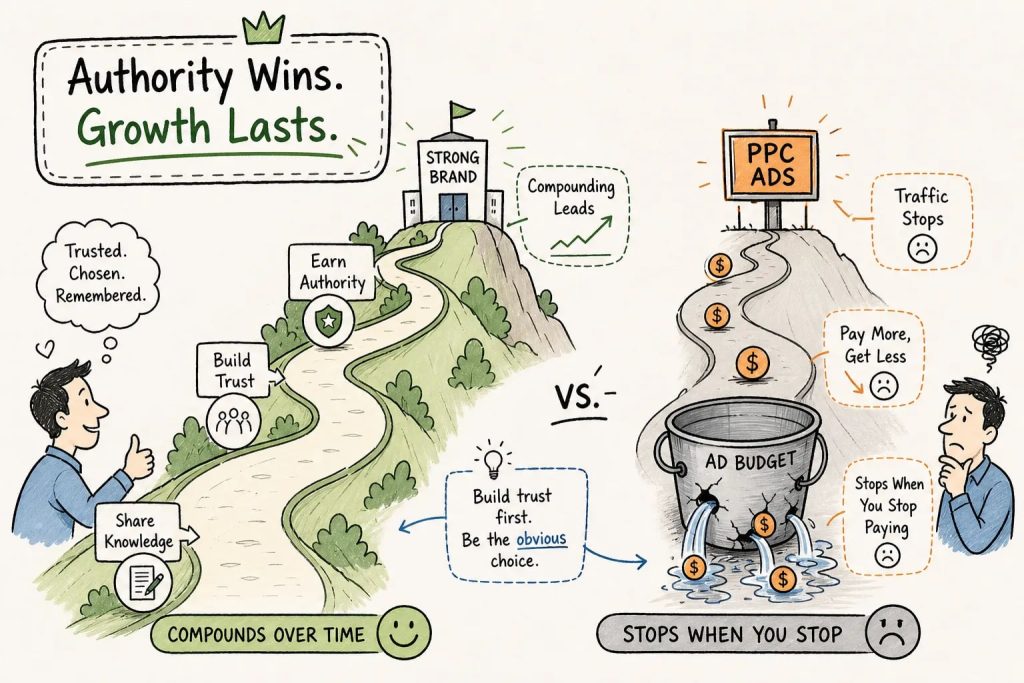
The math is straightforward. PPC generates leads at $67 to $181 each. Referrals average around $25. Organic search, once established, runs $31 to $60 per qualified lead. The economics aren’t close, and they keep diverging as bidding pressure rises in competitive service categories. Paid traffic rents attention. Authority marketing builds an asset that earns attention without continuous spend.
Why PPC is a cost, not an investment
Many service firms treat paid search as their primary growth lever because it’s measurable and immediate. Both of those things are true. But immediate and measurable don’t mean efficient or sustainable. When the ad account goes dark, the pipeline goes quiet.
Every dollar spent on PPC produces a lead or it doesn’t. It rarely produces anything you keep. No content. No ranking. No reputation. No trust signal. Nothing that improves your position next quarter. The CPL looks clean in a dashboard, but it doesn’t account for management fees, declining quality scores, or the competitive bidding pressure that makes every year more expensive than the last. At some point, you’re paying more to stay in the same place.
That’s what makes authority-based marketing alternatives to PPC worth examining seriously. Unlike paid search, organic lead generation for service businesses compounds. The investment doesn’t reset to zero at the end of the billing cycle.
What authority-based marketing alternatives to PPC actually build
Authority marketing isn’t a rebranded content calendar. It’s a system that creates credibility assets: thought leadership that gets found, reputation signals that verify your expertise, and trust infrastructure that makes buyers confident before they ever contact you. Unlike PPC, these assets accumulate over time instead of expiring with the budget cycle.
A strong piece of expert content can generate qualified discovery for years. A cluster of credible reviews improves both conversion and search visibility simultaneously. According to the Edelman-LinkedIn B2B Thought Leadership Study, more than 80% of professional-services buyers examine a firm’s website and related evidence before making initial contact, and 73% of B2B decision-makers say thought leadership is more trustworthy than a firm’s own marketing materials when evaluating capabilities. You can’t buy that kind of credibility with a Google Ads campaign.
Authority-based marketing also places trust signals throughout the buyer’s research journey, not just at the point of a click. It shows up in search results, in AI-generated answers, in reviews, and in the expert content a firm publishes. Buyers of professional services don’t usually click one ad and convert. They research, compare, and look for proof. Authority marketing is built for that process.
The trust signals buyers actually use in 2026
Google AI Overviews, ChatGPT, and similar tools are now part of how buyers research service providers. These systems favor firms with clear positioning, documented expertise, and credible reputation signals across multiple sources. That’s not traditional SEO. It’s authority infrastructure, and it’s where local SEO and reputation management intersect with thought leadership marketing in ways paid ads simply can’t replicate.
AI search surfaces businesses that have earned consistent trust signals: structured content that answers specific buyer questions, reviews that confirm real-world results, and a website experience that reflects genuine expertise. The firms that get recommended aren’t the ones running the biggest ad budgets. They’re the ones with the most coherent, verifiable record of who they serve and how well they do it. Referrals reward the same underlying asset. So does organic search. Building your visible reputation isn’t separate from marketing. It is the marketing.
How a structured authority approach gets operationalized
Abstract arguments about authority are easy to make. Building a working system is where most firms stall. A common pattern: they try LinkedIn for a month, publish a few blog posts, then conclude that content marketing doesn’t work. It’s not the channel. It’s the absence of a diagnosis.
The Authority Audit process
This is where TW3 Marketing’s approach makes a practical difference. The TW3 Marketing Authority Audit™ evaluates a firm across six dimensions: positioning, proof, expertise, visibility, engagement, and experience. The output is a proprietary 100-point Authority Score paired with a prioritized roadmap. That’s the opposite of a generic content calendar or a “let’s try something new” guess. It identifies the specific gaps that are costing a firm credibility and qualified conversations, and it tells you exactly where to start.
Conversion infrastructure
Authority marketing without a conversion system is just branding. TW3 Marketing connects trust-building with the operational infrastructure, offer-specific landing pages, lead qualification, appointment booking, and follow-up pipelines that turn research interest into qualified sales conversations. Authority gets you found. The system converts the opportunity.
Webinars, content, and other quick wins
Webinars and podcast marketing are among the fastest ways to generate early traction in an authority program. They put a real expert voice in front of a targeted audience and create reusable content assets in the same session. Referral and partner marketing can also produce early pipeline while longer-lead channels like organic search build momentum. These aren’t random tactics, they’re selected based on where a firm’s authority gaps are most acute.
What a realistic 30- to 90-Day shift looks like
Authority-based marketing won’t produce a flood of leads in week two. It also doesn’t take years to show any signal. Based on industry benchmarks for webinar and content lead generation, most firms see initial qualified conversations emerge within 60 to 90 days of launching targeted content and webinar programming. A more reliable inbound channel typically develops between months four and nine, consistent with content marketing timelines showing early organic signals at three to six months and meaningful volume at six to twelve.
The fastest wins come from what’s already working but undocumented: existing client relationships that haven’t been turned into verified proof, expertise that hasn’t been published, and a website that doesn’t communicate credibility as clearly as it should.
Fix the foundation before adding new channels. Track booked conversations, qualified opportunity rate, and revenue by source. Raw lead volume from a new blog post in month one is a meaningless metric. The meaningful signal is whether the right buyers are finding you, understanding your value, and choosing to start a conversation.
Build the asset, not the bill: authority-based marketing alternatives to PPC for service businesses
PPC typically produces leads faster than authority marketing. That debate isn’t worth prolonging. The real question for an established service firm is whether the fastest option is the best one, or whether you’re perpetually renting attention you could be earning.
The goal isn’t to eliminate paid search entirely. It’s to reduce dependence on it. Build enough credibility infrastructure, through content marketing, local SEO and reputation management, referral systems, and thought leadership, and you can shift budget away from channels that reset to zero toward assets that compound. Firms that begin that shift now can materially reduce PPC dependence within 12 to 24 months, based on documented case-study timelines for authority programs.
If you want to know where your firm actually stands, TW3 Marketing offers a free Authority Level assessment as a starting point, a quick look at how your authority-based marketing compares to PPC-dependent competitors in your service category. For a full diagnostic with a proprietary 100-point score, evidence-based gap analysis, and a prioritized implementation roadmap, the TW3 Marketing Authority Audit™ is where to begin. Reach out to the TW3 team to get started.
