
AI is changing what a service business website can do, but that’s not the biggest change.
AI can now help us build websites faster and with fewer technical limits. But for HVAC companies, electricians, plumbers, professional service firms, and other service businesses, better technology only matters when it creates more trust.
By Bobby Christy, Founder, TW3 Marketing. Updated August 2026.
For years, there has been a question I hate hearing when we’re building a website.
“Can the website builder do that?”
Sometimes the answer was yes.
Sometimes we could find a workaround.
And sometimes the answer was simply no.
Every website platform has limits. If the software didn’t offer the design, function, or feature we wanted, we either had to compromise, bring in more custom development, or move outside the platform.
Artificial intelligence is starting to change that.
AI tools like Claude Code can now help create custom website code much faster. Platforms such as HighLevel also allow custom code to extend what can be done beyond a standard page builder.
HighLevel is moving further in this direction itself. Its current tools include AI-assisted custom code generation that can turn plain-language instructions into working code for specific functions.
That’s an important technical development.
But I think there’s a much bigger story for business owners.
The question is shifting from “Can our website builder do this?” to “What should our website do to help a customer choose us?”
Those are two very different questions.
For a service business, the second one is far more important.
AI Website Design Isn’t Really About Design
When people hear “AI website,” they tend to think about speed.
Build a website faster.
Write the copy faster.
Create images faster.
Generate code faster.
Those things are useful.
But speed isn’t the biggest opportunity.
AI is reducing the technical distance between an idea and our ability to build it.
If we want a better way to present an HVAC company’s service areas, we have more options.
If an electrician needs a better way to explain residential versus commercial services, we can create it.
If a plumber wants emergency information to be ridiculously easy to find when someone has water pouring through the ceiling, we can build around that situation.
The same applies to attorneys, accountants, consultants, financial professionals, insurance agencies, HR firms, business coaches, and other professional service companies.
We can build more customized ways to explain expertise, demonstrate proof, answer questions, guide visitors, and create action.
That’s where AI website development becomes interesting.
Not because AI can make something look cool.
Because we can increasingly build around how a customer actually makes a decision.
Your Website Has a Different Job in 2026
For years, businesses treated websites like digital brochures.
Here is who we are.
Here are our services.
Here is our phone number.
Give us a call.
That isn’t enough anymore.
Your prospect may encounter your business through Google Search, Google Maps, an AI Overview, ChatGPT, another AI assistant, social media, a referral, an online review, or a third-party website.
They may never begin on your homepage.
And they are increasingly researching before contacting you.
A Pew Research Center study of Google browsing behavior found something worth paying attention to.
When an AI-generated summary appeared in Google results, users clicked a traditional search result in only 8% of visits.
When no AI summary appeared, they clicked a traditional result 15% of the time.
Clicks on sources directly inside the AI summary occurred in just 1% of visits.
That’s a significant change in search behavior.
It doesn’t mean your website is becoming less important.
It means its job is changing.
Your website used to be the destination. Increasingly, it’s also evidence.
It gives search engines, AI systems, prospects, referral partners, and other sources information they can use to determine who you are, what you know, what you do, and whether you deserve to be trusted.
SEO Isn’t Dead. But SEO Alone Isn’t Enough.
There is a lot of noise right now about SEO, AEO, and GEO.
Let’s make this simple.
SEO, or Search Engine Optimization, helps search engines find, understand, and rank your website.
AEO, or Answer Engine Optimization, makes your information easier to understand and use when a search or AI system is trying to answer a specific question.
GEO, or Generative Engine Optimization, focuses on helping generative AI systems understand your business, expertise, content, and supporting evidence well enough to potentially reference or recommend you.
These aren’t three separate worlds.
They overlap.
Google itself says the same SEO fundamentals used for traditional Search remain relevant for AI Overviews and AI Mode.
There isn’t a secret set of AI tags that suddenly makes a business authoritative.
That’s an important distinction.
You don’t win AI search by stuffing more AI keywords onto your website.
You become easier to find by becoming easier to understand.
You become easier to recommend by becoming easier to trust.
AI Search Is Raising the Value of Authority
This is where I think many businesses are missing the bigger change.
Search used to be largely about rankings.
Today, we also need to think about recommendation.
Suppose someone asks:
“Who is the best HVAC company near me for replacing an aging heat pump?”
“Who is a trusted electrician near me for installing an EV charger?”
“What’s the best plumbing company near me for an emergency water heater replacement?”
The customer doesn’t necessarily want ten blue links.
They want an answer.
Now consider the same behavior in professional services:
“Who is a good HR consultant for a 50-person company?”
“Who is an experienced estate planning attorney in my area?”
“Who can help my business with tax planning?”
“Who is a reputable financial professional for a business owner nearing retirement?”
Again, the intent has changed.
The person isn’t merely searching. They’re asking for a recommendation.
And recommendation requires more than relevance.
It requires evidence.
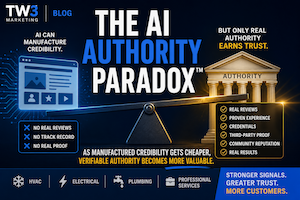
The AI Authority Paradox™
This brings us to something I believe we’re going to see much more clearly over the next few years.
I call it The AI Authority Paradox™.
AI is making it incredibly easy for almost any business to look professional.
An HVAC contractor can generate a beautiful website.
A plumber can publish 50 articles.
An electrician can create professional-looking videos.
A consultant can publish every day.
A financial professional can produce polished social media posts.
A brand-new company can create an online presence that looks like it has been around for years.
That sounds like an advantage.
But there’s another side to it.
The easier AI makes it for everybody to look credible, the harder it becomes for customers to determine who actually is credible.
AI can create the appearance of authority.
It cannot manufacture the underlying evidence.
It can’t manufacture 127 legitimate customer reviews.
It can’t manufacture 25 years of experience.
It can’t manufacture a professional license.
It can’t manufacture recognized credentials.
It can’t manufacture hundreds of completed customer projects.
It can’t manufacture genuine community reputation.
It can’t manufacture legitimate media coverage.
It can’t manufacture real customer results.
And it can’t manufacture decades of expertise.
That leads to what I believe will become one of the most important marketing realities of the AI era:
As manufactured credibility gets cheaper, verifiable authority becomes more valuable.
Bobby Christy, Founder, TW3 Marketing
That’s why I don’t believe AI eliminates the need for authority.
I believe it does exactly the opposite.
What We’re Seeing in Authority Audits
We see a version of this problem repeatedly when evaluating service businesses through the TW3 Marketing Authority Audit.
Many businesses have far more real-world authority than their websites demonstrate.
The HVAC contractor may have served the community for 22 years.
The electrician may hold important certifications.
The consultant may have advised hundreds of companies.
The insurance professional may have decades of experience.
The business owner may be respected throughout the community.
Then we look online.
Almost none of it is there.
The About page barely tells the story.
Credentials are buried.
Customer results aren’t documented.
Reviews aren’t being used as proof.
There are few third-party mentions.
Nobody has connected the dots between the owner’s expertise and the company.
And the website sounds almost exactly like every competitor’s website.
The authority already exists.
The digital proof doesn’t.
That is a very different problem from “we need more traffic.”
And buying more traffic doesn’t fix it.
It simply sends more people to an incomplete story.
What Does an AI-Ready Service Business Website Need?
An AI-ready website doesn’t need to look futuristic.
It needs to make several important things easy to establish.
Who are you?
Your business identity should be unmistakable.
Business name.
Location.
Leadership.
History.
Contact information.
Service area.
Don’t make a customer, or a machine, piece together your identity from five different pages.
What exactly do you do?
“Quality solutions for all your needs” tells us almost nothing.
Be specific.
An HVAC contractor should clearly explain heating repair, air conditioning repair, system replacement, heat pumps, maintenance, indoor air quality, and the actual services it provides.
A plumber should identify emergency plumbing, drain cleaning, water heaters, leak detection, repiping, sewer work, or whatever it actually does.
An electrical contractor should clearly identify panel upgrades, generators, EV chargers, lighting, residential repairs, commercial electrical work, and its other core services.
White-collar companies need the same discipline.
What problem do you solve?
Who do you solve it for?
Why should someone come to you instead of the other 20 businesses they just found?
Where do you provide it?
For local service businesses, geography matters.
Explain the markets you actually serve.
Provide useful local information.
Connect services to real locations.
And don’t create hundreds of nearly identical city pages just because somebody told you it was good for SEO.
Why should anyone believe you?
This is where most service business websites become painfully weak.
They make claim after claim.
“Trusted.”
“Experienced.”
“Best.”
“Professional.”
“Customer-focused.”
Anybody can type those words.
Authority requires proof.
Licenses. Certifications. Years of experience. Awards. Associations. Case studies. Customer stories. Before-and-after examples. Published work. Media mentions. Speaking appearances. Community involvement. Real reviews. Named experts. Original research. Specific results.
Don’t just tell people you’re good.
Give them enough evidence to reach that conclusion themselves.
Reviews Are Becoming Part of the AI Decision
This matters enormously for local service companies.
BrightLocal’s 2026 Local Consumer Review Survey reported that 97% of consumers read reviews for local businesses.
Even more interesting is where they’re looking.
In BrightLocal’s survey, use of ChatGPT and other generative AI tools for local business recommendations rose from 6% to 45% year over year, making AI the third most-used source in its study.
Think about what that means.
Reputation and AI visibility aren’t two completely separate marketing projects anymore.
A great website claiming you’re the best plumber in town means less when the rest of the web tells a different story.
A strong Google Business Profile helps.
Recent reviews help.
Consistent business information helps.
Industry associations help.
Local press helps.
Useful expert content helps.
Credible third-party mentions help.
Your website matters.
But your authority doesn’t live exclusively on your website.
AI Makes Generic Websites Easier, Which Makes Them Less Valuable
Here’s the part nobody wants to talk about.
AI can now create a decent-looking website incredibly quickly.
That means the value of simply having a decent-looking website is going down.
If every HVAC contractor can generate a professional-looking homepage…
If every consultant can generate 20 polished articles…
If every electrician can create clean service pages…
If every business can produce unlimited “helpful content”…
then looking professional is no longer enough to separate you.
AI makes generic competence cheap.
That makes genuine proof more valuable.
Original experience matters more.
Specificity matters more.
Reputation matters more.
Third-party validation matters more.
Recognizable expertise matters more.
Your point of view matters more.
Authority becomes the separator.
The Best Service Business Websites Will Be Built Around Decisions
This is where I’m most excited about AI-assisted website development.
We can stop thinking only in pages.
Start thinking in decisions.
What does a homeowner need to know before replacing an HVAC system?
Build around that decision.
What makes someone hesitate before calling an electrician?
Answer it.
What does a customer need immediately when a pipe bursts at 10:30 at night?
Put it in front of them.
What does a business owner need to see before trusting an HR consultant with a serious employee problem?
Show the expertise and evidence.
What questions does a family have before contacting an estate planning attorney?
Answer them before asking for the appointment.
That’s what a website should do.
Not just exist.
Not just rank.
Not just look pretty.
Help the right person make the right decision with confidence.
The Website Builder Is Becoming Less Important
HighLevel, WordPress, Webflow, or whatever platform comes next isn’t the strategy.
Neither is Claude Code.
They’re tools.
And the tools will continue to change.
What AI is doing is giving skilled marketers, designers, and developers a much larger toolbox.
HighLevel’s current capabilities are a good example. It supports custom code in its workflows and now provides AI-assisted code generation that lets users describe the needed function in plain language and generate JavaScript to perform it.
HighLevel specifically recommends reviewing and testing AI-generated code before putting it into live use.
That’s how we look at AI development too.
AI doesn’t remove judgment.
It gives people with judgment better tools.
Millions of people have access to AI.
The advantage isn’t having Claude.
The advantage is knowing what should be built, why it should be built, what the customer needs to see, and what evidence needs to be there when they arrive.
Don’t Rebuild Your Website Yet
This may sound strange coming from a marketing company that builds websites.
But don’t assume you need a new website.
Not yet.
Start by looking at what your customer sees.
Search your company.
Search the owner’s name.
Look at your Google Business Profile.
Read your recent reviews.
Look at your website on a phone.
Ask ChatGPT and other AI systems questions about your company and your category.
Look at your service pages.
Can you find your credentials?
Can you find third-party proof?
Can you quickly understand what makes the business different?
Can you find useful answers to the questions customers actually ask?
Then ask yourself one question:
If I knew nothing about this company, would there be enough evidence here for me to trust it?
That’s a much harder question than:
“Do you like our website?”
It’s also a much more valuable one.
That’s Why We Start With the Authority Framework™
One of the biggest mistakes I see businesses make is fixing marketing tactics before diagnosing the real problem.
Traffic is down?
Buy ads.
Website looks old?
Build another one.
Not enough leads?
Post more.
Google rankings slipped?
Hire another SEO company.
AI is changing search?
Publish 50 AI-generated articles.
Stop.
Just because AI lets us build almost anything doesn’t mean we should.
Before we build, we need to know what’s missing.
That’s why we created the TW3 Marketing Authority Framework™.
We look at the signals surrounding a business that help determine whether a prospect, and increasingly an AI system, can understand it, trust it, and confidently choose or recommend it.
The website is part of that.
But it isn’t the entire picture.
Free Authority Audit Through Labor Day
That’s also why I don’t want you rebuilding your website just because you read this article.
Let’s find out where you actually stand first.
Now through Labor Day, TW3 Marketing is offering our full Authority Audit at no charge.
We’ll examine the authority signals surrounding your business and show you where you’re strong, where you’re weak, and where prospects may be losing confidence before they ever contact you.
Maybe you need a new website.
Maybe you don’t.
Maybe the bigger problem is reputation.
Maybe your proof is missing.
Maybe your business information is inconsistent.
Maybe search engines understand you, but AI systems don’t have enough reliable information to recommend you.
Or maybe you’ve spent 20 years building tremendous real-world authority that simply isn’t showing up online.
We won’t know until we look.
If you own an HVAC company, electrical company, plumbing business, professional service firm, or another service-based business, here’s my offer:
Message me the word WEBSITE before Labor Day.
We’ll run the Authority Audit.
We’ll show you where you stand.
Then we’ll talk about what, if anything, needs to be built.
Because AI has changed the question.
It isn’t:
“Can the website builder do that?”
It’s:
“What does your customer need your website to do?”
Let’s answer that question before we build anything.
Until next time,
Bobby
Bobby ‘CoachC’ Christy
Founder/CEO, TW3 Marketing
Frequently Asked Questions
What is an AI-ready website?
An AI-ready website clearly explains who a business is, what it does, where it operates, who it serves, and why its claims should be trusted. Strong SEO fundamentals, direct answers, structured information, original expertise, and verifiable proof all contribute to making a website easier for people, search engines, and AI systems to understand.
Is SEO still important with ChatGPT and AI search?
Yes. Google says its standard SEO best practices remain relevant for AI Overviews and AI Mode. Technical accessibility, useful people-first content, internal linking, crawlability, and clear information remain important. AI visibility adds another consideration: whether sufficient credible evidence exists online for systems to understand your business.
What are AEO and GEO?
Answer Engine Optimization (AEO) focuses on making information easy for search and AI systems to understand and use when answering questions. Generative Engine Optimization (GEO) focuses more broadly on how a company, expert, or source is understood and potentially referenced by generative AI systems. Both build on many of the same fundamentals as good SEO.
Does my HVAC, plumbing, electrical, or professional service company need a new website for AI search?
Not necessarily. Your existing website may need stronger service information, proof, structured data, local information, expert content, reviews, or technical improvements rather than a complete rebuild. Diagnose the gaps before deciding that a new website is the answer.
What is the TW3 Marketing Authority Audit?
The TW3 Marketing Authority Audit evaluates the online signals that influence whether customers and AI systems can understand, trust, and confidently choose or recommend a service business. Its purpose is simple: identify the gaps before you spend money fixing the wrong marketing problem.
